
On this page
Your needs, this model
Does it fit your priorities?
Will the 12,876 Wh V6400/B6400 package meet a single-station 120 V load whose continuous draw is at most 3,800 W?
The matching 6,438 Wh station and 6,438 Wh battery total 12,876 Wh; the Home Panel does not add another station inverter.
Explore this need in the finder →Is one compatible B6400 included in the V6400 Home Panel option?
The exact selector configuration includes one B6400 and the Home Panel; the B4600 is not a substitute.
Explore this need in the finder →Do you need the included ten-circuit Home Panel with the V6400 rather than a portable-only bundle?
ZDSHPEV2 is included and listed as ten-circuit. Have an electrician confirm the one-station layout before relying on a home-service topology.
Explore this need in the finder →Is the V6400’s 3,000 W solar input essential if the panel hardware itself will be sourced separately?
The station accepts solar within its specified electrical window, but this package includes no panel.
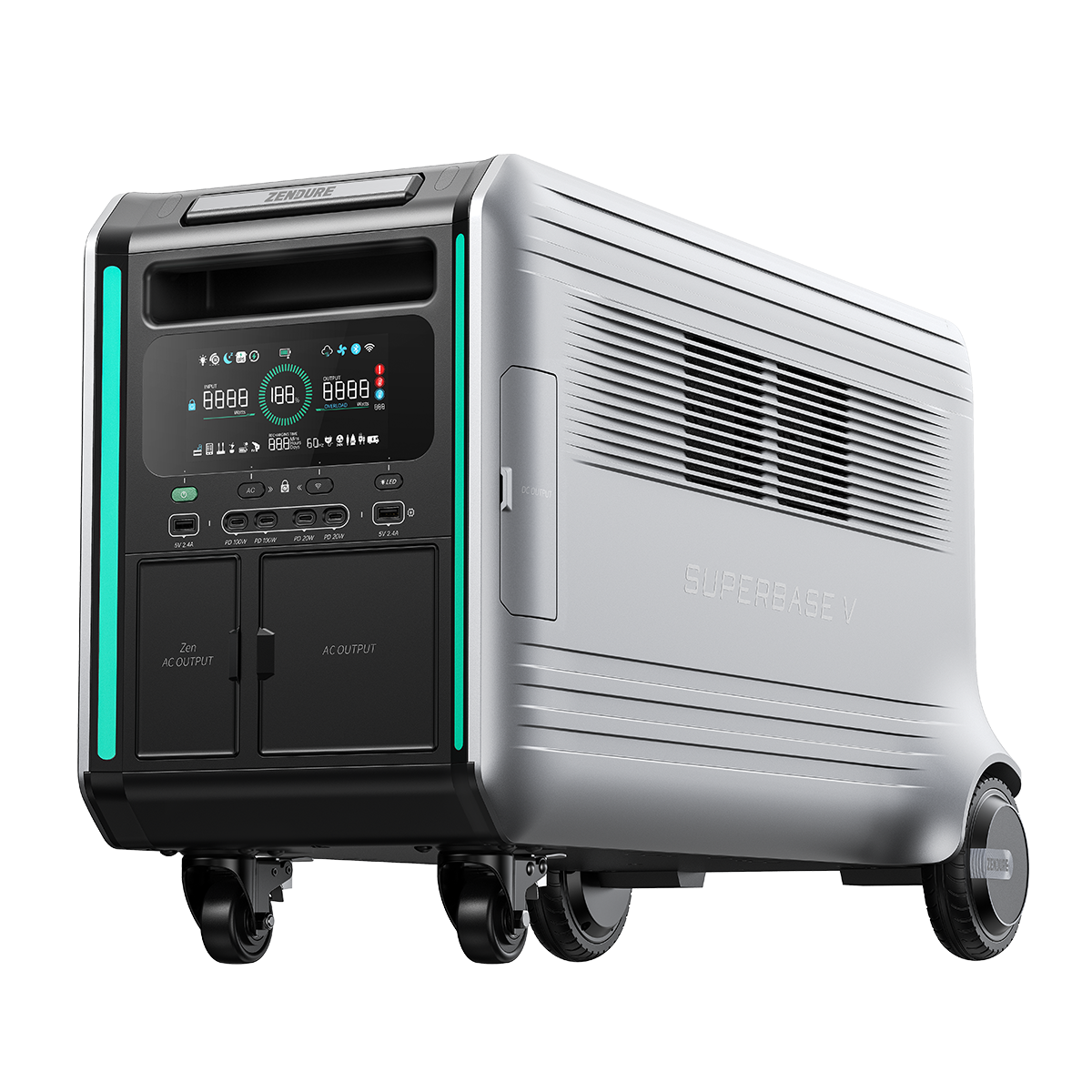
Explore this need in the finder →The exact selector option is “V6400 / 1 / Yes”: one SuperBase V6400, one matching B6400 Satellite Battery and Zendure’s Home Panel. The two 6,438 Wh battery components give the package 12,876 Wh of nameplate storage. The important caveat is that this is still a one-station V6400 package; an extra battery increases storage, not the station’s 3,800 W rated AC output.
Panel-in-box is not the same as an installed home system
The Home Panel may be useful if a qualified electrician has already confirmed an installation plan and the circuits you intend to back up. Zendure’s U.S. Home Panel with EV Outlets manual identifies the ZDSHPEV2 and documents a ten-circuit, 120/240 V panel. A panel in the offer does not tell you whether your house wiring, local code, selected circuit arrangement and chosen one-station configuration are compatible. The exact single-station 120/240 service topology remains unconfirmed in the source material reviewed, so ask Zendure and the electrician before relying on this offer for a specific panel or appliance.
Do not read the two-station 7,600 W figure into a single V6400 bundle. One V6400 has 3,800 W rated output and a separately listed 5,000 W peak/AmpUp figure; the latter is not continuous power. The B6400 raises the battery’s nameplate reserve to 12,876 Wh, but it does not add a second inverter. Nameplate watt-hours also should not be represented as guaranteed energy reaching AC loads after conversion and reserve limits.
Storage, compatibility and physical scale
The V6400 and included B6400 use the matching semi-solid-state battery family. Zendure’s manual says expansion batteries must be compatible and warns against mixing B4600 and B6400 types. One pack is included; the manual’s allowance for further batteries is a future expansion limit, not package contents. The base station weighs 130 lb and the satellite battery 101 lb; the Home Panel adds about 19.4 lb. That is roughly 250 lb of named equipment before packaging and any wiring, so it makes more sense as a planned installation than as a mobile camping bundle.
For direct portable output, the V6400 provides four ordinary 120 V outlets and two Zen outlets that can be configured for 120 V or 240 V. The solar input is listed at up to 3,000 W within the manual’s voltage/current limits, but no solar panel is included. AC input is rated up to 1,800 W at 120 V or 3,600 W at 240 V; those are separate voltage conditions, not a universal 3,600 W input. Small-device USB output and the car/DC group can support ancillary equipment, with the manual’s 126 W combined car/DC5521 ceiling rather than an assumed per-port value. The published 13 ms UPS figure is not proof of fit for every sensitive device.
Who should choose this over the alternatives?
This package is best evaluated by someone who wants the V6400’s higher one-station storage, an included B6400, and a Home Panel as part of a real electrical plan. If the panel is not going to be installed, the no-Home-Panel V6400-plus-B6400 option is the cleaner comparison. If 7,600 W of linked output is the reason for buying a panel, compare the two-V6400 Home Panel option instead; do not infer that rating from this single unit. Buyers whose circuits can be powered from portable receptacles may prefer a no-panel bundle and keep the installation decision separate.
The manufacturer’s captured selector showed this exact package unavailable. That is a dated availability observation, not proof it has been discontinued. This review reports manufacturer specifications and package identity, not a hands-on test of transfer, runtime, or installation. Confirm the single-station panel arrangement before using it to make a home-backup decision.
Key details at a glance
| Nameplate battery capacity | 12876 Wh |
|---|---|
| Rated AC output | 3800 W |
| Manufacturer surge rating | 5000 W |
| Maximum solar input | 3000 W |
| Included panels, combined nameplate | 0 W |
| Maximum USB-C output per port | 100 W |
More specifications and setup details
| Listed weight | 130 lb |
|---|---|
| Compatible extra-battery expansion | Yes |
| 12 V DC output | 126 W |
| Manufacturer UPS transfer figure | 13 ms |
| AC outlet output | Yes |
| USB-C ports | 4 |
| USB-A ports | 2 |
| Battery chemistry | Semi-solid-state battery |
| Expansion battery in this package | Yes |
| Home Power Panel in this package | Yes |
| HPP 120/240 V split-phase | Yes |
| Separate station units in offer | 1 |
| Smart Transfer Switch in this package | Yes |
| Expansion packs in exact offer | 1 |
| Solar panels in exact offer | 0 |
| Included expansion batteries | 1 units |
Use the exact model’s instructions for operating limits, supplied equipment and version differences.
Sources for this assessment
A useful match starts with the loads that matter.
Use the finder for hard electrical requirements, then check appliance starting behavior, actual run time and the exact package in the full assessment.