
On this page
Your needs, this model
Does it fit your priorities?
Does one V6400 plus one B6400 cover a 12,876 Wh nameplate plan at or below the station’s 3,800 W rated AC output?
The single V6400 and matching B6400 are each 6,438 Wh; together the exact package totals 12,876 Wh, with no second inverter.
Explore this need in the finder →Do you require the semi-solid-state V6400 package to arrive with one compatible B6400 instead of buying a battery later?
The selector says “V6400 / 1 / No”; the listed B6400 is the V6400’s matched expansion type.
Explore this need in the finder →Can the V6400’s two Zen outlets be set to 240 V while you keep a home transfer panel out of this offer?
The manual documents the Zen 120/240 V mode; the selector explicitly says Home Panel No.
Explore this need in the finder →Will you provide the panel array for this solar-capable V6400 + B6400 option?
The station accepts up to 3,000 W of solar input within its documented limits, but no solar panel is in this package.
Explore this need in the finder →This U.S. selector choice is “V6400 / 1 / No”: one SuperBase V6400 station, one compatible B6400 Satellite Battery and no Home Panel. Each matching battery is listed at 6,438 Wh, so the package’s nameplate total is 12,876 Wh. The V6400’s 3,800 W rated AC output does not rise when the extra battery is connected. The exact option was unavailable in the manufacturer snapshot; stock status is not a discontinuation notice.
A larger battery reserve on one station
The main reason to choose the V6400 over the V4600 is its higher base storage and its different cell chemistry. Zendure describes the V6400 as semi-solid-state, with 6,438 Wh in the station; the V4600 is the 4,608 Wh LFP alternative. Adding the matching B6400 brings this offer to 12,876 Wh, while the same single inverter remains rated for 3,800 W continuous AC. This is useful where a load plan needs more nameplate energy over time, not where an appliance needs more continuous watts than the station is rated to supply.
Zendure’s 5,000 W peak/AmpUp figure should not be treated as the ordinary running rating. Nor is the nameplate capacity a guaranteed AC-delivered amount; conversion losses and reserve settings affect usable energy. The manual includes a cycle-life claim, but that is a manufacturer figure rather than a test or service-life guarantee. Extra-battery compatibility is model-specific: this bundle includes one B6400. Do not substitute a B4600 or assume that a V4600 battery can be mixed into the semi-solid-state system.
Outlet and charging choices
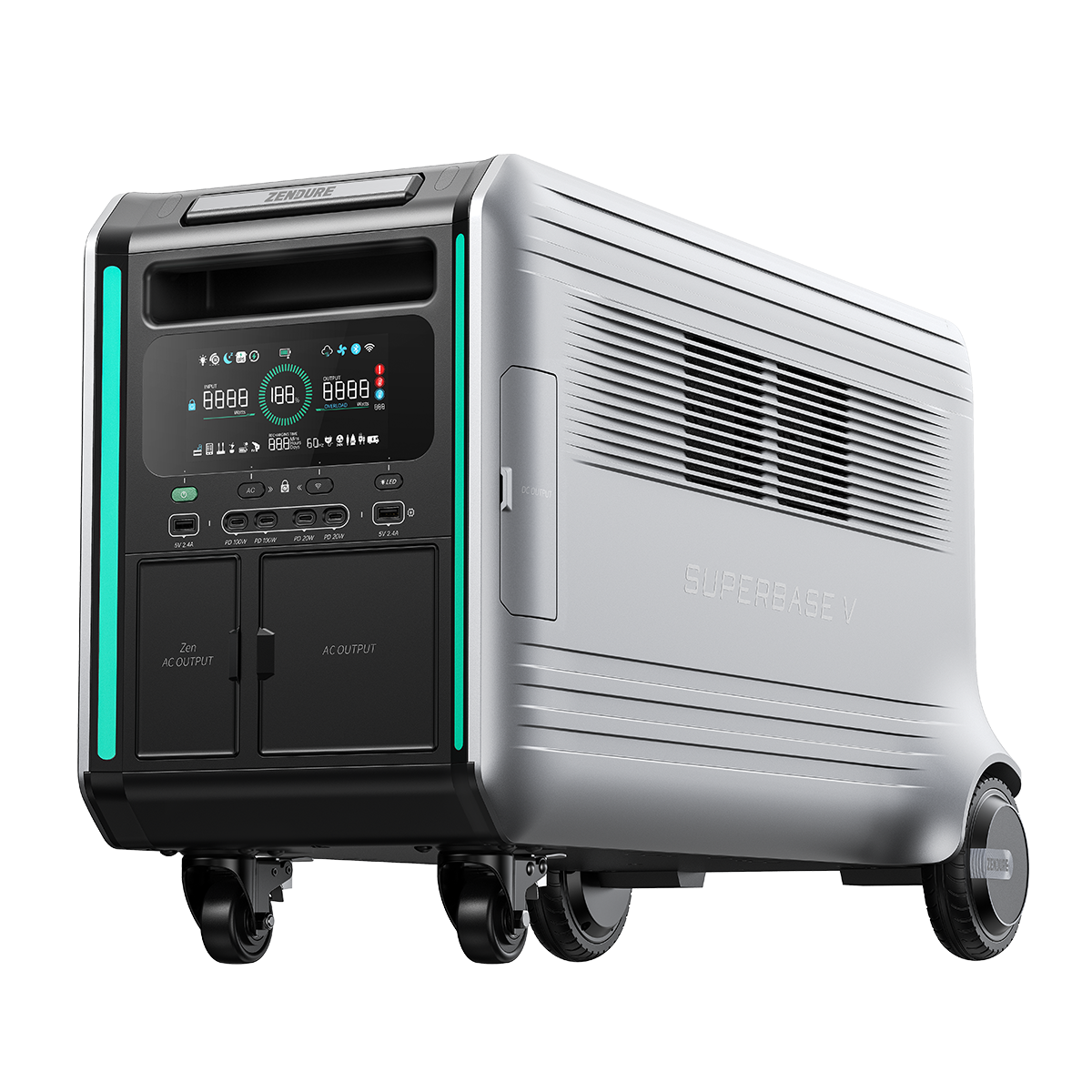
The V6400 has four conventional 120 V AC outlets and two Zen outputs that can be set for 120 V or 240 V operation. If you use a 240 V appliance, check the actual Zen outlet configuration and the appliance’s continuous and starting draw; the setting does not convert the four ordinary receptacles into 240 V outlets. This offer has no Home Panel, so it is not a wired circuit-transfer package.
Solar input is listed up to 3,000 W for the station, within the manual’s voltage and current envelope. This offer includes no panel, so the buyer still needs a separately compatible array and cable plan. AC charging is likewise voltage-specific: Zendure lists up to 1,800 W at 120 V and 3,600 W at 240 V. The car input may be useful for slower top-ups when travel and the manual’s limits allow. USB ports and 12 V outputs remain available for smaller loads; the cited 126 W ceiling combines the car and DC5521 output group and is not a rating for each socket.
Account for the weight and compare the right alternative
The V6400 base unit is listed at 130 lb and the B6400 at 101 lb. At about 231 lb of named equipment before packaging, this is a large stationary or carefully repositioned system, not something most people will casually move between campsites. Its wheels help on a level, suitable path but do not eliminate doorway, floor-load or stair issues. Follow Zendure’s clearance and temperature instructions, particularly when placing charging equipment in a utility area.
This option fits a buyer who has a reason for the V6400’s higher base capacity and wants one matching pack immediately, while the load stays within one station’s AC rating. Compare the single V6400 without a battery if 6,438 Wh is enough; compare a V4600 and B4600 if the chemistry and smaller reserve better fit the budget or physical plan. Choose a two-station option only if you truly need two independent outlets or the separately documented Home Panel connection. The Home Panel is absent here, and an extra battery alone does not create a 7,600 W service path.
Key details at a glance
| Nameplate battery capacity | 12876 Wh |
|---|---|
| Rated AC output | 3800 W |
| Manufacturer surge rating | 5000 W |
| Maximum solar input | 3000 W |
| Included panels, combined nameplate | 0 W |
| Maximum USB-C output per port | 100 W |
More specifications and setup details
| Listed weight | 130 lb |
|---|---|
| Compatible extra-battery expansion | Yes |
| 12 V DC output | 126 W |
| Manufacturer UPS transfer figure | 13 ms |
| AC outlet output | Yes |
| USB-C ports | 4 |
| USB-A ports | 2 |
| Battery chemistry | Semi-solid-state battery |
| Expansion battery in this package | Yes |
| Home Power Panel in this package | No |
| Separate station units in offer | 1 |
| Smart Transfer Switch in this package | No |
| Expansion packs in exact offer | 1 |
| Solar panels in exact offer | 0 |
| Included expansion batteries | 1 units |
Use the exact model’s instructions for operating limits, supplied equipment and version differences.
Sources for this assessment
A useful match starts with the loads that matter.
Use the finder for hard electrical requirements, then check appliance starting behavior, actual run time and the exact package in the full assessment.