
On this page
Your needs, this model
Does it fit your priorities?
Is the Home Panel and documented 120/240 V circuit plan essential for this 6-battery V6400 pair?
The exact selector includes the Home Panel. The manual describes a paired 120/240 V, ten-circuit system up to 7,600 W; a qualified electrician must confirm the home.
Explore this need in the finder →Would 51,504 Wh nameplate across the two stations and 6 B6400 batteries meet your storage target?
The exact component list sums to 51,504 Wh. This is not usable AC energy or a runtime estimate.
Explore this need in the finder →Do you need at least 6 matching B6400 batteries included rather than optional expansion support?
The selector explicitly lists 6 B6400 batteries total; the distribution between the two stations is not stated.
Explore this need in the finder →Can your site stage a 885.4 lb named-component package?
Two station bases, 6 B6400 units and Home Panel weigh about 885.4 lb before packaging or wiring.
Explore this need in the finder →Do you need a documented 240 V output plan and what can it power?
The paired 240 V plan relies on the included Home Panel and is rated up to 7,600 W for the system, subject to installation.
Explore this need in the finder →Is solar charging required even if no solar panels are included in this station bundle?
Each base station lists up to 3,000 W solar input inside manufacturer voltage/current limits; this exact selector choice includes no panels.
Explore this need in the finder →The “V6400*2 / 6 / Yes” option combines two SuperBase V6400 stations, six matching B6400 Satellite Batteries and the Zendure Home Panel. At 6,438 Wh per named battery unit, the package totals 51,504 Wh nameplate. This is not a claim of usable AC energy or outage duration. The V6400 uses semi-solid-state cells. The saved selector showed this option unavailable at capture and left its SKU blank; present inventory and exact retail identifier remain unknown.
Six satellites form an even three-per-base layout
The six B6400 packs contribute 38,628 Wh beyond the two base stations. Zendure’s manual allows up to four matching satellites on each V6400, so a three-and-three layout fits the published limit. That arrangement is feasible, although the selector lists only the total and does not promise a station allocation. Compared with the four-pack, this choice adds two batteries, 12,876 Wh and about 202 lb. The eight-pack adds another pair and reaches the two-base maximum. The question is whether the documented circuit plan and energy schedule require the extra reserve; a large figure alone is not a reason to buy it.
Home Panel integration has a specific output envelope
The included Home Panel manual describes up to two SuperBase V units, ten load circuits and 120/240 V service. Zendure documents a maximum 7,600 W for the paired system. That is the panel-connected system limit, not an output rating for each V6400 and not a promise of whole-home coverage. A qualified electrician must review the site service, selected circuits, transfer design and local code. The archived documentation does not establish 120/208 V service. If the setup is not installed as a paired Home Panel system, do not carry this limit into a station-only plan.
Storage does not solve an output mismatch
Each V6400 alone is rated for 3,800 W continuous AC. The paired Home Panel plan is rated up to 7,600 W, regardless of the six included satellites. A battery module contributes energy, not inverter output. Before deciding on the six-pack, check both the largest concurrent load and the total energy needed over time. A high-starting pump or heating appliance may exceed output, while lower-power circuits can use a large reserve over a longer period. Real duration depends on load, temperature and system settings; this assessment uses manufacturer information and contains no hands-on test.
Solar and placement requirements
Zendure lists up to 3,000 W solar input per station within its specified electrical range, and the selector does not include solar modules. Confirm the panel string’s voltage and the cables separately; six B6400 batteries do not increase solar input. The two bases weigh approximately 260 lb together; six satellites add roughly 606 lb; and the Home Panel is about 19.4 lb. That is around 885.4 lb of named components before cartons and wiring. This system is intended for a planned installation, not frequent moves. Make sure the equipment route, floor, ventilation and panel location work before committing.
Who should choose the six-pack?
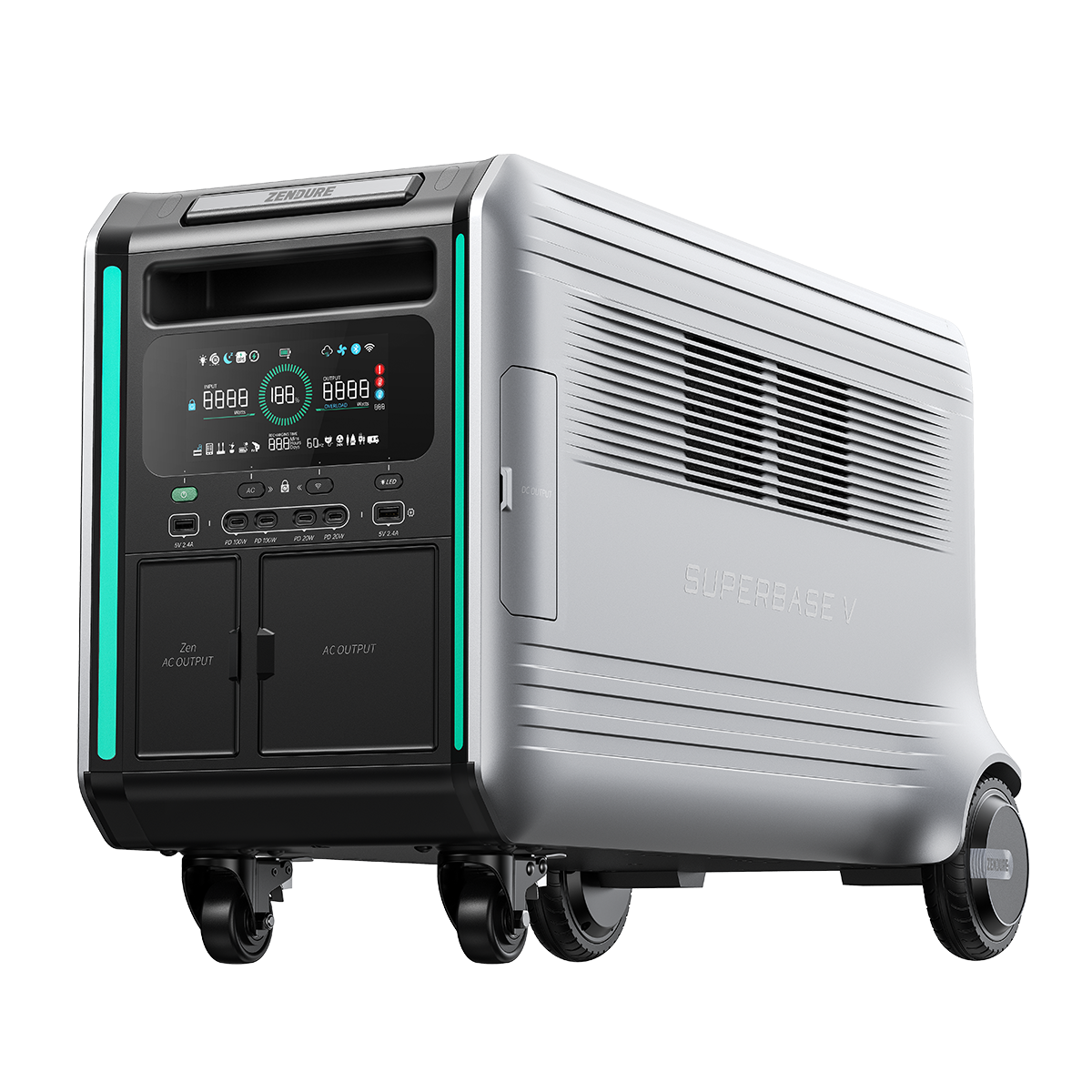
Six is a reasonable upper-middle tier when the four-pack’s 38,628 Wh is short of the planned reserve and the full eight-pack is more storage and weight than needed. It preserves an even possible allocation of three batteries per station and includes the Home Panel for the documented 120/240 V circuit plan. If the panel is not important, the no-panel twin is a different use case with separate station outputs. If a load is too large for 7,600 W, extra B6400s will not help. The product image is a single-base V6400 rendering; the selector and manuals establish the two stations, six packs and panel. No live stock, installation quote, usable AC test or verified ASIN is provided.
Key details at a glance
| Nameplate battery capacity | 51504 Wh |
|---|---|
| Rated AC output | 7600 W |
| Maximum solar input | 3000 W |
| Included panels, combined nameplate | 0 W |
| Maximum USB-C output per port | 100 W |
| Listed weight | 130 lb |
More specifications and setup details
| Compatible extra-battery expansion | Yes |
|---|---|
| 12 V DC output | 126 W |
| Manufacturer UPS transfer figure | 13 ms |
| AC outlet output | Yes |
| USB-C ports | 4 |
| USB-A ports | 2 |
| Battery chemistry | Semi-solid-state battery |
| Expansion battery in this package | Yes |
| Home Power Panel in this package | Yes |
| HPP 120/240 V split-phase | Yes |
| Separate station units in offer | 2 |
| Smart Transfer Switch in this package | Yes |
| Expansion packs in exact offer | 6 |
| Solar panels in exact offer | 0 |
| Included expansion batteries | 6 units |
Use the exact model’s instructions for operating limits, supplied equipment and version differences.
Sources for this assessment
A useful match starts with the loads that matter.
Use the finder for hard electrical requirements, then check appliance starting behavior, actual run time and the exact package in the full assessment.