
On this page
Your needs, this model
Does it fit your priorities?
Would you require an included Home Power Panel, or is a 240 V plan from one V6400 station enough?
This exact selector offer includes two V6400 bases and 6 B6400 batteries but no Home Power Panel. It can meet a 240 V Zen plan from one station at 3,800 W; it does not provide a panel-based linked 7,600 W plan. Choose a Home Panel-included bundle if that transfer arrangement is essential.
Explore this need in the finder →Would 51,504 Wh nameplate across the two stations and 6 B6400 batteries meet your storage target?
The exact component list sums to 51,504 Wh. This is not usable AC energy or a runtime estimate.
Explore this need in the finder →Do you need at least 6 matching B6400 batteries included rather than optional expansion support?
The selector explicitly lists 6 B6400 batteries total; the distribution between the two stations is not stated.
Explore this need in the finder →Can your site stage a 866.0 lb named-component package?
Two station bases, 6 B6400 units weigh about 866.0 lb before packaging or wiring.
Explore this need in the finder →Can a single V6400 station’s 3,800 W rated 240 V plan handle the load, without counting the pair as a linked 7,600 W output?
The pair contains two separate V6400 stations, each rated at 3,800 W. Its 240 V Zen plan is one station only; this exact no-Home-Panel offer does not document a combined 7,600 W output. Its supported 240 V plan uses a conservative battery allocation documented for this 6-battery option.
Explore this need in the finder →Is solar charging required even if no solar panels are included in this station bundle?
Each base station lists up to 3,000 W solar input inside manufacturer voltage/current limits; this exact selector choice includes no panels.
Explore this need in the finder →This U.S. selector package contains two Zendure SuperBase V6400 stations, six matching B6400 Satellite Batteries and no Home Panel. Each listed unit contributes 6,438 Wh nameplate, which produces a 51,504 Wh sum across the full 120 V independent-station offer. The V6400 uses semi-solid-state cells. The source record marked this variant unavailable at capture and did not expose a SKU; the review preserves both facts without inferring a current listing state or reusing another bundle’s identifier.
What the sixth battery contributes
Six B6400s store 38,628 Wh beyond the two base batteries. Relative to the five-pack, the sixth adds 6,438 Wh and about 101 lb. That increment is meaningful only if the outage schedule needs the extra reserve. It does not change the rated output of an individual station, which remains 3,800 W continuous AC. Because the offer has no Home Panel, the pair must be treated as two independent power sources: do not combine their ratings to claim one 7,600 W output. A larger battery stack can stretch a suitable load plan but cannot power an appliance above the station’s output limit.
240 V planning is constrained to one station
The V6400 manual documents a selectable 240 V Zen AC outlet on one base station. The safe 240 V plan for this package uses one V6400 plus at most four B6400s on that station, for up to 32,190 Wh nameplate within the supported expansion limit. The exact selector records six total packs but does not divide them between the two bases. A three-plus-three allocation can support separate 120 V plans; a four-plus-two arrangement is possible if one station is intended to serve the 240 V load. Neither allocation is promised by the listing. If a 120/240 V split-phase circuit system is the goal, the Home Panel is a separate configuration requirement.
Expansion rules and chemistry
Zendure’s manual sets a maximum of four same-family satellite batteries on a V6400 and cautions against mixing battery types. Six packs fit within the two-base combined limit of eight, but a per-base allocation matters. Confirm how many packs are assigned to each station and which connecting leads are included. The exact package distinguishes inclusion from mere capability: six compatible units are listed as part of the offer. Buyers should not assume that a large bundle automatically arrives assembled in the desired layout or that one station can take all six.
Solar input and physical scale
The published solar input limit is up to 3,000 W per station within the voltage and current boundaries in the manual. No panels are included in this option, and six expansion batteries do not multiply that input rating. Check the exact array design and connector requirements before charging. Two V6400 bases weigh about 260 lb together; six B6400s add approximately 606 lb, bringing the named package to roughly 866 lb before cartons and any wiring. The equipment is divided into individual pieces, but moving and installing them still requires planning for doors, floors, ventilation and storage. This is a fixed backup bank, not a compact weekend-camping solution.
Which nearby configuration is better?
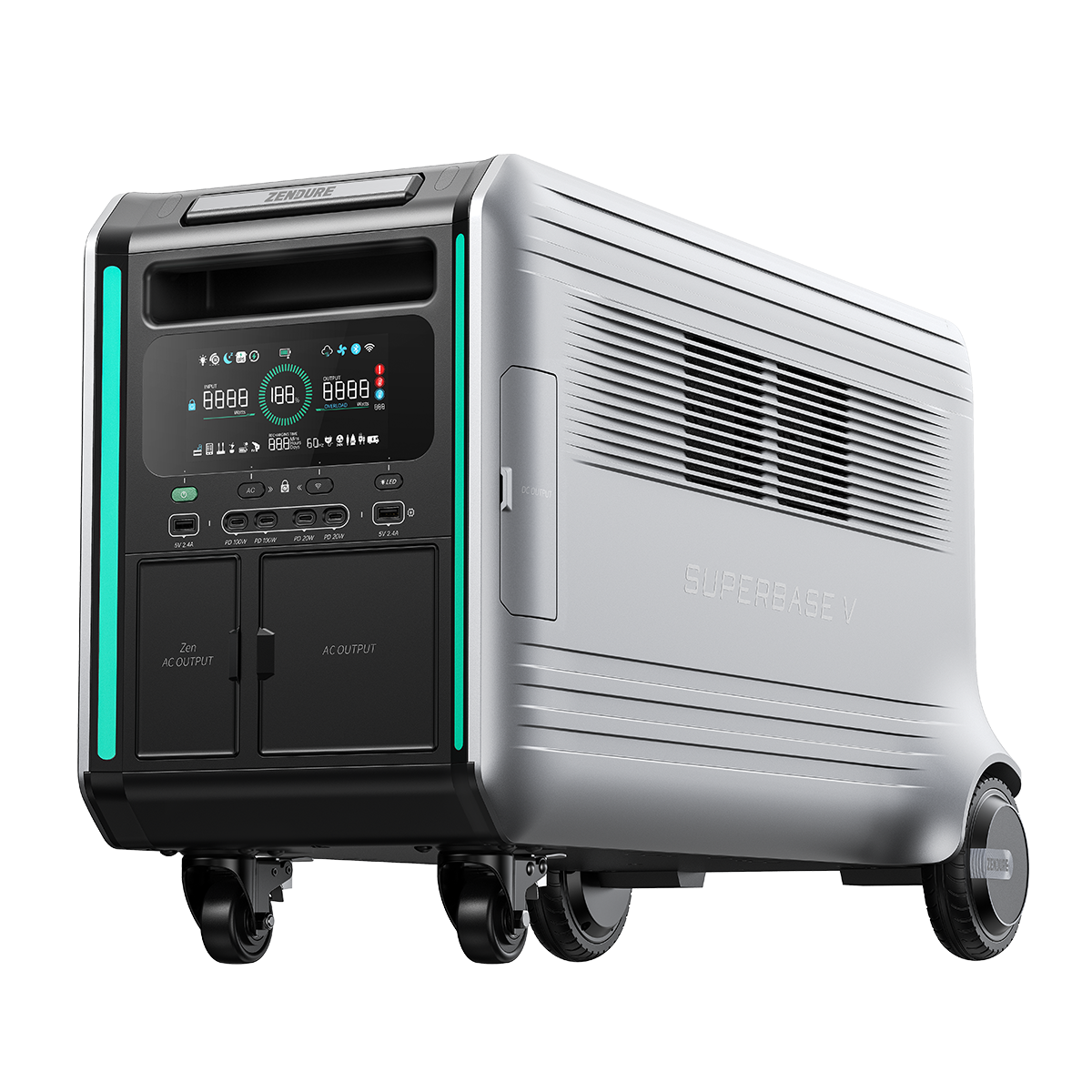
The four-pack is about 202 lb lighter and provides 38,628 Wh nameplate; the eight-pack adds two units and another 12,876 Wh. The six-pack is a middle ground if the five-pack does not meet an energy budget but the maximum stack is unnecessary. If the priority is a 240 V house-circuit system, choose a Home Panel option rather than this station-only package. If the priority is a single 240 V appliance, evaluate the single-station plan with the correct allocation and load rating. The official manufacturer image shows one V6400 base only; it does not depict six packs or certify package contents. The U.S. selector and user manual support the identity and specifications. Runtime, current availability, installation cost and a verified ASIN remain unknown.
Key details at a glance
| Nameplate battery capacity | 51504 Wh |
|---|---|
| Rated AC output | 3800 W |
| Maximum solar input | 3000 W |
| Included panels, combined nameplate | 0 W |
| Maximum USB-C output per port | 100 W |
| Listed weight | 130 lb |
More specifications and setup details
| Compatible extra-battery expansion | Yes |
|---|---|
| 12 V DC output | 126 W |
| Manufacturer UPS transfer figure | 13 ms |
| AC outlet output | Yes |
| USB-C ports | 4 |
| USB-A ports | 2 |
| Battery chemistry | Semi-solid-state battery |
| Expansion battery in this package | Yes |
| Home Power Panel in this package | No |
| Separate station units in offer | 2 |
| Smart Transfer Switch in this package | No |
| Expansion packs in exact offer | 6 |
| Solar panels in exact offer | 0 |
| Included expansion batteries | 6 units |
Use the exact model’s instructions for operating limits, supplied equipment and version differences.
Sources for this assessment
A useful match starts with the loads that matter.
Use the finder for hard electrical requirements, then check appliance starting behavior, actual run time and the exact package in the full assessment.