
On this page
Your needs, this model
Does it fit your priorities?
Is the Home Panel and documented 120/240 V circuit plan essential for this 7-battery V6400 pair?
The exact selector includes the Home Panel. The manual describes a paired 120/240 V, ten-circuit system up to 7,600 W; a qualified electrician must confirm the home.
Explore this need in the finder →Would 57,942 Wh nameplate across the two stations and 7 B6400 batteries meet your storage target?
The exact component list sums to 57,942 Wh. This is not usable AC energy or a runtime estimate.
Explore this need in the finder →Do you need at least 7 matching B6400 batteries included rather than optional expansion support?
The selector explicitly lists 7 B6400 batteries total; the distribution between the two stations is not stated.
Explore this need in the finder →Can your site stage a 986.4 lb named-component package?
Two station bases, 7 B6400 units and Home Panel weigh about 986.4 lb before packaging or wiring.
Explore this need in the finder →Do you need a documented 240 V output plan and what can it power?
The paired 240 V plan relies on the included Home Panel and is rated up to 7,600 W for the system, subject to installation.
Explore this need in the finder →Is solar charging required even if no solar panels are included in this station bundle?
Each base station lists up to 3,000 W solar input inside manufacturer voltage/current limits; this exact selector choice includes no panels.
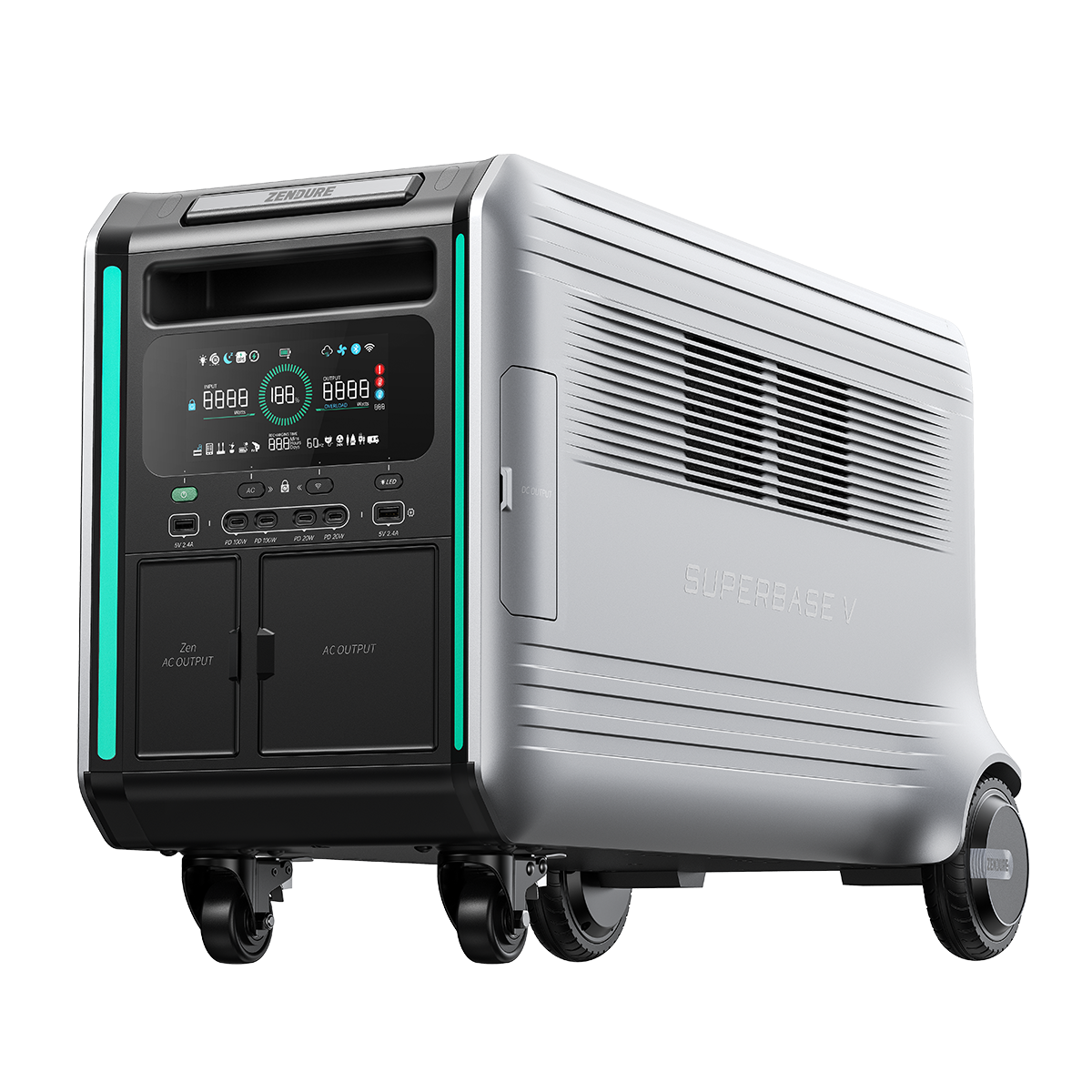
Explore this need in the finder →The saved Zendure selector title “V6400*2 / 7 / Yes” defines this package: two SuperBase V6400 stations, seven matching B6400 packs and the Home Panel. Each component is rated at 6,438 Wh nameplate, yielding a total of 57,942 Wh. This describes battery capacity, not tested AC energy or duration. The V6400 uses semi-solid-state cells. The captured U.S. option was unavailable and did not show a SKU; neither observation establishes current stock or a substitute product code.
Seven packs sit one below the two-base maximum
With four matching satellites allowed per V6400, seven packs can be divided three on one base and four on the other. The exact selector only gives the total number, not that split, so the three-plus-four arrangement is a viable plan rather than a guaranteed shipment configuration. This seventh B6400 adds another 6,438 Wh and roughly 101 lb beyond the six-pack. The eighth reaches the full eight-pack allowance. Weigh the added reserve against the practical weight and space; the Home Panel output is unchanged by the module count.
Documented Home Panel use requires careful installation
Zendure’s installation manual for the Home Panel with EV Outlets describes ten circuits, 120/240 V service and support for up to two SuperBase V stations. The company documents up to 7,600 W for the linked pair. This is not 7,600 W from each V6400, nor does it mean every household load can run at once. The panel creates a specific circuit-backup arrangement, and a qualified electrician must confirm the service, wiring, load selection and local requirements. The saved evidence supports 120/240 V; it does not confirm 120/208 V. Buy this offer for the documented panel integration only if that is actually part of the plan.
One capacity number cannot answer two load questions
The full package has 57,942 Wh nameplate across its bases and batteries, but an individual station remains rated at 3,800 W continuous AC. The paired panel arrangement is rated up to 7,600 W total. First check whether the chosen circuits and motor starts stay within that output ceiling; separately estimate the energy consumed over the outage period and include reserve, conversion losses and temperature effects. The seventh battery can increase duration potential for a compatible set of loads, not the maximum instantaneous draw. No runtime is claimed because there is no measured household load schedule or independent test.
Recharge and staging at high capacity
The V6400 manual lists up to 3,000 W solar input per station within its voltage and current limits. This selector choice includes no solar panels. Module strings and connector routes require separate checks; seven batteries do not raise the 3,000 W station input rating. The two bases weigh about 260 lb together, while seven 101 lb B6400 modules add approximately 707 lb. With the 19.4 lb panel, named component weight is around 986.4 lb before boxes and wiring. The multi-piece system needs a safe route, floor support, ventilation and a place for the panel that remains accessible to the electrician.
Is seven the right stopping point?
The seven-pack is a near-maximum choice for a buyer who has a documented need above the six-pack’s 51,504 Wh and would rather not install the eighth satellite. The eight-pack adds one 6,438 Wh module and about 101 lb. If the circuit plan needs a Home Panel but the battery reserve is modest, the two- or four-pack variants reduce handling burden. If no circuit integration is required, compare the no-panel offer, but do not assume it has the same linked topology. The official V6400 image depicts a single base; the selected offer contains two stations, batteries and panel as established by selector and manuals. Current availability, installation cost, usable energy and verified ASIN remain unknown.
Key details at a glance
| Nameplate battery capacity | 57942 Wh |
|---|---|
| Rated AC output | 7600 W |
| Maximum solar input | 3000 W |
| Included panels, combined nameplate | 0 W |
| Maximum USB-C output per port | 100 W |
| Listed weight | 130 lb |
More specifications and setup details
| Compatible extra-battery expansion | Yes |
|---|---|
| 12 V DC output | 126 W |
| Manufacturer UPS transfer figure | 13 ms |
| AC outlet output | Yes |
| USB-C ports | 4 |
| USB-A ports | 2 |
| Battery chemistry | Semi-solid-state battery |
| Expansion battery in this package | Yes |
| Home Power Panel in this package | Yes |
| HPP 120/240 V split-phase | Yes |
| Separate station units in offer | 2 |
| Smart Transfer Switch in this package | Yes |
| Expansion packs in exact offer | 7 |
| Solar panels in exact offer | 0 |
| Included expansion batteries | 7 units |
Use the exact model’s instructions for operating limits, supplied equipment and version differences.
Sources for this assessment
A useful match starts with the loads that matter.
Use the finder for hard electrical requirements, then check appliance starting behavior, actual run time and the exact package in the full assessment.