
On this page
Your needs, this model
Does it fit your priorities?
Would you require an included Home Power Panel, or is a 240 V plan from one V6400 station enough?
This exact selector offer includes two V6400 bases and 7 B6400 batteries but no Home Power Panel. It can meet a 240 V Zen plan from one station at 3,800 W; it does not provide a panel-based linked 7,600 W plan. Choose a Home Panel-included bundle if that transfer arrangement is essential.
Explore this need in the finder →Would 57,942 Wh nameplate across the two stations and 7 B6400 batteries meet your storage target?
The exact component list sums to 57,942 Wh. This is not usable AC energy or a runtime estimate.
Explore this need in the finder →Do you need at least 7 matching B6400 batteries included rather than optional expansion support?
The selector explicitly lists 7 B6400 batteries total; the distribution between the two stations is not stated.
Explore this need in the finder →Can your site stage a 967.0 lb named-component package?
Two station bases, 7 B6400 units weigh about 967.0 lb before packaging or wiring.
Explore this need in the finder →Can a single V6400 station’s 3,800 W rated 240 V plan handle the load, without counting the pair as a linked 7,600 W output?
The pair contains two separate V6400 stations, each rated at 3,800 W. Its 240 V Zen plan is one station only; this exact no-Home-Panel offer does not document a combined 7,600 W output. Its supported 240 V plan uses a conservative battery allocation documented for this 7-battery option.
Explore this need in the finder →Is solar charging required even if no solar panels are included in this station bundle?
Each base station lists up to 3,000 W solar input inside manufacturer voltage/current limits; this exact selector choice includes no panels.
Explore this need in the finder →The “V6400*2 / 7 / No” U.S. selector option describes two SuperBase V6400 stations and seven B6400 Satellite Batteries, with no Home Panel. Each named battery is listed at 6,438 Wh, giving the package 57,942 Wh nameplate across the two independent 120 V stations. This is the semi-solid-state V6400 platform, not an LFP V4600 configuration. The saved availability flag was false, and the source left the SKU blank. Those exact source facts are retained; they do not imply present stock or discontinuation.
Near the paired expansion ceiling
Seven satellites sit one pack below the two-station maximum of eight, based on the manual’s limit of four matching B6400s per V6400. A three-plus-four allocation is possible, but the selector records only a total quantity and does not promise that division. That means this package can support two separate stations with nearly the maximum battery expansion, provided the actual setup follows Zendure’s manual. Compared with the six-pack, the seventh adds 6,438 Wh and about 101 lb. The eight-pack adds one more unit at the same increment. Decide between them from a real energy budget and handling plan.
Do not mistake two stations for one linked output
This option excludes the Home Panel. Each V6400 has a 3,800 W continuous AC rating, but the exact bundle does not establish a paired 7,600 W outlet or 120/240 V household circuit system. A station’s Zen AC outlet can be selected for 240 V; a conservative plan credits one base and no more than four B6400 packs to that outlet. Even though the entire package contains 57,942 Wh, the one-station 240 V plan can only count its assigned station and batteries. If you need the documented two-station split-phase arrangement or transfer to selected home circuits, compare the selector choice that includes the Home Panel and consult an electrician.
Energy and output both need review
Use the full-package nameplate number for a distributed load plan across the two 120 V station outputs, not as usable AC watt-hours. The actual energy available depends on conversion losses, reserve settings, temperature and load. For each appliance, check continuous draw and starting behavior against the 3,800 W station limit. More batteries do not increase that limit. A seven-pack bundle can be oversized for modest critical loads while still being unsuitable for an appliance whose inrush exceeds the inverter rating. This assessment includes no independent runtime or performance test.
Solar input and heavy-component planning
Zendure lists up to 3,000 W solar input per V6400 within the documented voltage and current window. No panels are included. Additional battery modules increase storage, not the station’s solar-input ceiling, and panel strings must remain within the manual’s electrical limits. The two bases weigh about 260 lb together; seven B6400s at approximately 101 lb each add 707 lb, for roughly 967 lb of listed hardware before cartons and wiring. These are separate pieces, yet seven large batteries require a deliberate route, storage footprint and connection plan. Check floor capacity and ventilation and confirm which station will receive each pack before delivery.
Should the seventh pack be the last?
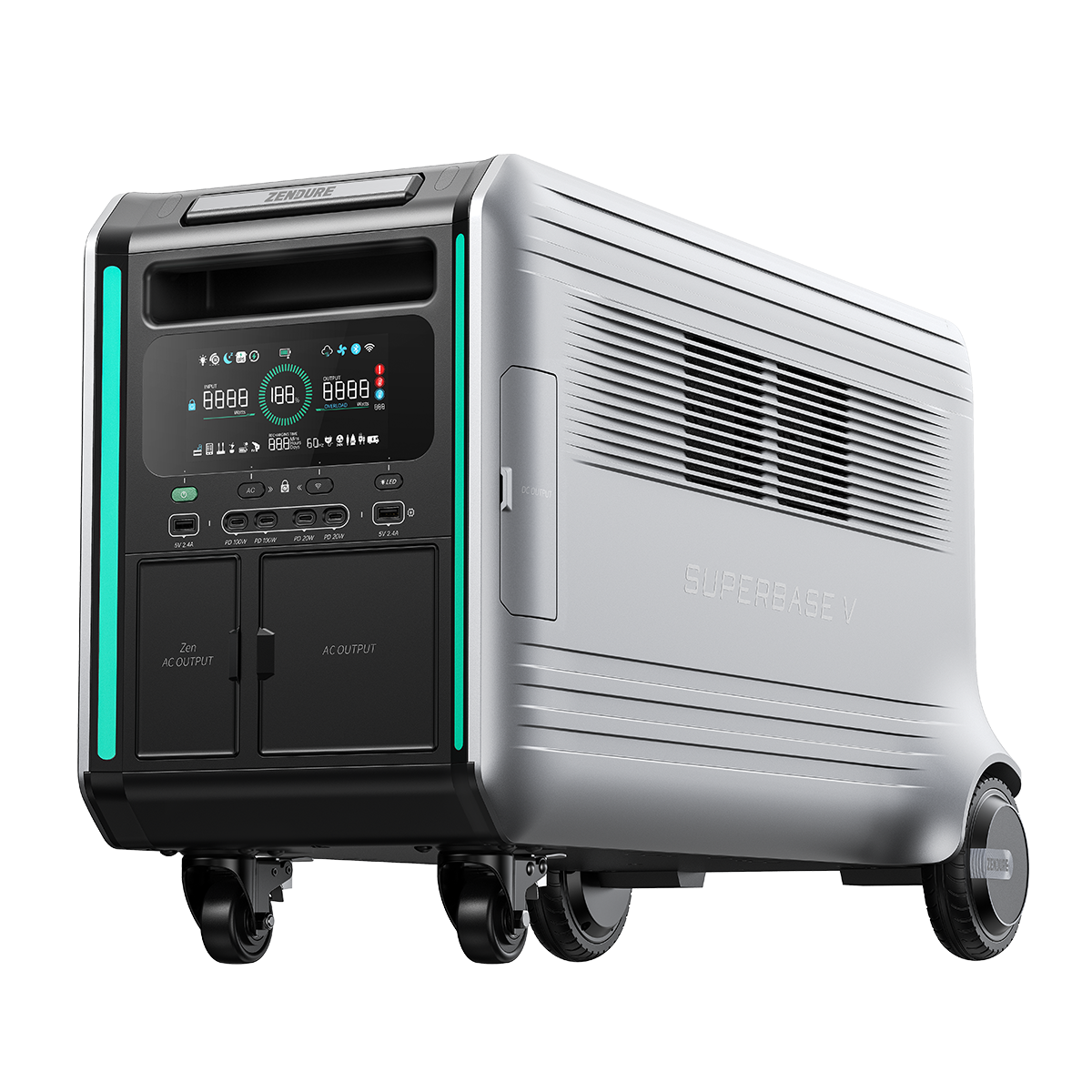
This offer makes sense when the six-pack’s 51,504 Wh nameplate falls short of a planned distributed 120 V reserve, but the eighth pack’s additional 6,438 Wh and 101 lb are not needed. If a 240 V single-station need drives the purchase, seven units total do not mean one station can accept all seven; it remains limited to four B6400 packs. A no-panel two-station bundle avoids the included circuit panel but cannot replace it with more storage. The official image is a manufacturer CGI of one base station, not the two-station and seven-battery package. The selector establishes exact contents; installation cost, live availability, usable AC capacity and any verified seller ASIN are unknown.
Key details at a glance
| Nameplate battery capacity | 57942 Wh |
|---|---|
| Rated AC output | 3800 W |
| Maximum solar input | 3000 W |
| Included panels, combined nameplate | 0 W |
| Maximum USB-C output per port | 100 W |
| Listed weight | 130 lb |
More specifications and setup details
| Compatible extra-battery expansion | Yes |
|---|---|
| 12 V DC output | 126 W |
| Manufacturer UPS transfer figure | 13 ms |
| AC outlet output | Yes |
| USB-C ports | 4 |
| USB-A ports | 2 |
| Battery chemistry | Semi-solid-state battery |
| Expansion battery in this package | Yes |
| Home Power Panel in this package | No |
| Separate station units in offer | 2 |
| Smart Transfer Switch in this package | No |
| Expansion packs in exact offer | 7 |
| Solar panels in exact offer | 0 |
| Included expansion batteries | 7 units |
Use the exact model’s instructions for operating limits, supplied equipment and version differences.
Sources for this assessment
A useful match starts with the loads that matter.
Use the finder for hard electrical requirements, then check appliance starting behavior, actual run time and the exact package in the full assessment.