
On this page
Your needs, this model
Does it fit your priorities?
Does the paired V6400 Home Panel plan reach 19,314 Wh nameplate storage and 7,600 W rated AC output?
Two V6400 bases and one B6400 total 19,314 Wh; Zendure documents up to 7,600 W with the paired units through the Home Panel.
Explore this need in the finder →Is one matching B6400 included with the paired V6400/Home Panel option?
The exact selector records one B6400 total for the pair; additional expansion batteries are not part of this option.
Explore this need in the finder →Must the two-station offer include a ten-circuit panel rated for the documented 120/240 V plan?
The package includes ZDSHPEV2; Zendure documents up to 7,600 W on the paired plan. The manual does not establish 120/208 V service, and installation requires an electrician.
Explore this need in the finder →Will you supply compatible solar panels separately for the V6400 pair’s solar input?
The station solar inputs are rated up to 3,000 W each within the manual limits, but none is included in the exact bundle.
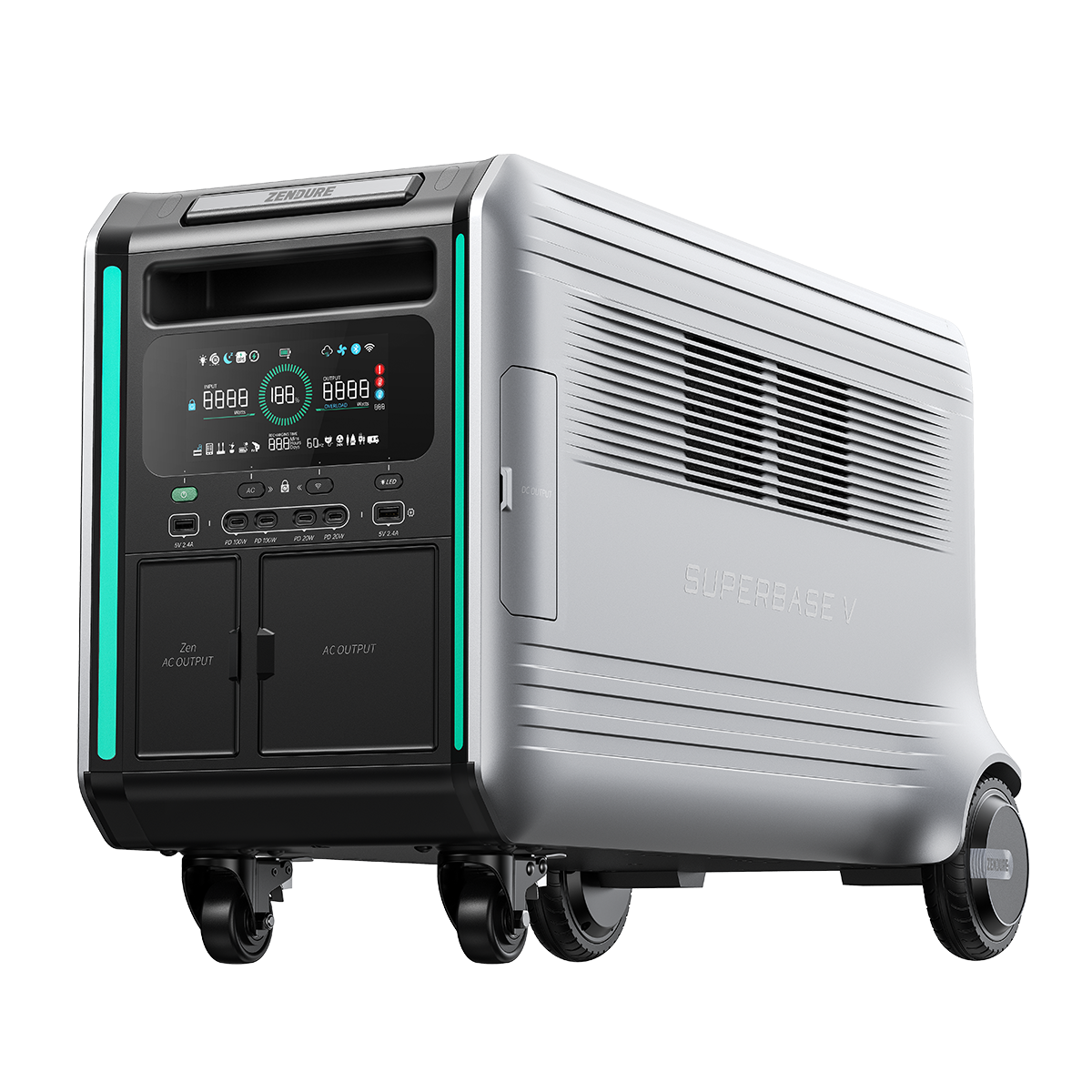
Explore this need in the finder →This “V6400*2 / 1 / Yes” U.S. option is the largest of the one-extra-battery SuperBase V packages assessed here: two V6400 stations, one matching B6400 Satellite Battery and the Home Panel. The two base batteries and one satellite add up to 19,314 Wh of nameplate capacity. Zendure documents up to 7,600 W rated output when two stations are used with the Home Panel; that is a system figure for the paired connection, not a rating for each V6400.
When the paired Home Panel plan is useful
This package is meant to be considered as a home-circuit system. Zendure’s U.S. Home Panel manual identifies a ten-circuit ZDSHPEV2 panel rated for 120/240 V service and supports one or two SuperBase V stations. With two compatible V6400 units through the panel, the manufacturer describes the 7,600 W paired arrangement. A qualified electrician must confirm circuits, neutral/ground arrangements, service compatibility and local code. The bundle itself is not a finished installation, and no wiring or labor is included by the selector choice.
For direct-use receptacles, each station still has four ordinary 120 V outlets and two Zen AC outputs that can be set for 120 V or 240 V. The paired home-panel path should be planned from the manual, not from the visual similarity of those ports. The listed output is continuous; the manual’s 5,000 W peak/AmpUp number for a station is not a continuous figure and should not be used to size a circuit. A large station may run many loads, but it is not a reason to assume every home circuit, compressor or 240 V appliance will work. Check the actual load plan with the installer.
Capacity is large, but the one-battery allocation is specific
The selector says one extra battery for the two-station offer. It does not identify a particular base unit as the one receiving the B6400, so this profile counts the 19,314 Wh of package nameplate storage without claiming an equal split between units. Zendure’s manual says the B6400 belongs with the V6400 battery family and should not be mixed with the B4600. The maximum expansion claim is up to four matching satellite batteries per station—eight across two stations—but only one is included here. Nameplate watt-hours do not equal guaranteed AC output energy after conversion and reserve.
Recharge and accessories remain separate decisions. Zendure lists up to 3,000 W solar input per station within its voltage/current limits, but this offer does not include solar panels. AC input is up to 1,800 W at 120 V or 3,600 W at 240 V per station. The U.S. manual’s 126 W car/DC5521 maximum is combined for those output groups, not an individual rating. A 13 ms UPS transfer time is a published manufacturer figure and should be checked against sensitive equipment requirements, rather than treated as universal compatibility.
Weight and package alternatives
Two V6400 stations at 130 lb each, one 101 lb B6400 and the roughly 19.4 lb Home Panel total about 380 lb before packaging. The wheels are useful for positioning on a suitable surface, but the package is a heavy fixed-backup project; plan the moving route before delivery and do not treat the Home Panel as a portable accessory. The panel’s installation is a professional job.
Choose the paired no-Home-Panel V6400 option if you need two separate stations but no fixed circuit connection. A V4600 pair with a Home Panel offers the same 7,600 W paired rating but less nameplate storage and LFP chemistry. One V6400 with B6400 is the simpler alternative if you want the 12,876 Wh single-station bundle, provided one 3,800 W station is enough and an electrician confirms the single-station panel topology. This exact option was shown unavailable in the saved U.S. selector snapshot; no discontinuation or present-stock claim follows from that capture.
Key details at a glance
| Nameplate battery capacity | 19314 Wh |
|---|---|
| Rated AC output | 7600 W |
| Maximum solar input | 3000 W |
| Included panels, combined nameplate | 0 W |
| Maximum USB-C output per port | 100 W |
| Listed weight | 130 lb |
More specifications and setup details
| Compatible extra-battery expansion | Yes |
|---|---|
| 12 V DC output | 126 W |
| Manufacturer UPS transfer figure | 13 ms |
| AC outlet output | Yes |
| USB-C ports | 4 |
| USB-A ports | 2 |
| Battery chemistry | Semi-solid-state battery |
| Expansion battery in this package | Yes |
| Home Power Panel in this package | Yes |
| HPP 120/240 V split-phase | Yes |
| Separate station units in offer | 2 |
| Smart Transfer Switch in this package | Yes |
| Expansion packs in exact offer | 1 |
| Solar panels in exact offer | 0 |
| Included expansion batteries | 1 units |
Use the exact model’s instructions for operating limits, supplied equipment and version differences.
Sources for this assessment
A useful match starts with the loads that matter.
Use the finder for hard electrical requirements, then check appliance starting behavior, actual run time and the exact package in the full assessment.