
On this page
Your needs, this model
Does it fit your priorities?
Will two V6400s and a single B6400 give separate station loads 19,314 Wh across the package without a 7,600 W Home Panel claim?
The two 6,438 Wh bases and one 6,438 Wh satellite total 19,314 Wh. With no Home Panel, each V6400 is treated as a 3,800 W station.
Explore this need in the finder →Does the V6400*2 offer contain one B6400 rather than two expansion packs?
The U.S. selector records one extra battery total for two V6400 stations; it does not promise one pack per station.
Explore this need in the finder →Do you need two separate V6400 station bodies and a documented 240 V Zen outlet, but not a Home Panel in the offer?
The option contains two bases, and either station has documented 120/240 V Zen modes; no linked Home Panel is included.
Explore this need in the finder →Can you supply your own array for the solar-capable V6400 pair?
Zendure lists up to 3,000 W solar input per station. No solar panel is included in the selected option.
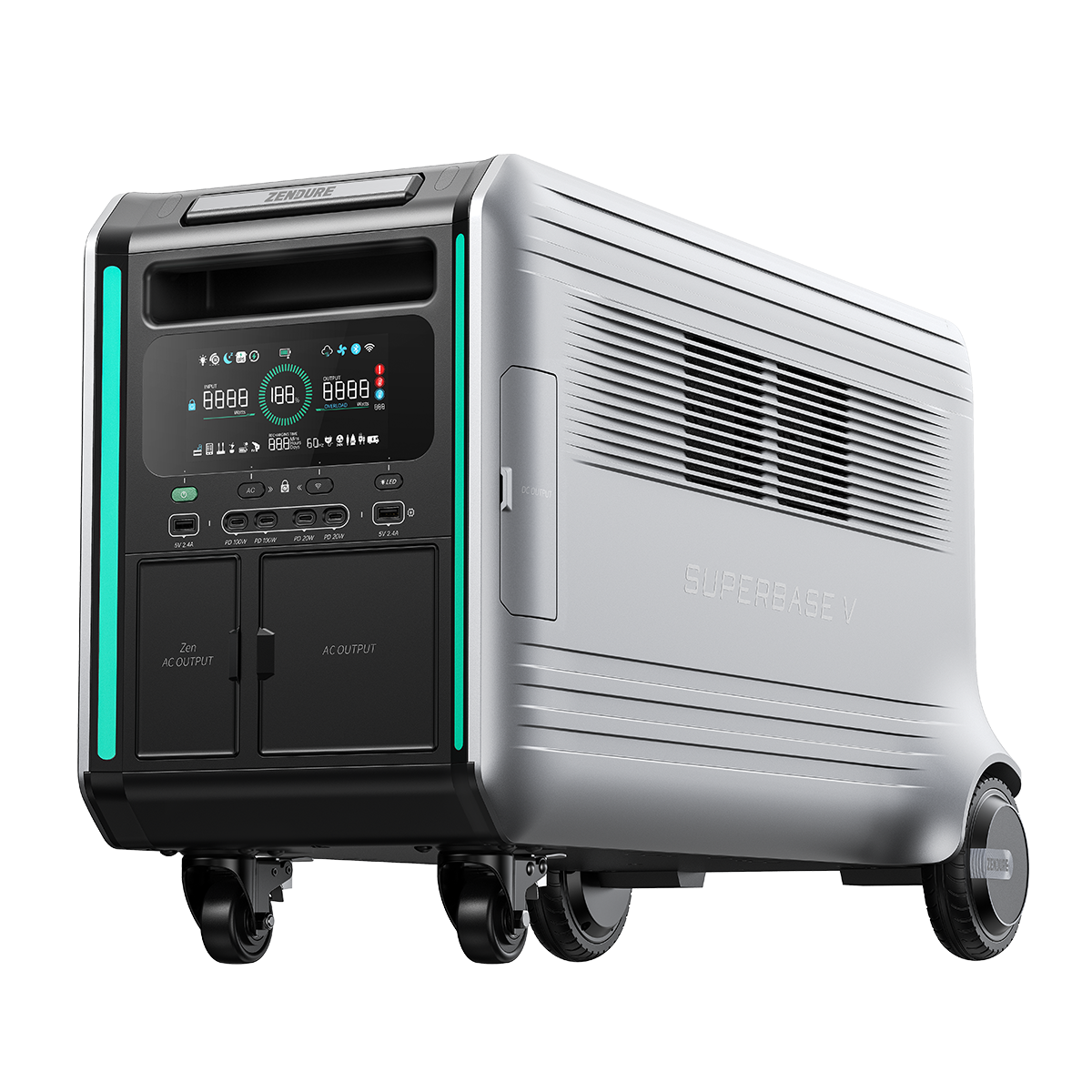
Explore this need in the finder →The exact “V6400*2 / 1 / No” option contains two SuperBase V6400 stations, one B6400 Satellite Battery and no Home Panel. Two 6,438 Wh base batteries plus one matching B6400 give 19,314 Wh of nameplate storage across the offer. The listing does not turn those three battery components into one inverter: each V6400 is rated for 3,800 W continuous AC, and this package lacks the Home Panel required for the documented 7,600 W linked plan.
Choose it for separate loads and more reserve
Two separate stations can be useful when devices are in different areas or when you want to keep a second output source aside from the first. Each station has its own four ordinary 120 V receptacles and two Zen AC outlets that can be selected for 120 V or 240 V. But the source offer does not establish a shared household connection here. Keep the two stations independent unless you separately obtain and install a manufacturer-approved connection plan. In particular, do not treat the 7,600 W Home Panel number as the rating of two stations that are not linked through that component.
The selector labels one B6400 battery for the two-station package; it does not specify which base unit receives the satellite. At least one station can be built out with that matching battery, but for a single 240 V appliance, the unit supplying it must be the unit configured for 240 V and connected to the pack if that extra capacity is part of the requirement. The plan facts therefore treat 3,800 W as the continuous rating of one station and do not claim a combined output. Zendure’s 5,000 W peak/AmpUp figure remains a peak feature, not continuous wattage.
The V6400 chemistry and charging details matter
Zendure describes the V6400 and B6400 as semi-solid-state batteries, separate from the V4600/B4600 LFP family. The U.S. manual says not to mix those battery types. The selector includes one B6400 in this package; the platform maximum of up to four matching satellite batteries per station is an expansion capability, not a description of the delivered bundle. The 19,314 Wh sum is nameplate storage, not a measured AC run time or a guaranteed usable-energy figure. Loads, conversion and reserve settings determine the practical result.
Each station supports up to 3,000 W of solar input subject to Zendure’s voltage and current window. No panel is supplied. AC charging is listed at 1,800 W on 120 V or 3,600 W on 240 V for the station; buyers should match the charging source to the right voltage rather than reading a single maximum across all arrangements. The manual’s 126 W combined ceiling for the station’s car and DC5521 outputs also is not a per-port rating. The V6400 lists a 13 ms UPS transfer time, but sensitive equipment should be checked against the exact device and setup rather than relying on the headline alone.
Physical scale and alternatives
Each V6400 base is listed at 130 lb; one B6400 weighs 101 lb. The named components total about 361 lb before packaging. Built-in wheels help on a suitable surface, but this is a heavy multi-piece system; consider doors, floor strength, lifting routes and whether the two stations can remain at their intended locations. The no-Home-Panel package is not an installed backup transfer arrangement.
Compare the no-extra-battery dual V6400 option if two independent units are enough without the B6400. Compare the paired Home Panel bundle if a licensed electrician confirms that a linked 7,600 W home-circuit plan is your goal. A single V6400 with B6400 is a more compact alternative when one location and one 3,800 W station plan are sufficient. The U.S. selector showed this exact option unavailable in its saved snapshot; that is not a discontinued-product finding. This assessment reflects manufacturer specifications, not hands-on or load-bank testing.
Key details at a glance
| Nameplate battery capacity | 19314 Wh |
|---|---|
| Rated AC output | 3800 W |
| Maximum solar input | 3000 W |
| Included panels, combined nameplate | 0 W |
| Maximum USB-C output per port | 100 W |
| Listed weight | 130 lb |
More specifications and setup details
| Compatible extra-battery expansion | Yes |
|---|---|
| 12 V DC output | 126 W |
| Manufacturer UPS transfer figure | 13 ms |
| AC outlet output | Yes |
| USB-C ports | 4 |
| USB-A ports | 2 |
| Battery chemistry | Semi-solid-state battery |
| Expansion battery in this package | Yes |
| Home Power Panel in this package | No |
| Separate station units in offer | 2 |
| Smart Transfer Switch in this package | No |
| Expansion packs in exact offer | 1 |
| Solar panels in exact offer | 0 |
| Included expansion batteries | 1 units |
Use the exact model’s instructions for operating limits, supplied equipment and version differences.
Sources for this assessment
A useful match starts with the loads that matter.
Use the finder for hard electrical requirements, then check appliance starting behavior, actual run time and the exact package in the full assessment.