
On this page
Your needs, this model
Does it fit your priorities?
Can one V6400 meet your 6,438 Wh nameplate and 3,800 W rated-output floor?
The included Home Panel does not add battery storage or inverter capacity; this remains one 6,438 Wh / 3,800 W station.
Explore this need in the finder →Does your equipment need the V6400’s documented 240 V Zen AC outlet?
The station manual documents 240 V Zen AC mode; this does not certify the single-station Home Panel service topology.
Explore this need in the finder →Is the Home Panel itself essential in the exact package?
This exact selector option is Home Panel Yes and the related installation manual identifies the ZDSHPEV2 panel.
Explore this need in the finder →Will you use the car-style 12 V output under its combined DC/car limit?
The manual lists a car outlet; the 126 W limit applies to the combined car and DC5521 group.
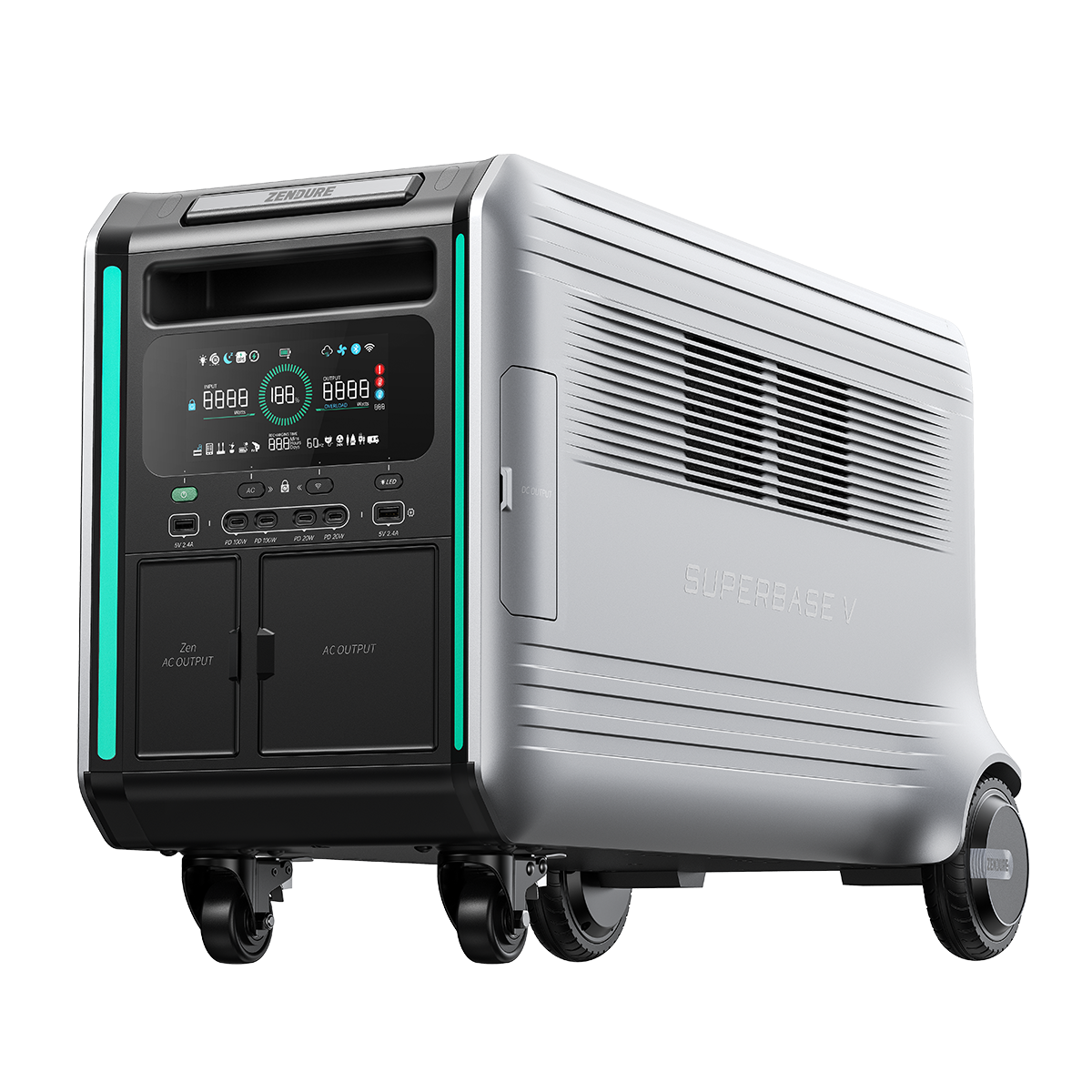
Explore this need in the finder →This is the Zendure SuperBase V6400 with the U.S. selector set to “Extra Batteries / 0” and “Home Panel / Yes.” The base unit uses a semi-solid-state battery, stores 6,438 Wh nameplate and supplies 3,800 W rated AC output; Zendure’s saved U.S. option JSON marked this exact Home Panel variant sold out and exposed no SKU. The Home Panel changes the package into a possible fixed home-circuit system, but it does not change the capacity or make a single V6400 a 7,600 W configuration.
A fixed installation needs a real circuit plan
Zendure identifies the Home Panel with EV Outlets as model ZDSHPEV2. Its installation manual lists a 120/240 V rated system, ten load circuits, two EV outlets and a weight of about 19.4 lb. The panel is a smart load-side transfer switch, not a portable station accessory. Zendure says it must be installed by a licensed electrician and verified by local authorities having jurisdiction. The installer needs to review the actual circuits, upstream protection, wiring path and local code. Ten circuits do not mean that ten arbitrary high-wattage appliances may all run at once.
One V6400’s limits still govern the backup plan
One V6400 brings 6,438 Wh nameplate and 3,800 W rated AC output to this package. Zendure lists four ordinary 120 V outlets plus two Zen AC outlets configurable for 120 V or 240 V, one mode at a time. Its product manual says a Home Panel may connect to one or two SuperBase V stations, but the one-station option does not establish a 7,600 W setup. Although the Home Panel’s system voltage is rated 120/240 V, I would not promise a particular 240 V load arrangement from this single-station package without confirmation from Zendure and the licensed electrician. For the published 7,600 W dual-station configuration, the manual requires two compatible units connected through the panel or ZenY cable.
Semi-solid-state cells are not the LFP V4600
The SuperBase V6400’s battery is the semi-solid-state version; Zendure lists 3,000+ cycles in the manual. That number is a manufacturer figure, not a measured service life or proof of lower lifetime cost. Zendure says the V6400 uses B6400 expansion batteries and cannot mix battery types with the V4600/B4600 system. The exact package here includes zero expansion batteries. Up to four compatible B6400 packs may be added to one station separately, but the new pack weight and total installed capacity need to be included in a real room and load plan. If a buyer’s essential requirement is LiFePO4 chemistry, the V4600 is the relevant alternative.
Solar and transport are still buyer responsibilities
The V6400 manual lists 3,000 W maximum solar input, 12–150 V DC input and 25 A maximum current, with a 12–120 V MPPT range. It warns against exceeding 150 V open-circuit input. Zendure’s station manual says solar panels are sold separately, and this option does not name a panel in its selector. The exact station-side lead supplied in the selected offer was not established. AC charging is listed up to 1,800 W at 120 V or 3,600 W at 240 V; use an appropriately rated outlet and cable. At about 130 lb before the Home Panel, the station is a large, wheeled appliance. Its motorized wheels aid movement across a suitable floor, not stair carrying.
Who should choose the single V6400 Home Panel package?
It is a plausible choice for an owner who wants the larger single V battery and has already decided that a professionally installed Zendure panel belongs in the system. It is not the right match if the needed plan requires two stations, a verified 7,600 W system or a specific single-unit 120/240 home-circuit topology that has not been confirmed. The station-only V6400 removes the panel; the paired V6400/Home Panel option is the documented route to use both base units together, but it roughly doubles the station weight and battery inventory. Compare those exact configurations before hiring an installer. No home runtime or whole-house coverage is promised.
Variant identity is from Zendure’s U.S. product selector. V6400 specifications are in the SuperBase V U.S. manual, pages 2–3, 6–8 and 11. Home Panel model, weight, voltage, circuits and installation requirements are in Zendure’s U.S. installation manual, pages 2–3 and 7–10. Zendure’s comparison page rounds the single-V6400 maximum expanded configuration to about 32 kWh; the exact zero-expansion offer here is 6,438 Wh.
Key details at a glance
| Nameplate battery capacity | 6438 Wh |
|---|---|
| Rated AC output | 3800 W |
| Manufacturer surge rating | 5000 W |
| Maximum solar input | 3000 W |
| Included panels, combined nameplate | 0 W |
| Maximum USB-C output per port | 100 W |
More specifications and setup details
| Listed weight | 130 lb |
|---|---|
| Compatible extra-battery expansion | Yes |
| 12 V DC output | 126 W |
| Manufacturer UPS transfer figure | 13 ms |
| AC outlet output | Yes |
| USB-C ports | 4 |
| USB-A ports | 2 |
| Battery chemistry | Semi-solid-state battery |
| Expansion battery in this package | No |
| Home Power Panel in this package | Yes |
| HPP 120/240 V split-phase | Yes |
| Separate station units in offer | 1 |
| Smart Transfer Switch in this package | Yes |
| Expansion packs in exact offer | 0 |
| Solar panels in exact offer | 0 |
| Included expansion batteries | 0 units |
Use the exact model’s instructions for operating limits, supplied equipment and version differences.
Sources for this assessment
A useful match starts with the loads that matter.
Use the finder for hard electrical requirements, then check appliance starting behavior, actual run time and the exact package in the full assessment.