
On this page
Your needs, this model
Does it fit your priorities?
Will 6,438 Wh nameplate and 3,800 W rated AC fit the load you plan to power?
The V6400’s manual lists 6,438 Wh and 3,800 W rated AC; its 5,000 W peak/AmpUp figure is not a sustained output rating.
Explore this need in the finder →Is the documented 240 V Zen AC outlet useful for your equipment?
Zendure lists the Zen AC outlets as 120 V or 240 V, one mode at a time; this selector option does not include a Home Panel.
Explore this need in the finder →Do you want compatible future battery expansion but no added battery included now?
A V6400 supports up to four matching B6400 Satellite Batteries, while this exact option is Extra Batteries 0.
Explore this need in the finder →Must the station provide a 12 V car-style outlet?
The manual lists a car output, with 126 W combined maximum for the car and DC5521 outputs.
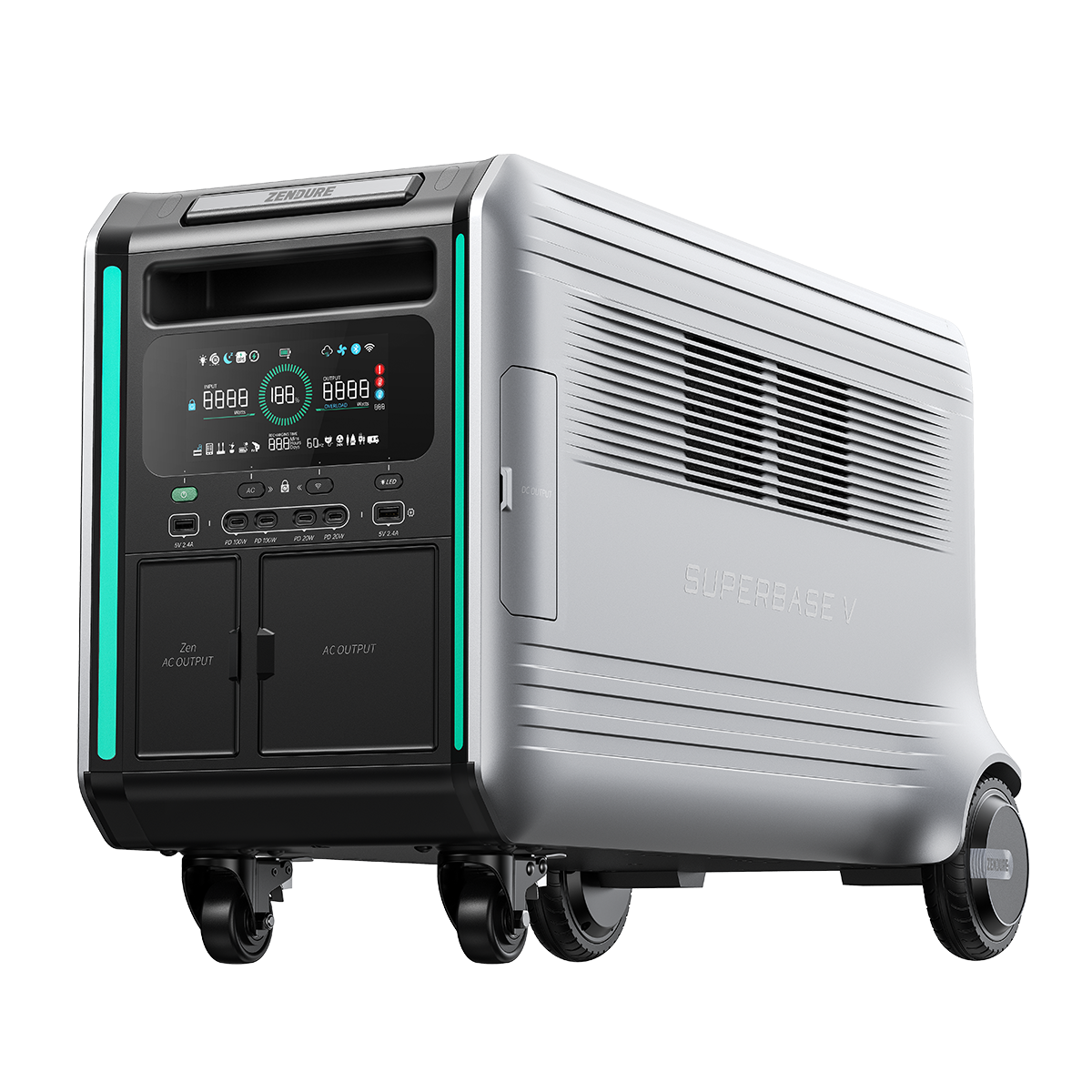
Explore this need in the finder →The SuperBase V6400 is Zendure’s higher-capacity single-station option in the V family. This review is for the exact U.S. selector setting “V6400 / 0 / No”: one V6400, no Satellite Battery and no Home Panel. Zendure’s product JSON identifies variant 40159460393034 with SKU ZDSBV6400-gy-us; the captured listing marked it sold out, which is not by itself proof of discontinuation. The U.S. manual lists 6,438 Wh of nameplate storage, 3,800 W rated AC output and a 130 lb weight. Its battery type is the semi-solid-state version, not the LFP V4600.
More stored energy, but not a larger inverter rating
Capacity and output solve different problems. The 6,438 Wh battery is larger than the V4600’s 4,608 Wh, but both single V models are rated at 3,800 W continuous AC output. The V6400 therefore offers more stored energy for loads that fit the inverter; it does not make a 4,000 W appliance a normal 3,800 W load. Zendure publishes 5,000 W peak/AmpUp capability, with explicit limits on which appliances work in that mode. Treat the 3,800 W continuous rating as the planning ceiling, leave margin for startup behavior, and do not estimate runtime by dividing nameplate Wh by the load without allowing for conversion losses.
Battery chemistry is a meaningful distinction
The manual calls the V6400 battery semi-solid-state and lists 3,000+ cycles. Zendure describes this chemistry as distinct from the V4600’s LFP pack. This is not evidence that one chemistry is universally safer, longer-lasting or a better fit; the cycle figure is a manufacturer specification and the manual does not make it a warranty promise. Zendure specifically says a V6400 can connect to B6400 Satellite Batteries but must not be mixed with B4600 batteries. A buyer who has a hard LiFePO4 requirement should not select this model merely because it is the higher-capacity V option.
AC and DC ports support varied loads
The manual lists four household 120 V AC outlets and two Zen AC outlets configurable for either 120 V or 240 V, with one mode at a time and 3,800 W total rated AC output. That is useful for equipment that genuinely accepts the Zen outlet’s voltage, but it is not the same as a home transfer-panel installation. There are four USB-C ports, two capable of 100 W each and two of 20 W, along with two USB-A ports and several DC outputs. Zendure lists 126 W as the combined maximum for the car outlet and DC5521 ports, not an independent 126 W allowance for each connector. Confirm the needs of sensitive electronics and high-starting loads at the outlet level.
Charging and moving the V6400
The V6400 supports up to 3,000 W solar input within the manual’s 12–150 V DC / 25 A limit; Zendure recommends keeping open-circuit input below 150 V. Panels are sold separately. The manual lists AC recharging up to 1,800 W at 120 V or 3,600 W at 240 V, though the actual circuit and cable must support the selected rate. A manual solar specification is more useful than a promotional “fast” claim, but it still does not guarantee a particular recharge time in changing sunlight. The 130 lb station has a pull handle and motorized rear wheels; plan its route, floor surface and storage location rather than thinking of it as hand-portable.
Expansion and backup are separate buying decisions
This exact offer includes zero extra batteries and no Home Panel. A single V6400 supports up to four B6400 expansion batteries, sold separately, for a larger system; two V6400 units can be linked with Zendure’s cable or Home Panel for up to 7,600 W output. The exact standalone selector option reviewed here does not include either linking accessory. It also does not include a solar panel. Zendure’s manual describes a 13 ms seamless UPS transfer and advises testing compatibility before depending on it. Battery capacity, a UPS claim and a professionally installed home circuit are different requirements; do not assume this station-only SKU supplies the latter.
Who should consider this exact offer?
The V6400 suits a buyer who prioritizes the single-unit 6.4 kWh nameplate capacity, needs no more than 3,800 W continuous output, accepts a 130 lb device and does not require LFP chemistry or an included Home Panel. The V4600 stores less per unit but uses LFP and has a higher published cycle count. A paired system or Home Panel package is more relevant when selected household circuits or higher combined output are essential, but those configurations need separate review and installation planning. No independent runtime, acoustic or load test is claimed here; the decision is limited to Zendure’s published specifications and the exact selector option.
Variant identity comes from Zendure’s U.S. SuperBase V selector. Battery chemistry, capacity, cycle-life label, port ratings, inputs, weight, expansion and UPS transfer are from Zendure’s SuperBase V6400/4600 U.S. manual, pages 2–3, 6–11. The review does not treat manufacturer claims as independent testing.
Key details at a glance
| Nameplate battery capacity | 6438 Wh |
|---|---|
| Rated AC output | 3800 W |
| Manufacturer surge rating | 5000 W |
| Maximum solar input | 3000 W |
| Included panels, combined nameplate | 0 W |
| Maximum USB-C output per port | 100 W |
More specifications and setup details
| Listed weight | 130 lb |
|---|---|
| Compatible extra-battery expansion | Yes |
| 12 V DC output | 126 W |
| Manufacturer UPS transfer figure | 13 ms |
| AC outlet output | Yes |
| USB-C ports | 4 |
| USB-A ports | 2 |
| Battery chemistry | Semi-solid-state battery |
| Expansion battery in this package | No |
| Home Power Panel in this package | No |
| Separate station units in offer | 1 |
| Smart Transfer Switch in this package | No |
| Expansion packs in exact offer | 0 |
| Solar panels in exact offer | 0 |
| Included expansion batteries | 0 units |
Use the exact model’s instructions for operating limits, supplied equipment and version differences.
Sources for this assessment
A useful match starts with the loads that matter.
Use the finder for hard electrical requirements, then check appliance starting behavior, actual run time and the exact package in the full assessment.