
Your needs, this model
Does it fit your priorities?
Do you need at least 5,000 Wh nameplate capacity in an expansion-ready 120 V backup configuration?
The exact B178111L package pairs one 2,560 Wh F2600 with one 2,560 Wh BP2600 for 5,120 Wh nameplate capacity; it remains a single 2,400 W, 120 V AC station.
Explore this need in the finder →Is an RV-style TT-30 receptacle useful for your 120 V loads?
The exact station has a TT-30R output, but all AC receptacles share a 2,400 W station ceiling. Do not assume the shape supplies 30 A continuously; compare the RV's total load and startup needs with the published limit.
Explore this need in the finder →Must the full F2600-plus-expansion plan stay below 100 lb of combined component weight?
No: the F2600 is listed at 69.7 lb and the separate BP2600 at 48.1 lb, totaling 117.8 lb. The F2600 can be moved separately from the expansion module, but the expanded plan exceeds a 100 lb combined limit.
Explore this need in the finder →The Anker SOLIX F2600 + BP2600 package adds storage, not a second inverter. Its U.S. listing identifies B178111L: one 2,560 Wh F2600 A1781 and one BP2600 expansion battery, not two power stations.
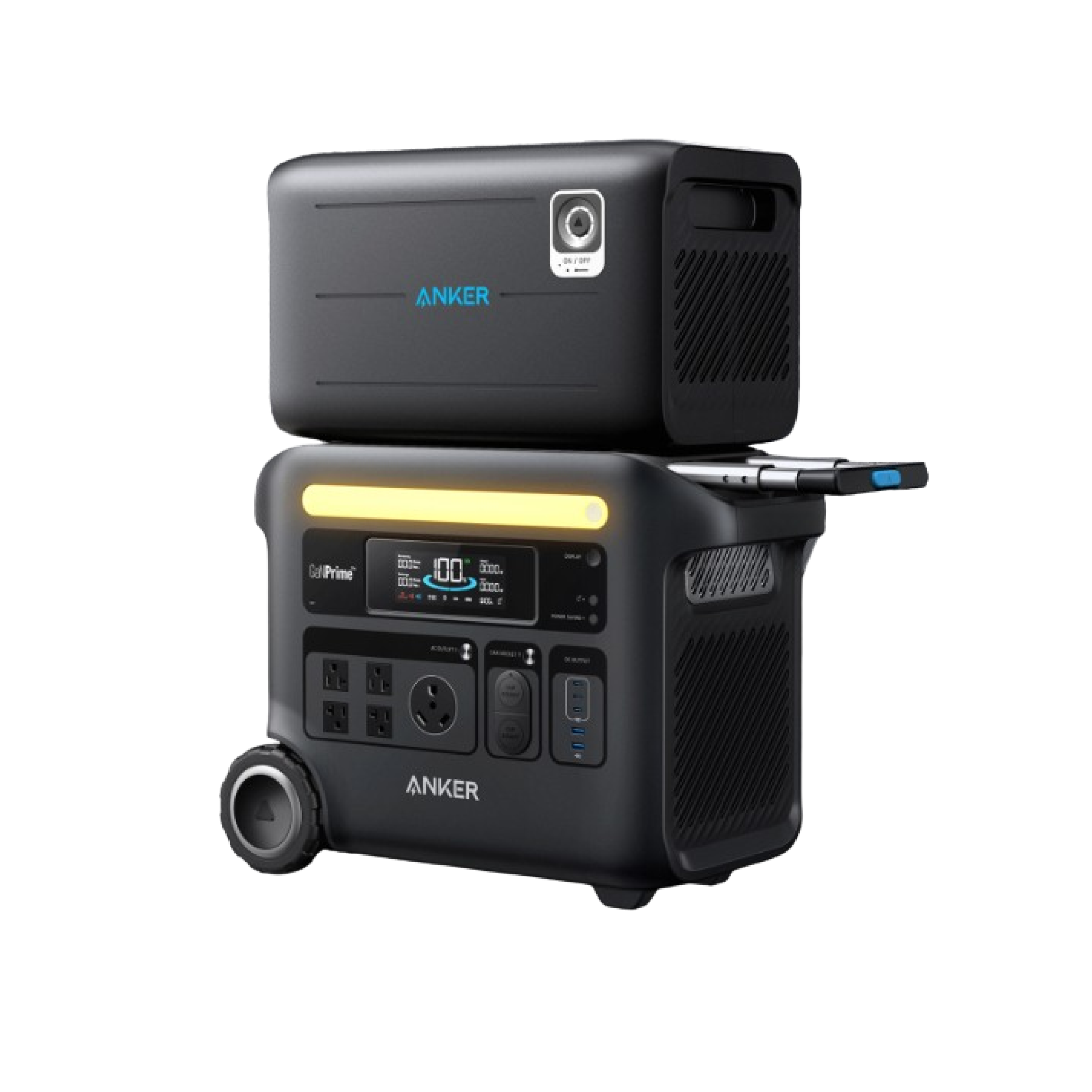
Capacity grows; the output limit does not
The package’s headline 5,120 Wh is the two batteries’ combined nameplate capacity: 2,560 Wh in the F2600 plus 2,560 Wh in the BP2600. It is not a promise of 5,120 Wh delivered to AC appliances. Inverter losses, idle consumption, temperature, and the load’s operating pattern reduce what reaches a device. No runtime test or guaranteed AC-delivered-energy figure is published for the combination, so use the battery figure as stored energy rather than a runtime forecast.
Anker lists 2,400 W continuous AC output and 2,800 W surge for the station. The BP2600 adds storage, not another inverter; the expanded package remains a 2,400 W AC plan. Four household AC receptacles and one TT-30R share that ceiling. The TT-30 shape does not promise 30 A continuous: at 120 V the station limit is about 20 A, so check RV loads and startup needs. Surge is not continuous output.
The exact U.S. F2600 page has conflicting subtype labels for those four household receptacles: its visible specification says NEMA 5-20, a structured field says NEMA 6-20 at 120 V, and the A1781 manual uses generic NEMA-20R wording. If blade pattern or plug fit matters, have Anker confirm the outlet rather than assuming either subtype.
This is a 120 V arrangement, not a 240 V or split-phase source. If your essential equipment needs 240 V, or needs more than 2,400 W continuously, this configuration is the wrong electrical plan even though its battery reserve is substantial. The product page lists a UPS switch time under 20 ms, but the manual limits UPS use and warns against relying on the unit for medical, life-safety, or other high-risk equipment.
More pieces, more mass
The F2600 station body is listed at 69.7 lb and has wheels and a retractable handle. The separate BP2600 is listed at 48.1 lb. Together those component weights add to 117.8 lb, but the package is not one 117.8 lb lift: the batteries are separate pieces joined by a cable. That distinction can help when moving equipment from a vehicle to a fixed backup spot, but it still means handling and storing a second heavy module. If you need one compact item for stairs, frequent carrying, or a long walk from the car, a lighter station with less stored energy is a more realistic choice.
The F2600 manual describes a connected expansion battery on the station’s expansion port. The BP2600 guide names the F2600 as a compatible host, says the expansion battery cannot be used by itself, and explains the connection and storage steps. Its first-use instructions call for app connection and a firmware update; follow the current instructions for the exact units before relying on the expanded setup. The expansion battery’s cable must be disconnected as directed, not pulled out while its power is on.
Charging is possible without buying a panel in this package
The selected B178111L option is labeled “No Panel.” The F2600 manual lists AC, car, and solar charging cables for the standalone station, but the package page does not give a complete B178111L carton list; do not assume those cables ship with this bundle. The manual rates AC input at up to 1,440 W and solar input at up to 1,000 W, with an 11–60 V range, 10 A limit from 11–32 V and 20 A limit from 32–60 V. It illustrates up to five panels, but no panel is included in this option. Match array voltage and current to the manual, and verify the station-side lead and connectors rather than assuming a panel’s cable is enough. Car charging is a separate, slower 120 W route, not a second solar input.
The manual also lists three 100 W USB-C ports, two 12 W USB-A ports and 12 V car-style outputs; port maxima are not a simultaneous-output guarantee. They can charge phones and laptops while AC serves larger devices, but each device’s voltage, connector, and required power still need to match.
Which answers change the decision?
Select expansion as essential and a 5,000 Wh minimum if your plan truly needs this package’s documented 5,120 Wh nameplate arrangement; a lower-capacity F2600 configuration cannot meet that requirement. The optional combined-weight limit matters too: the station and BP2600 total 117.8 lb by listed component weights, so a 100 lb limit rejects the expanded plan even though the station body alone weighs 69.7 lb. A 120 V requirement and a 2,400 W continuous floor fit; a 240 V requirement or a continuous floor above 2,400 W does not. That is why “larger battery” and “more output” must be treated as different choices.
Do not confuse this SKU with Anker’s separately listed F2600 + BP2000 package. That page names a 4,608 Wh configuration; BP2000 and BP2600 are different expansion models, and their quantities should not be silently swapped. If 5,120 Wh is more reserve than you need, compare the F2600 without an expansion battery or the more compact C2000 Gen 2. If 240 V or a home-circuit transfer setup is essential, evaluate a specifically documented dual-voltage system and its installation equipment instead. A portable station’s AC receptacle is not a connection to household wiring.
On the U.S. product-page snapshot checked for this review, the B178111L offer was marked sold out. This assessment describes the exact configuration and its published limits; it is not a claim about present stock or a promise that this package can currently be ordered.
Key details at a glance
| Nameplate battery capacity | 5120 Wh |
|---|---|
| Rated AC output | 2400 W |
| Manufacturer surge rating | 2800 W |
| Maximum solar input | 1000 W |
| Maximum USB-C output per port | 100 W |
| Listed weight | 69.7 lb |
| Compatible extra-battery expansion | Yes |
| 12 V DC output | 120 W |
| Maximum AC recharge input | 1440 W |
| Base warranty term | 5 years |
| AC outlet output | Yes |
| USB-C ports | 3 |
| USB-A ports | 2 |
| Solar input ports | 1 |
| 12 V car-style output | 120 W |
| Battery chemistry | LiFePO4 |
Use the exact model’s instructions for operating limits, supplied equipment and version differences.
Sources for this assessment
- Anker SOLIX F2600 + BP2600 Expansion Battery - 5120Wh | 2400W (Anker SOLIX U.S.)
- Anker SOLIX F2600 Portable Power Station - 2560Wh | 2400W (Anker SOLIX U.S.)
- Anker SOLIX F2600 Portable Power Station User Manual, Product Number A1781, 51005003812 V03 (English section)
- Anker SOLIX BP2600 Expansion Battery - 2560Wh LFP (For Anker SOLIX F2000, F2600) (Anker SOLIX U.S.)
- Anker SOLIX BP2600 Expansion Battery User Guide A1781111-85 (manufacturer-hosted Japanese guide)
- First image on exact F2600 + BP2600 U.S. package page

A useful match starts with the loads that matter.
Use the finder for hard electrical requirements, then check appliance starting behavior, actual run time and the exact package in the full assessment.