
Your needs, this model
Does it fit your priorities?
Must one panel be supplied with this 1,024 Wh station?
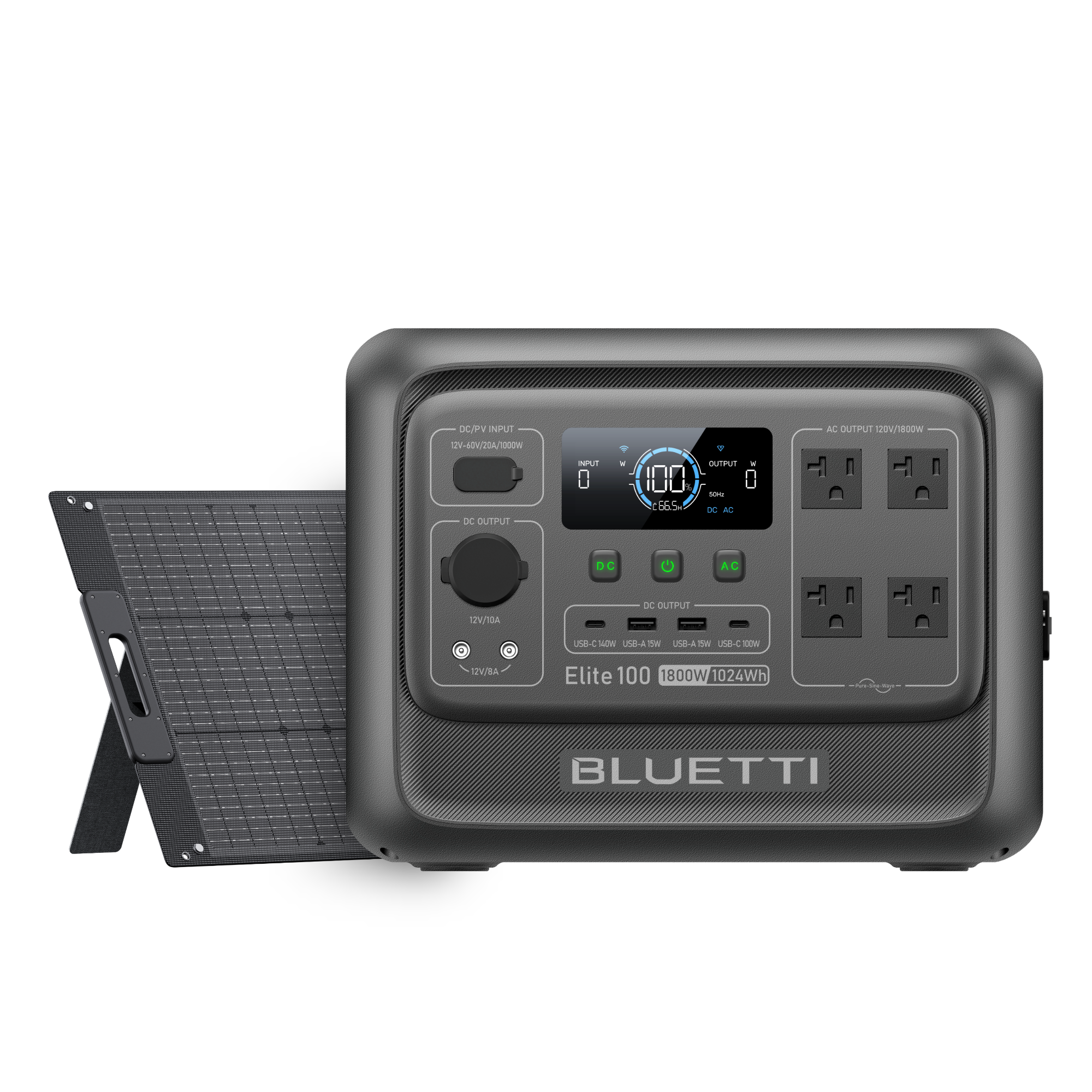
This exact package lists one SP100L 100 W panel and a solar charging cable. The panel changes the charging equipment, not the EL100V2’s 1,024 Wh battery or 1,800 W rated AC output.
Explore this need in the finder →Would the EL100V2’s 25.3 lb body meet your weight ceiling?
BLUETTI lists the station at 25.3 lb; the SP100L adds a separately listed 10.9 lb before its cable and packaging. The official full-kit weight is unknown.
Explore this need in the finder →Do you need more than the included 100 W panel?
The selected EL100V2 package supplies 100 W of panel nameplate against a 1,000 W station-input ceiling. A threshold above 100 W for the in-box panel does not fit this variant, even though the station can accept more solar input with a separately verified array.
Explore this need in the finder →The Elite 100 V2 + 100W Solar package is the EL100V2 station with one SP100L folding panel and a solar charging cable in the exact U.S. offer. It differs from the standalone Elite 100 V2 by putting one modest panel in the same package, not by increasing the battery or changing the inverter. This is the option to consider when you want a roughly 1 kWh station and a ready starting point for daylight charging, but do not want to mistake a small panel for the station’s maximum solar capacity.
One 100 W panel for a 1,000 W input
The Elite 100 V2 has 1,024 Wh of nameplate capacity, 1,800 W of rated 120 V AC output and a 1,000 W solar-input ceiling at 12–60 V and 20 A. The included SP100L is rated up to 100 W; the official panel page lists 24.62 V open-circuit voltage, 5.13 A short-circuit current and a 10.9 lb mass. The U.S. option page shows one 100 W panel and one 1.5 m solar charging cable; its panel image/file and component page identify SP100L. At its published nominal values, one panel is comfortably below the EL100V2’s stated input ceiling. No panel temperature coefficient or field-yield measurement was established here, so treat actual charge contribution as dependent on siting, sun and conditions.
The key compromise is scale. One 100 W panel is one tenth of the station’s 1,000 W maximum solar-input figure. That does not make the bundle incompatible; it means the included panel is a starter route rather than an array that exploits the station’s full solar ceiling. If fast solar replenishment is essential, verify a larger compatible array and its voltage, current and cable arrangement against the current manual. Do not interpret the station’s 1,000 W input as the wattage of the supplied panel or as guaranteed charging speed.
A useful middle-size station, but not a light complete kit
The station’s 1,800 W AC output gives more headroom than the Elite 30 V2 for ordinary appliances that stay within its continuous rating, while 1,024 Wh stores substantially more nameplate energy than the 288 Wh model. It can suit a small outage kit, vehicle campsite or work setup with a carefully inventoried list of loads. Nameplate Wh is not guaranteed AC energy delivered, and runtime depends on the actual load, inverter losses, temperature and station settings. A compressor, tool or pump can have a starting demand above its steady running label. BLUETTI’s Power Lifting feature is restricted to suitable resistive loads; it does not raise the normal 1,800 W AC rating for every appliance.
BLUETTI lists the EL100V2 body at 25.3 lb and the SP100L at 10.9 lb. That is about 36.2 lb in separate components before cable, carton or other accessories, not an official full-package weight. The panel folds, but carrying the whole option is a different task from lifting the station alone. It can be sensible to keep the station near a vehicle or a fixed outage location and carry the panel separately when needed.
When the bundle is right—and when it is not
Pick this configuration when a panel must be included, 100 W of supplied panel nameplate is enough for your plan, and the EL100V2’s 1,024 Wh, 1,800 W AC and 25.3 lb station body fit. If your question is only about the station, the standalone EL100V2 has the same capacity, ports and limits and may be preferable if you already own compatible solar equipment. If the supplied-panel threshold is at least 200 W, compare the Elite 100 V2 + 200W option; it is a separate panel package, not an upgrade to the station’s stored energy. If portability matters more than a 1 kWh reserve, the EL30V2 is smaller but also gives less capacity and AC output.
In a questionnaire, requiring both solar charging and a panel in the package separates this option from the standalone station. A minimum 100 W panel threshold is met; a minimum above 100 W is not. The advanced solar-input question can show the station’s 1,000 W ceiling, but that number should not be confused with the included 100 W panel. A strict station-weight cap below 25.3 lb rules out the EL100V2 before considering the panel; a full-kit carrying limit needs a separate weight allowance because the complete package mass was not confirmed.
Planning checks before relying on it
List every essential appliance and its running and starting wattage. Then estimate duration from actual energy consumption rather than assuming that a 1,024 Wh label is all available at the outlets. For solar, look at where the panel can sit, whether it can remain in sun, and whether you are willing to move it as the sun changes. A 100 W nameplate panel may provide meaningful daytime replenishment under suitable conditions, but it cannot guarantee a full recharge on a schedule. If an outage plan depends on replacing most of the battery each day, investigate a larger input arrangement and confirm each panel’s electrical limits and connector path with the manufacturer.
The Elite 100 V2 + 100W bundle makes sense as a moderate-capacity station paired with one correctly identified panel and cable. Its strengths are the familiar 120 V output, 1,024 Wh reserve and an included solar component. Its drawbacks are a 100 W panel against a much higher station input ceiling, added lifting burden and no independent runtime or solar test. Buy it for the exact station-plus-panel arrangement you need, not because the bundle label suggests that a larger solar system or longer runtime is automatically included.
Key details at a glance
| Nameplate battery capacity | 1024 Wh |
|---|---|
| Rated AC output | 1800 W |
| Maximum solar input | 1000 W |
| Included panels, combined nameplate | 100 W |
| Maximum USB-C output per port | 140 W |
| Listed weight | 25.3 lb |
| 12 V DC output | 120 W |
| Maximum AC recharge input | 1200 W |
| Manufacturer UPS transfer figure | 10 ms |
| AC outlet output | Yes |
| USB-C ports | 2 |
| USB-A ports | 2 |
| Solar input ports | 1 |
| 12 V car-style output | 120 W |
| Battery chemistry | LiFePO4 |
| Solar panels in exact offer | 1 |
Use the exact model’s instructions for operating limits, supplied equipment and version differences.
Sources for this assessment
A useful match starts with the loads that matter.
Use the finder for hard electrical requirements, then check appliance starting behavior, actual run time and the exact package in the full assessment.