
Your needs, this model
Does it fit your priorities?
Does this exact package meet your 560 W vehicle-charging ceiling and station requirements?
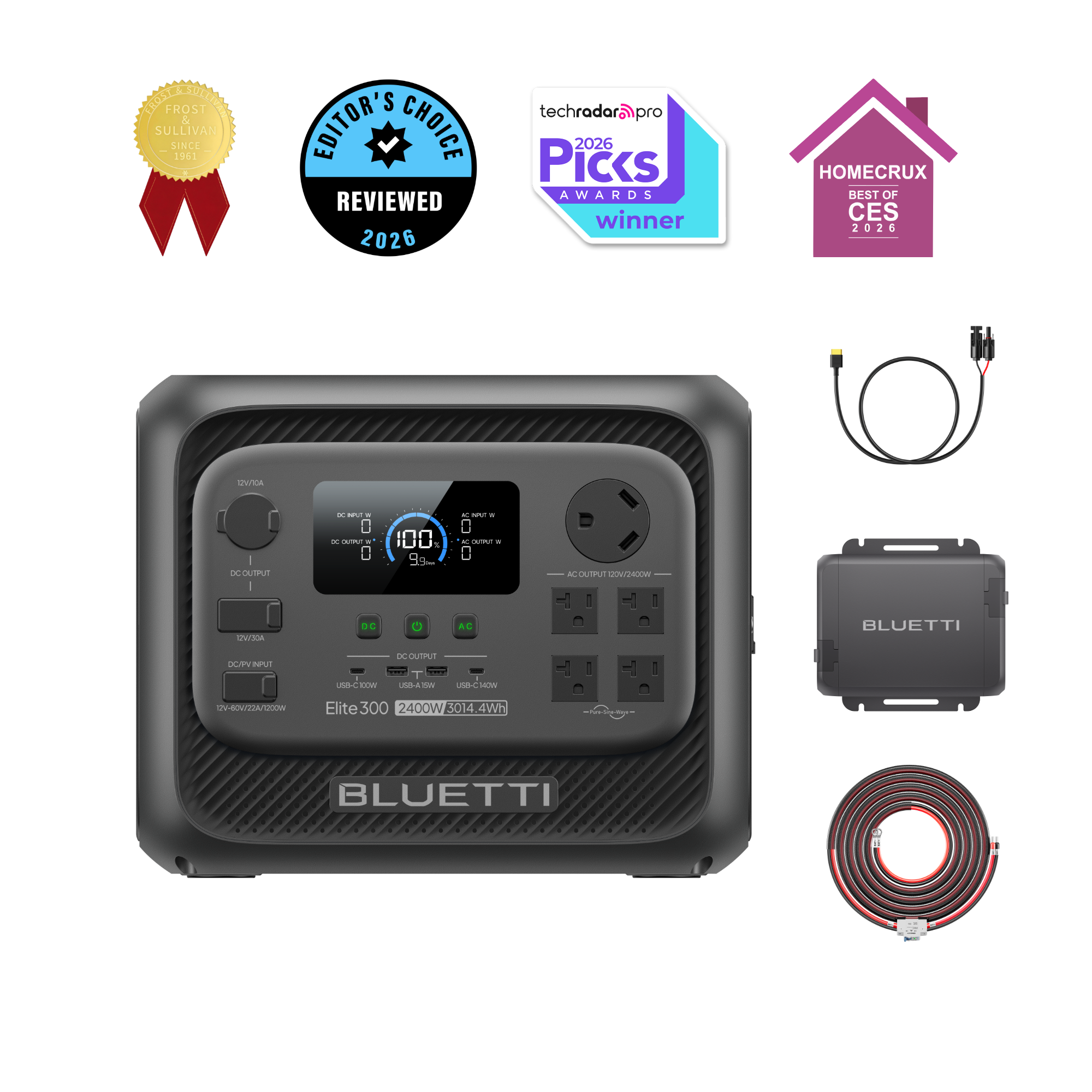
The exact EL300-2-46-SPFUS-00 U.S. package pairs the Elite 300 station with BLUETTI Charger 1. The station ratings do not change; 560 W is a manufacturer package ceiling, not a measured everyday rate.
Explore this need in the finder →Can you safely accommodate a hardwired BLUETTI Charger 1 and its installation limits?
This box includes BLUETTI Charger 1; it is not a cigarette-lighter adapter. The manual requires a vehicle battery wiring installation and the exact fuse/clearance requirements must be followed. The station itself remains 57.98 lb and the full package mass is not stated.
Explore this need in the finder →Do you require solar input to be available at the same time as vehicle charging?
Charger 1 provides a vehicle route; simultaneous solar charging through the same station input is not established by the reviewed manufacturer documentation, so an essential simultaneous-input condition should rule this package out.
Explore this need in the finder →The BLUETTI Elite 300 + Charger 1 package keeps the same EL300 station reviewed in our standalone assessment, but adds an installed DC-to-DC vehicle charger. The distinction matters if a day of driving is part of your recharge plan: this is not simply an Elite 300 with a faster cigarette-lighter cable. BLUETTI identifies the bundle SKU as EL300-2-46-SPFUS-00 and lists Charger 1, a 5 m 6 AWG DC input cable kit, an MC4 output cable and mounting hardware in the box.
The station is still a 3 kWh, 2,400 W EL300
The bundle does not add battery capacity or AC output. The EL300 remains a 3,014.4 Wh LiFePO4 station rated for 2,400 W AC at 120 V. The U.S. station page identifies a TT-30 RV receptacle, four household AC outlets, two USB-A ports, and USB-C outputs rated at 140 W and 100 W. The 12 V/30 A port and 12 V/10 A car-style socket share a 30 A total ceiling, rather than delivering 40 A when used together. Check the actual appliance startup draw and the station's 2,400 W output limit; a connector does not add inverter capacity.
At 57.98 lb, the station is a deliberate move, not a one-hand carry. Charger 1 itself weighs about 2.645 lb, before the included cable and mounting hardware. The bundle's complete carried mass is not stated, so a person setting a strict total lift limit should not treat the station-only weight as the kit's total. It suits a vehicle, RV or fixed backup spot better than a long walk from the parking area.
What the included Charger 1 changes
Charger 1 is a hardwired alternator charger that draws from a vehicle's standard 12 V or 24 V battery and supplies up to 560 W to a compatible power station. That is meaningfully above the ordinary 12 V cigarette-lighter route, which BLUETTI lists at 100 W for the EL300, but the gain requires planning and installation. The official EL300 bundle page lists the charger, AC charging cable, grounding screw, 5 m 6 AWG input cable kit, MC4 output cable, four hex-socket screws, six self-tapping screws, wrench and manual. It does not list a solar panel.
BLUETTI's Charger 1 manual requires a 60 A circuit breaker on the input cable, says to match charger output voltage to the station's DC input, and describes a 12/24 V vehicle-battery route. Its safety instructions say installation should be performed by authorized personnel. It also specifies a dry, ventilated mounting location with at least 20 cm of clearance on each side. This is a permanently wired addition, not an accessory to toss in a day bag. If you are not equipped to plan safe automotive wiring, the included charger is not a reason to improvise a connection.
Charging speed does not erase the one-input tradeoff
The EL300's own solar input remains rated up to 1,200 W at 12–60 V and 22 A. That figure describes the station's solar input, not a panel included in this bundle. Charger 1 sends its output to the station's DC/solar input; its manual does not give Charger 1 a separate solar input. Plan on using the installed alternator route or the station's direct solar route, rather than counting on alternator and a solar array being combined simultaneously through Charger 1. Use the panel voltage and cable limits in the Elite 300 manual if solar is your parked-site option.
Choose this package when the drive itself is a useful charging window and the 560 W class of installed charging is enough. If you require simultaneous solar and alternator input while moving, BLUETTI's separate Elite 300 + Charger 2 package is the more relevant comparison; it is a different bundle SKU and a different electrical plan. If you only need an occasional slow top-up from a vehicle outlet, the standalone Elite 300 and its basic charging route avoid installed wiring.
Who should choose it—and what changes the answer
This is the more sensible EL300 configuration for a frequent road-to-camp routine in which a professionally installed vehicle route is valuable, TT-30 is useful at camp, and the station's 57.98 lb handling burden is manageable. In the finder, selecting Charger 1 and setting a 560 W package-charging minimum points to this exact configuration; a demand for Charger 2 or simultaneous solar-plus-alternator charging removes it. A 2,500 W AC requirement also removes the EL300 family regardless of the alternator bundle, because the base station remains a 2,400 W unit.
The Elite 400 + Charger 1 is the larger alternative: it raises the base station to 3,840 Wh and 2,600 W, but weighs 85.98 lb and has no listed TT-30 outlet. The Elite 200 V2 is lighter at 53.35 lb, though its 2,073.6 Wh battery is smaller and it does not represent the same RV-connector plan. Charger 1 changes the recharge arrangement, not the station's stored energy, output ceiling, outlet layout or lifting job.
See the Elite 300 standalone assessment for the station's complete port and operating limits, and the alternator-charger comparison for the Charger 1 versus Charger 2 installation tradeoff. We did not test the bundle or measure charge time. Check the exact SKU, wiring and current box contents before ordering.
Official references: the exact U.S. package option, the Charger 1 User Manual (V1.0), and the BLUETTI Elite 300 U.S. User Manual.
Key details at a glance
| Nameplate battery capacity | 3014.4 Wh |
|---|---|
| Rated AC output | 2400 W |
| Maximum solar input | 1200 W |
| Maximum USB-C output per port | 140 W |
| Listed weight | 57.98 lb |
| Compatible extra-battery expansion | No |
| 12 V DC output | 360 W |
| Maximum AC recharge input | 1800 W |
| Manufacturer UPS transfer figure | 10 ms |
| AC outlet output | Yes |
| USB-C ports | 2 |
| USB-A ports | 2 |
| Solar input ports | 1 |
| 12 V car-style output | 120 W |
| Battery chemistry | LiFePO4 |
| Ingress rating | IP20 |
| TT-30 RV outlet | Yes |
| Published vehicle-charger package ceiling | 560 W |
Use the exact model’s instructions for operating limits, supplied equipment and version differences.
Sources for this assessment
- BLUETTI U.S. BLUETTI Elite 300 + Charger 1 exact option
- BLUETTI U.S. BLUETTI Elite 300 base station page
- BLUETTI BLUETTI Elite 300 U.S. user manual
- BLUETTI BLUETTI Charger 1 official support page
- BLUETTI Charger 1 User Manual V1.0
- BLUETTI BLUETTI Elite 300 + Charger 1 exact package option image
- BLUETTI U.S. Elite 300 exact selected option page and current FAQ

A useful match starts with the loads that matter.
Use the finder for hard electrical requirements, then check appliance starting behavior, actual run time and the exact package in the full assessment.