
Your needs, this model
Does it fit your priorities?
Does this exact package meet your 1,200 W vehicle-charging ceiling and station requirements?
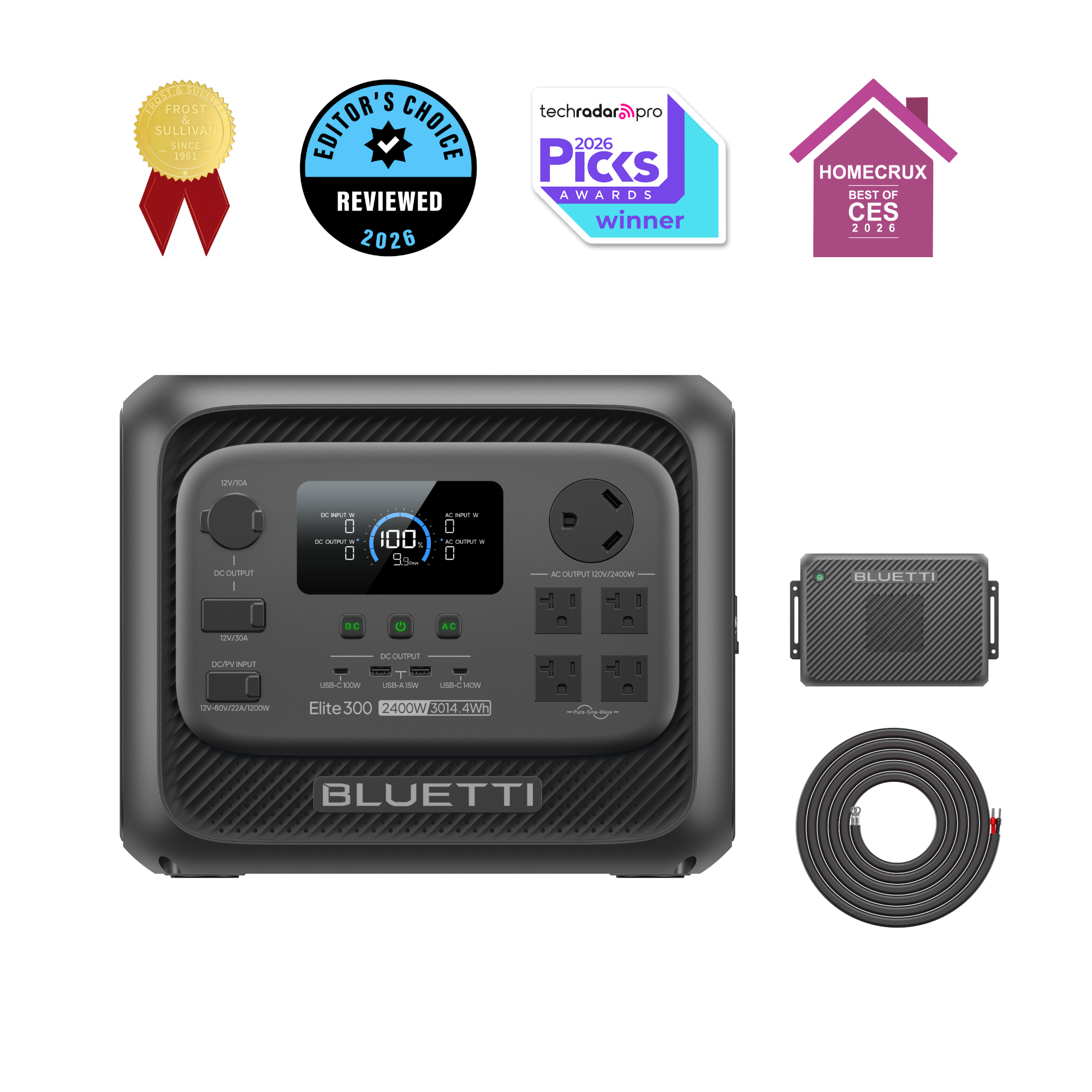
The exact EL300-2-07-SPFUS-00 U.S. package pairs the Elite 300 station with BLUETTI Charger 2. The station ratings do not change; 1,200 W is a manufacturer package ceiling, not a measured everyday rate.
Explore this need in the finder →Can you safely accommodate a hardwired BLUETTI Charger 2 and its installation limits?
This box includes BLUETTI Charger 2; it is not a cigarette-lighter adapter. The manual requires a vehicle battery wiring installation and the exact fuse/clearance requirements must be followed. The station itself remains 57.98 lb and the full package mass is not stated.
Explore this need in the finder →Do you require solar input to be available at the same time as vehicle charging?
Charger 2 is documented for dual-source operation with solar and vehicle inputs; the bundle’s station-specific combined ceiling is shown separately from hardware limits.
Explore this need in the finder →The BLUETTI Elite 300 + Charger 2 bundle combines the EL300 portable station with a dual-source alternator and solar charger. The exact U.S. page identifies package SKU EL300-2-07-SPFUS-00 and lists the Elite 300, Charger 2, battery cables, a 75 A fuse, MC4 input and output leads, an MC4-to-XT60 cable, a bidirectional power cable, six self-tapping screws and a manual. It is a distinct retail configuration, not the standalone EL300 carton.
More recharge routes, not a bigger power station
The EL300 itself remains a 3,014.4 Wh LiFePO4 station rated for 2,400 W AC at 120 V. The U.S. model's TT-30 outlet and household AC receptacles share that same output ceiling. The 12 V/30 A port and car-style socket share a 30 A combined limit, and its 57.98 lb weight is still a meaningful carry. Charger 2 does not increase the battery capacity, inverter rating, port count or weight that BLUETTI lists for the station; it changes how the station can be replenished from a vehicle and solar array.
That distinction is useful on a long road leg. BLUETTI's Charger 2 manual lists up to 800 W from a vehicle starter battery, up to 600 W solar input, and 1,200 W total charging input. The Elite 300 package page also advertises up to 1,200 W car-plus-solar charging. Those are component and system ceilings, not a promise that every car supplies the rate. The alternator's capacity, vehicle battery voltage, temperature, wiring, firmware and solar conditions affect actual input.
Dual input is the reason to select this option
Unlike Charger 1, Charger 2 has a dedicated solar input, so its intended road routine can combine alternator energy and compatible solar input without repeatedly unplugging sources. Solar takes priority up to 600 W in the Charger 2 manual; alternator contribution is limited to 800 W, while the sum is capped at 1,200 W. The Elite 300 also has its own direct solar input rated up to 1,200 W at 12–60 V/22 A. Do not confuse that station input ceiling with the separate 600 W PV limit on Charger 2.
The bundle page's included list names cables, fuse and Charger 2, but not a solar panel or the optional Hub D1 DC power hub. The charger manual says solar open-circuit voltage must stay within 13–50 V. If you need its separate 12 V/24 V DC-panel output, the quick-start guide specifically identifies Hub D1 as the accessory used for that route. The charge-package image and marketing headline are not a substitute for verifying panel voltage, polarity and exact accessories.
Installation is a real part of the purchase decision
Charger 2 is intended to be mounted inside the vehicle cabin or trunk near the station. Its current manual requires at least 20 cm of clearance on all sides, a dry location, and says a qualified automotive electrician should handle installation and wiring. The bundle includes the 75 A fuse and cable components, but the presence of hardware does not turn battery wiring into a plug-in setup. Plan where the unit will live, how cables pass safely through the vehicle, and how you will remove or protect the station when parked.
Compared with the Elite 300 + Charger 1, the Charger 2 package makes most sense when you want both vehicle and solar sources contributing during a trip and can support the more involved wiring. Charger 1 is the simpler single-source alternator solution rated at 560 W. For occasional charging from a cigarette lighter, the standalone EL300's slower vehicle route may be enough and avoids mounting either charger. For a parked site with solar and no regular driving, spend attention on a safe panel array rather than assuming the alternator bundle solves the use case.
Who should choose it—and when the match changes
Choose this exact package if you want the EL300's TT-30 connector, 3 kWh battery and 2,400 W AC ceiling, while also needing a dedicated Charger 2 setup for driving and solar input together. In the finder, selecting Charger 2 and simultaneous solar-plus-alternator charging keeps this package and excludes the Charger 1 variants. A minimum combined package-input threshold above 1,200 W excludes it; a requirement for more than 2,400 W AC excludes the whole EL300 family.
The Elite 400 + Charger 2 is worth comparing if you need its larger 3,840 Wh battery or 2,600 W AC rating, but it is much heavier at 85.98 lb and BLUETTI lists its station-specific car-plus-solar ceiling at 1,000 W. The EL300's lower-capacity station remains the lighter option with a documented TT-30 outlet and a 1,200 W advertised Charger 2 ceiling. If 57.98 lb is still too heavy to move, a smaller station may fit better even if its battery cannot support the same long load list.
Read the standalone Elite 300 assessment for limits that Charger 2 does not change, and the bundle guide before planning a vehicle installation. We did not test charging speed or inspect a retail carton; these are manufacturer specifications. Confirm the exact EL300-2-07-SPFUS-00 listing and included cable set before purchase.
Official references: the exact U.S. package option, the Charger 2 User Manual (V4.0), its Quick Start Guide, and the BLUETTI Elite 300 U.S. User Manual.
Key details at a glance
| Nameplate battery capacity | 3014.4 Wh |
|---|---|
| Rated AC output | 2400 W |
| Maximum solar input | 1200 W |
| Maximum USB-C output per port | 140 W |
| Listed weight | 57.98 lb |
| Compatible extra-battery expansion | No |
| 12 V DC output | 360 W |
| Maximum AC recharge input | 1800 W |
| Manufacturer UPS transfer figure | 10 ms |
| AC outlet output | Yes |
| USB-C ports | 2 |
| USB-A ports | 2 |
| Solar input ports | 1 |
| 12 V car-style output | 120 W |
| Battery chemistry | LiFePO4 |
| Ingress rating | IP20 |
| TT-30 RV outlet | Yes |
| Published vehicle-charger package ceiling | 1200 W |
| Charger 2 solar input ceiling | 600 W |
Use the exact model’s instructions for operating limits, supplied equipment and version differences.
Sources for this assessment
- BLUETTI U.S. BLUETTI Elite 300 + Charger 2 exact option
- BLUETTI U.S. BLUETTI Elite 300 base station page
- BLUETTI BLUETTI Elite 300 U.S. user manual
- BLUETTI BLUETTI Charger 2 official support page
- BLUETTI Charger 2 User Manual V4.0
- BLUETTI BLUETTI Elite 300 + Charger 2 exact package option image
- BLUETTI Charger 2 Quick Start Guide V1.0
- BLUETTI U.S. Elite 300 exact selected option page and current FAQ

A useful match starts with the loads that matter.
Use the finder for hard electrical requirements, then check appliance starting behavior, actual run time and the exact package in the full assessment.