
Your needs, this model
Does it fit your priorities?
Does this exact package meet your 560 W vehicle-charging ceiling and station requirements?
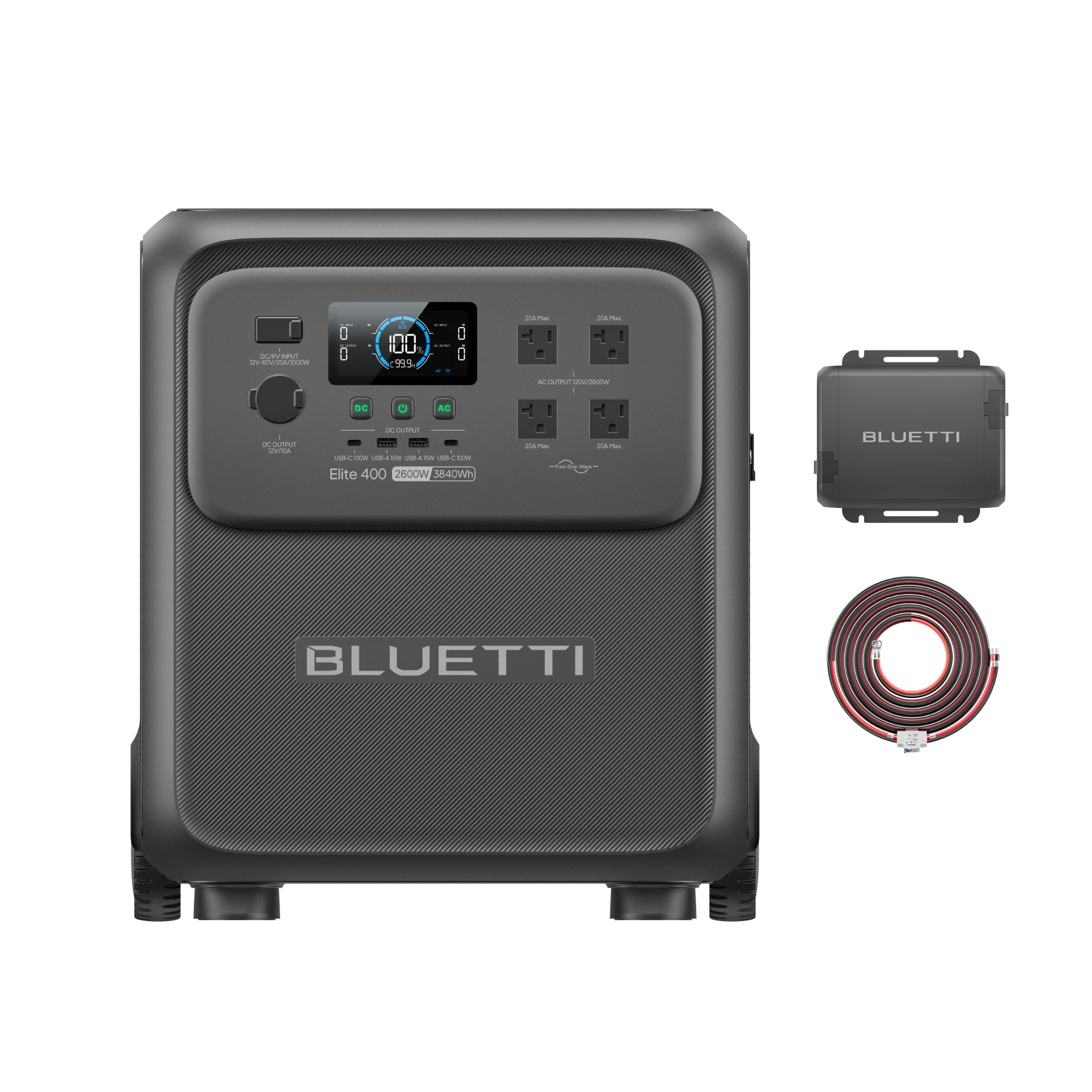
The exact EL400-2-44-SPFUS-00 U.S. package pairs the Elite 400 station with BLUETTI Charger 1. The station ratings do not change; 560 W is a manufacturer package ceiling, not a measured everyday rate.
Explore this need in the finder →Can you safely accommodate a hardwired BLUETTI Charger 1 and its installation limits?
This box includes BLUETTI Charger 1; it is not a cigarette-lighter adapter. The manual requires a vehicle battery wiring installation and the exact fuse/clearance requirements must be followed. The station itself remains 85.98 lb and the full package mass is not stated.
Explore this need in the finder →Do you require solar input to be available at the same time as vehicle charging?
Charger 1 provides a vehicle route; simultaneous solar charging through the same station input is not established by the reviewed manufacturer documentation, so an essential simultaneous-input condition should rule this package out.
Explore this need in the finder →The BLUETTI Elite 400 + Charger 1 is a specific EL400 station package with an installed alternator charger, identified by BLUETTI's U.S. option as SKU EL400-2-44-SPFUS-00. The main point is not a new battery size: the station remains the 3,840 Wh, 2,600 W Elite 400. The bundle adds Charger 1 and vehicle-wiring components so a drive can provide a quicker replenishment route than the station's ordinary cigarette-lighter cable.
A larger battery on a rolling base
The Elite 400 stores 3,840 Wh of nameplate energy and is rated for 2,600 W AC at 120 V. BLUETTI lists four household AC outlets, two 100 W USB-C ports, two USB-A ports, a 12 V car-style socket and a wheeled body with a retractable handle. There is no TT-30 receptacle on the reviewed Elite 400 outlet list. Its station weight is 85.98 lb, so wheels help on a smooth floor but do not make loading into a vehicle or using stairs effortless.
The Charger 1 package does not increase station storage or AC capability. Its purpose is to move vehicle energy into the station through a DC-to-DC charger. BLUETTI's Charger 1 manual specifies up to 560 W output, with a 12 V or 24 V starter-battery input. That rate can materially shorten a long road recharge compared with a standard car-style socket, but the larger 3.84 kWh battery still takes more energy to refill than a smaller station. The listed rate is a ceiling under suitable vehicle and installation conditions, not a measured charge-time promise.
Exact bundle contents and the wiring commitment
The official Elite 400 + Charger 1 page lists Elite 400, Charger 1 DC-DC Charger, AC charging cable, grounding screw, 5 m 6 AWG DC input cable kit, MC4 output cable, four hex-socket screws, six self-tapping screws, hex-socket wrench and a user manual. No solar panel is listed. The exact bundle differs from the standalone Elite 400 SKU; do not infer the charger or its long cable from a station-only listing.
The Charger 1 manual specifies a 60 A circuit breaker on the input cable, a compatible 12/24 V vehicle battery and matching output voltage to the power station's input range. It instructs that installation be done by authorized personnel and the device be mounted in a dry, ventilated area with at least 20 cm of clearance around it. It is not a portable charger you clip on only when driving. A buyer needs a suitable mounting location and a safe installation plan before choosing this bundle.
The Elite 400 station can accept up to 1,000 W of direct solar input at 12–60 V/20 A, but Charger 1 has no separate solar input. While its alternator output uses the station's DC input, do not count on simultaneous solar through that same input. Use the station's direct solar route when parked, and treat the wiring/charger route as an alternative. A direct-solar panel is not part of this charger bundle.
Who should choose the 560 W route?
This configuration is for someone whose vehicle alternator is a regular part of the itinerary and who wants more than a slow socket top-up, but does not require simultaneous solar charging while underway. It is a practical fit for a parked home-backup station that can be charged during a commute or a vehicle-based setup where the installation can stay put. In the finder, selecting Charger 1 and a 560 W minimum identifies this exact bundle; asking for Charger 2's dual-source operation removes it. A need for TT-30 also removes the Elite 400 regardless of charger.
If the vehicle route is occasional, compare the standalone Elite 400, which avoids the installation and leaves accessory choice open. If high vehicle charging plus solar input together is essential, compare the Elite 400 + Charger 2: the official package advertises up to 1,000 W from its car-plus-solar arrangement, while the Charger 2 device itself is rated for 1,200 W total input. If the station must be carried often or plugged into an RV TT-30 inlet, the smaller 57.98 lb Elite 300 is lighter and has a listed TT-30, though it stores 825.6 Wh less and has a 2,400 W AC rating.
Limits that remain after adding Charger 1
AC appliance fit is determined by the Elite 400, not Charger 1: the station's 2,600 W continuous output remains the ceiling. Check compressor and motor starting requirements and the manuals for each appliance. The Elite 400 lists a 15 ms UPS transfer, but BLUETTI cautions against using the UPS mode with servers or workstations requiring high-performance UPS behavior. No portable-station UPS figure is a medical-backup guarantee, and its AC output must not be tied into household wiring or the grid without a listed transfer arrangement.
The Elite 400's 85.98 lb station weight is the listed unit weight; Charger 1 itself weighs about 2.645 lb, and the total package weight including cables is not published here. Its station is IP20, not weatherproof. Keep the installation dry, ventilated, correctly fused and protected from cable abrasion and heat. These details matter more than an advertised charging-time number when the plan includes vehicle battery wiring.
See the Elite 400 standalone review for its station ports and output limits, and the alternator-charger guide for the Charger 1 versus Charger 2 tradeoff. We did not install, test or measure this package; its assessment is based on BLUETTI's exact U.S. product option and manuals. Confirm the exact EL400-2-44-SPFUS-00 box before ordering.
Official references: the exact U.S. package option, the Charger 1 User Manual (V1.0), and the BLUETTI Elite 400 U.S. User Manual.
Key details at a glance
| Nameplate battery capacity | 3840 Wh |
|---|---|
| Rated AC output | 2600 W |
| Maximum solar input | 1000 W |
| Maximum USB-C output per port | 100 W |
| Listed weight | 85.98 lb |
| 12 V DC output | 120 W |
| Maximum AC recharge input | 1800 W |
| Manufacturer UPS transfer figure | 15 ms |
| AC outlet output | Yes |
| USB-C ports | 2 |
| USB-A ports | 2 |
| Solar input ports | 1 |
| 12 V car-style output | 120 W |
| Battery chemistry | LiFePO4 |
| Ingress rating | IP20 |
| TT-30 RV outlet | No |
| Published vehicle-charger package ceiling | 560 W |
Use the exact model’s instructions for operating limits, supplied equipment and version differences.
Sources for this assessment

A useful match starts with the loads that matter.
Use the finder for hard electrical requirements, then check appliance starting behavior, actual run time and the exact package in the full assessment.