
Your needs, this model
Does it fit your priorities?
Can you use a fixed-capacity station with no extra-battery expansion?
Yes, if its standalone 1,024 Wh nameplate capacity is enough for your plan. EcoFlow's Classic specifications say battery expansion is not supported; do not count on adding a compatible pack later.
Explore this need in the finder →Is a 12 V DC output a must-have?
No 12 V DC output is listed on the Classic specification sheet. If your load needs a vehicle-style socket or other 12 V DC connection, the DELTA 3 and DELTA 3 Plus retain that output.
Explore this need in the finder →Is 1,000 W solar input or 140 W USB-C required?
No. The Classic supports up to 500 W solar input and has 100 W and 30 W USB-C ports. The Plus is the family member with two 500 W solar inputs and 140 W USB-C ports.
Explore this need in the finder →A simpler fixed-capacity member of the DELTA 3 family
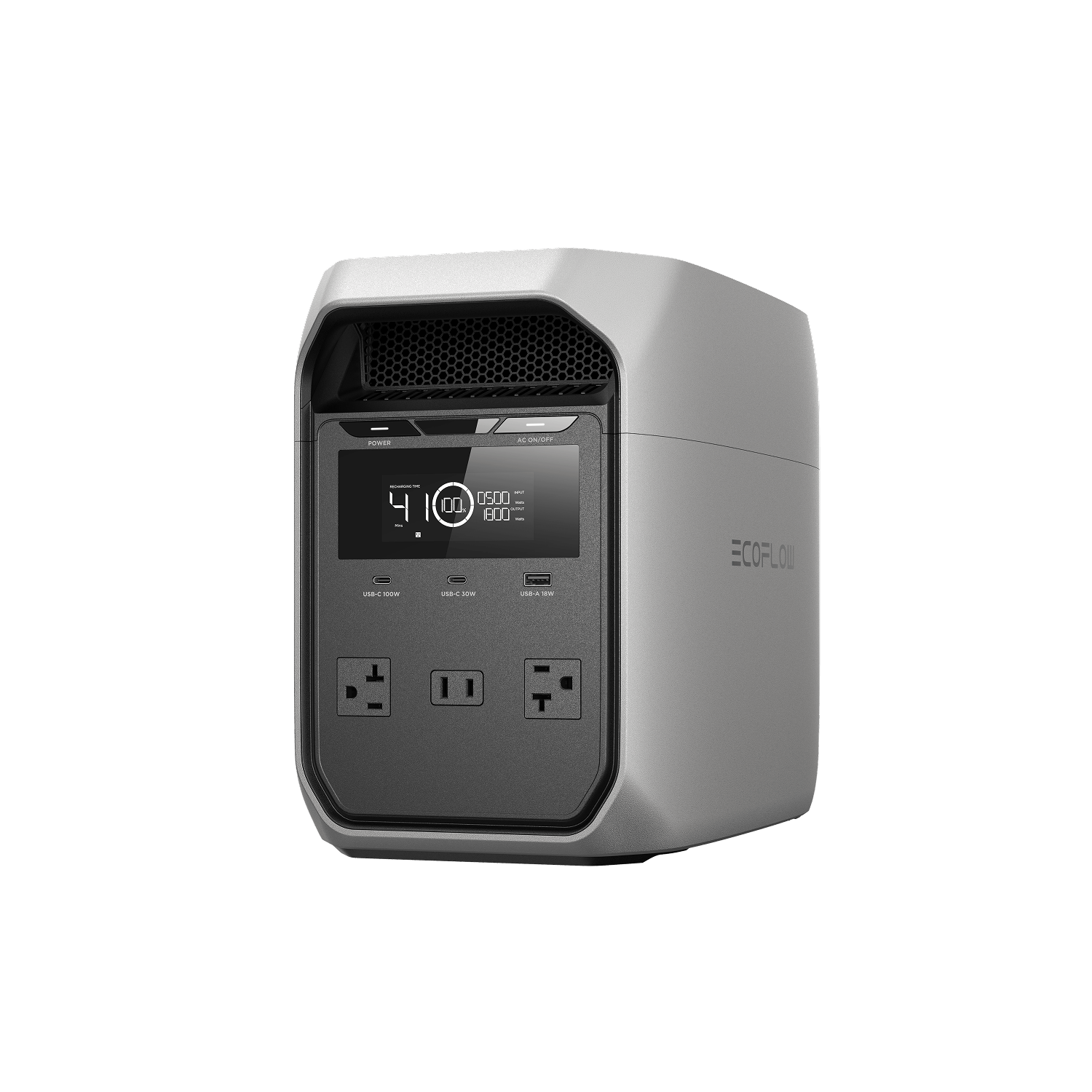
The DELTA 3 Classic keeps the central 1 kWh-class headline: a 1,024 Wh LFP battery, six 120 V AC outlets, 1,800 W rated AC output and a 3,600 W surge figure. Its manufacturer model is EF-DL3-C; the US item code shown for the standalone listing is EFDELTA3C-US-L. The practical trade is not a different inverter class. It is a shorter feature list: EcoFlow’s official Classic specification page says no extra-battery expansion and no 12 V DC output, and lists one 500 W maximum solar input, 1,400 W maximum AC charging input, one USB-A port and two USB-C ports rated 100 W and 30 W.
This makes the Classic worth considering if you want the AC side and do not need the family’s expansion or vehicle-style DC connection. Its listed weight is about 12.1 kg (26.6 lb), with the specification page giving a tolerance of ±0.3 kg. That is roughly a pound lighter than the 12.5 kg DELTA 3 and Plus listings, not a change in what its battery can store. It is still a substantial 27-pound box, and any cables add to the load.
Output claims need context
The Classic is rated for 1,800 W continuous AC output; 3,600 W surge and 2,600 W X-Boost are separate claims. Do not treat the X-Boost number as ordinary continuous 120 V rated output. EcoFlow’s manual warns that X-Boost changes voltage characteristics and is unsuitable for equipment with voltage-protection requirements. It is available only under specific conditions and not during AC input/bypass. A heater, kettle or motor that draws above the rated output may not operate as it would on the wall, even if a marketing illustration names a similar appliance. Check the exact device requirements.
The 1,024 Wh nameplate figure also is not guaranteed AC energy at the receptacle. Conversion loss, load, temperature, controls and standby draw all affect what a station delivers. The reviewed EcoFlow materials do not publish a load-specific AC-usable-energy figure for this configuration. That means a precise runtime claim would be false confidence. To plan an outage, list each appliance’s watts, whether it cycles, expected hours, voltage and startup characteristics; maintain a reserve and test noncritical loads. If you cannot accept an unknown output-energy figure for an essential load, these reviews cannot establish the required runtime.
Its input and small-device layout
The Classic’s single solar input is listed at up to 500 W. A compatible panel setup must follow the manual’s voltage, current and connector limits. “500 W solar” describes a maximum input ceiling, not expected production in changing sun. It is less flexible than the Plus’s two inputs and 1,000 W total ceiling. Wall input is rated up to 1,400 W, also below the 1,500 W AC input claimed for the regular DELTA 3 and Plus. In exchange, the Classic has a bit less mass and a straightforward single-unit configuration.
For direct-current devices, there is no 12 V car outlet or DC5521 output listed on the Classic specifications. If a cooler, tire inflator or other accessory needs a 12 V socket, do not assume an adapter creates a missing source; consider the DELTA 3 or Plus instead. The front panel has a USB-C port up to 100 W, another USB-C up to 30 W, and one USB-A rated 18 W. This is enough for many smaller electronics, but it is not the Plus’s 140 W-per-port USB-C arrangement. Check device charging protocols and cable ratings before treating any maximum as guaranteed.
UPS and safety are part of fit
EcoFlow lists a 10 ms UPS transfer time for the Classic. A transfer figure is not a universal compatibility result: a sensitive computer, network appliance or medical device may behave differently, so test the specific equipment. The user manual warns against using the station for life-sustaining medical equipment. Keep vents unobstructed, operate on a dry stable surface, protect the unit from rain and use only the manufacturer’s charging and connection methods.
It is not a substitute for a household transfer switch or a 240 V split-phase source. The Classic supplies 120 V US AC through its receptacles; plugging a cable into a wall outlet to energize household circuits can create backfeed and shock risks. If you want selected circuits available during an outage, have an appropriately qualified professional specify a listed transfer method for the intended equipment and jurisdiction.
Who should choose the Classic—and who should not
The Classic suits a shopper whose list is primarily ordinary 120 V plug-in loads, with no need for later battery expansion or 12 V DC. Its 1,400 W AC input and single 500 W solar port fit a modest input plan. It is the lightest listed member of this trio, but not an all-purpose solution merely because the family name is similar.
Choose the standard DELTA 3 if you want expansion and the 126 W car-style outlet while accepting one 500 W solar input and 100 W USB-C ports. Choose the Plus when two solar inputs, 1,000 W solar total or 140 W USB-C are important; it also retains expansion and 12 V DC. The exact difference is summarized in the DELTA 3 family comparison. No sibling increases the 1,024 Wh battery or the 1,800 W rated AC output, so if your load list needs more stored energy or more continuous AC power, compare an appropriately larger station rather than trying to extract that capability from this model.
This assessment is grounded in EcoFlow’s US listing, Classic specifications and compatibility page, and the exact manual. No physical sample was tested. Use the finder to exclude a model when a published output or interface is essential; then confirm the exact Classic suffix, package and current support information before purchase.
Key details at a glance
| Nameplate battery capacity | 1024 Wh |
|---|---|
| Rated AC output | 1800 W |
| Manufacturer surge rating | 3600 W |
| Maximum solar input | 500 W |
| Maximum USB-C output per port | 100 W |
| Listed weight | 26.6 lb |
| Compatible extra-battery expansion | No |
| 12 V DC output | 0 W |
| Maximum AC recharge input | 1400 W |
| Manufacturer UPS transfer figure | 10 ms |
| X-Boost figure (not rated output) | 2600 W |
| Base warranty term | 3 years |
| USB-C ports | 2 |
| USB-A ports | 1 |
| Solar input ports | 1 |
| Battery chemistry | LFP |
Use the exact model’s instructions for operating limits, supplied equipment and version differences.
Sources for this assessment
A useful match starts with the loads that matter.
Use the finder for hard electrical requirements, then check appliance starting behavior, actual run time and the exact package in the full assessment.