
Your needs, this model
Does it fit your priorities?
Do you need a station that can accept more than one solar input?
The DELTA 3 Plus lists two solar input ports and up to 1,000 W total, with 500 W maximum per port. The real array still has to fit the port voltage/current window and connector instructions; a 1,000 W input ceiling is not an expected daily yield.
Explore this need in the finder →Does one USB-C port need to have a published 140 W ceiling?
Each of its two USB-C ports is listed at up to 140 W. That is a negotiated maximum, not a guarantee for every laptop, cable or simultaneous port combination. The DELTA 3 and Classic have lower maximums.
Explore this need in the finder →Do you need both extra-battery expansion and a 12 V DC output?
Both capabilities are listed for the Plus, but the standalone station does not include the optional extra battery. Confirm the exact supported pack, 12 V connector and load limit for your intended setup.
Explore this need in the finder →Why this Plus version exists
The DELTA 3 Plus does not add a larger battery or a higher rated AC inverter to the basic DELTA 3 recipe. Its case for the extra complexity is on the input and device-charging side: EcoFlow lists two solar inputs with up to 500 W per port and 1,000 W total, along with two USB-C ports rated up to 140 W each. The US standalone model is EF-DL-H10-4, SKU EFDELTA3P-US. It otherwise sits in the same 1,024 Wh LFP, 1,800 W rated 120 V AC class as the DELTA 3 and the DELTA 3 Classic.
That distinction matters when the station must recharge during a short daylight window or supply a laptop that can use a higher-power USB-C source. It matters much less if you normally recharge from a wall outlet and your devices draw modest USB power. The Plus is not a bigger reserve merely because its charging ports are stronger; a longer outage may call for more stored energy, not just more ways to refill the same battery.
Read the solar ceiling carefully
EcoFlow’s stated maximum is 1,000 W across two solar ports, up to 500 W per port. That gives more flexibility for separately wired arrays than the single 500 W input on the DELTA 3 and Classic, but it is not a guarantee of harvesting 1,000 W. Panel voltage, current, connector, series/parallel arrangement and the manual’s limits still govern what can be plugged in. Sun angle, partial shade, weather, temperature and cable losses lower real-world input. Do not assume that every arbitrary pair of panels is compatible just because their nameplate watts add to 1,000.
The product page also lists 1,500 W AC charging input. EcoFlow advertises a rapid recharge from a wall outlet, but a promotional full-charge time should not be treated as a guarantee in every setup: charging may slow near full, operating conditions matter, and other input/output activity may change the result. A useful planning question is how much usable recharge time you actually have before an expected outage and whether the input source is available then.
Ports that answer specific needs
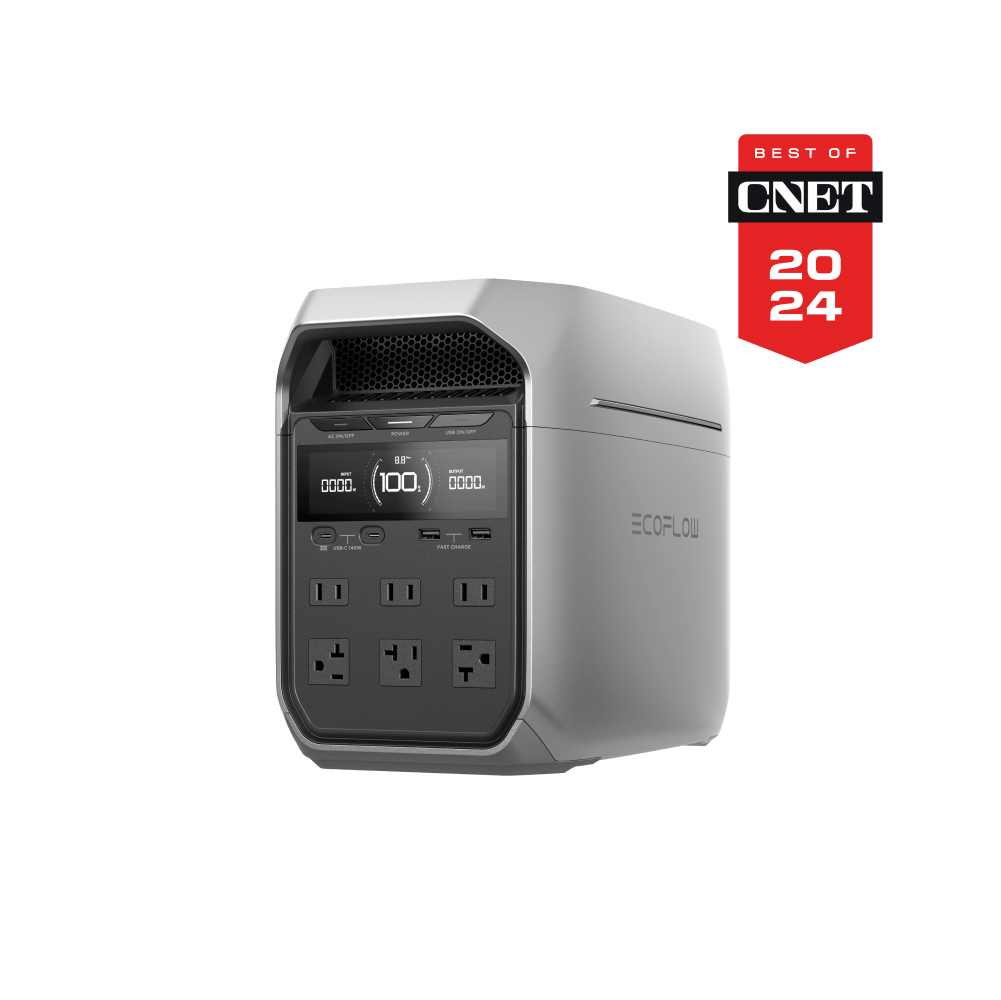
On the output side, the Plus has six 120 V AC receptacles with 1,800 W rated continuous output and 3,600 W surge. It includes a 12 V car-style output rated up to 126 W, plus USB-A and USB-C ports. Its 140 W USB-C maximum is per port; it does not mean every computer will draw 140 W, and it is not safe to add the two port maxima and assume all USB-C combinations hold that level. The cable and device must negotiate the appropriate Power Delivery profile. EcoFlow lists two USB-A ports with 36 W maximum output in its US page; that figure should not be mistaken for 36 W per USB-A port.
EcoFlow lists X-Boost up to 2,200 W for this model, while rated AC output remains 1,800 W. X-Boost is not equivalent to a normal higher-wattage supply. The manual says it can change voltage characteristics, is not suitable for voltage-protected equipment and cannot be used during AC input/bypass. Treat compressor startup, heaters, pumps and other loads according to their own labels and instructions, not X-Boost headline wattage. A surge rating is similarly a transient specification, not a continuous-output promise.
Expansion and outage considerations
EcoFlow describes supported battery expansion up to 5 kWh for the DELTA 3 Plus. The extra battery is optional and not supplied with the standalone station. Check the compatibility page and the exact accessory model before counting expansion in a plan; combined batteries change how the system is handled and add mass. The Plus weighs about 12.5 kg (27.6 lb) by itself, before cables or expansion modules.
The manufacturer lists a 10 ms UPS transfer figure. That may suit some equipment, but there is no one transfer number that proves every PC, network device or appliance can switch without interruption. The product manual also warns not to use the station for life-sustaining medical equipment. For a refrigerator or another intermittent load, inspect the AC timeout behavior and app settings, then verify that it stays on through the actual cycling routine; do not leave a critical load untested. Maintain the recommended ventilation and keep the station dry—the Plus family’s battery-pack IP rating must not be generalized into a waterproof rating for the whole power station.
Like any portable station with standard outlets, its output is not a license to energize house wiring through a receptacle or improvised cord. A transfer arrangement must be correctly designed and installed for the specific service and electrical code. This unit is a US 120 V source; the two outlet banks do not make 240 V split-phase output.
Choose it over the siblings only for a reason
Against the regular DELTA 3, the Plus costs you neither battery capacity nor rated AC output; it adds the higher solar ceiling and stronger USB-C. If you do not need either, the regular model already has a 12 V output and expansion capability. Against the Classic, the Plus adds expansion and 12 V DC as well as the stronger inputs and USB-C, while the Classic is a simpler fixed-capacity station with a lower listed weight and 1,400 W AC input. None is a 240 V whole-home system, and none gives a load-specific delivered-AC-energy guarantee from its 1,024 Wh nameplate.
This image on the official product page includes a CNET Best of 2024 badge, but the badge is promotional artwork rather than an independent test by this guide. I have not handled or bench-tested the Plus. If your shopping decision depends on charge rate, appliance startup, expansion compatibility or exact runtime, take the relevant manual to the decision and verify the proposed setup before relying on it. The solar input guide, expansion guide and family comparison clarify where this configuration’s extra capability is material.
Key details at a glance
| Nameplate battery capacity | 1024 Wh |
|---|---|
| Rated AC output | 1800 W |
| Manufacturer surge rating | 3600 W |
| Maximum solar input | 1000 W |
| Maximum USB-C output per port | 140 W |
| Listed weight | 27.6 lb |
| Compatible extra-battery expansion | Yes |
| 12 V DC output | 126 W |
| Maximum AC recharge input | 1500 W |
| Manufacturer UPS transfer figure | 10 ms |
| X-Boost figure (not rated output) | 2200 W |
| Base warranty term | 5 years |
| USB-C ports | 2 |
| USB-A ports | 2 |
| Solar input ports | 2 |
| Battery chemistry | LFP |
Use the exact model’s instructions for operating limits, supplied equipment and version differences.
Sources for this assessment
A useful match starts with the loads that matter.
Use the finder for hard electrical requirements, then check appliance starting behavior, actual run time and the exact package in the full assessment.