
Your needs, this model
Does it fit your priorities?
Will your equipment run from the station's 120 V US outlets?
The reviewed US configuration is rated for 120 V AC output. It is not a 240 V or split-phase source; check each appliance's voltage and starting draw.
Explore this need in the finder →Would a compatible extra battery later be useful?
The DELTA 3 supports compatible EcoFlow battery expansion, with the product page describing up to 5 kWh capacity. The extra battery is not part of the standalone station listing used here; verify the exact compatible battery and combined configuration before buying.
Explore this need in the finder →Do you need the stronger 140 W USB-C port or two solar inputs?
No. This model's USB-C ports are rated up to 100 W each, and its solar input is a single 500 W maximum. For a source-supported 140 W USB-C port or 1,000 W total solar input, the DELTA 3 Plus is the closer variant.
Explore this need in the finder →The useful middle of the family
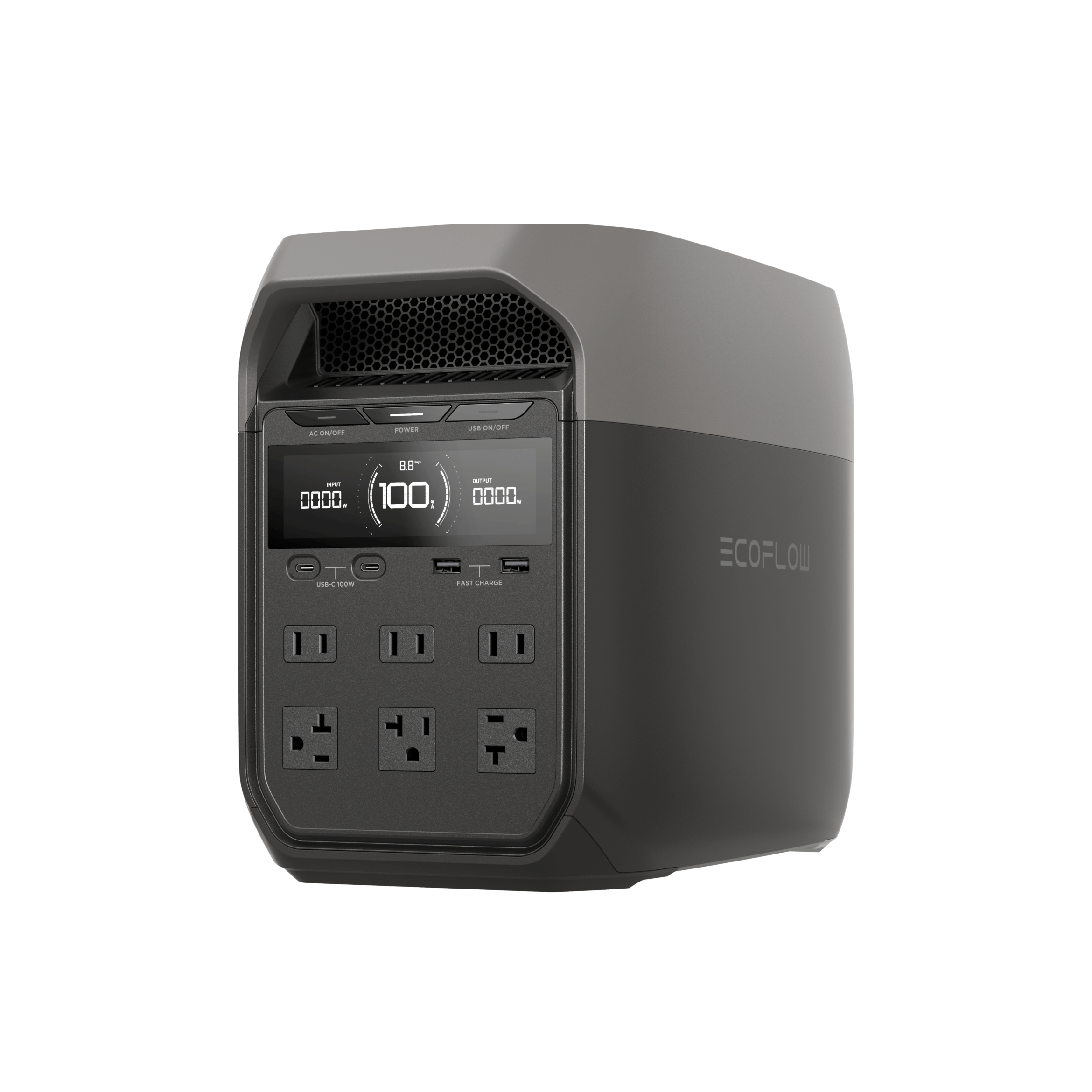
The EcoFlow DELTA 3 is the 1 kWh-class option for shoppers who want more than a basic AC-only battery but do not need the Plus model’s two solar inputs or its 140 W USB-C ports. Its US configuration combines a 1,024 Wh lithium iron phosphate (LFP) battery with 1,800 W of rated 120 V AC output, six AC outlets, a 12 V car-style output, two USB-C ports rated up to 100 W each, and support for compatible extra-battery expansion. Its manufacturer model is EF-DL-H10-3; the US standalone retail SKU shown on EcoFlow’s product page is EFDELTA3-US. Those identifiers matter because a product title that says simply “DELTA 3” may also describe a bundle or a different regional package.
This assessment is based on EcoFlow’s US product information and the corresponding manual, not a hands-on load test. The numbers explain what the unit is designed to support; they do not prove that a refrigerator will start, that an appliance will run for a stated number of hours, or that all ports can deliver their advertised maxima at once. If you need a feature to be a hard condition, verify that it is shown for the exact model and package you are considering.
Capacity and output are different questions
The 1,024 Wh figure is the battery’s nameplate capacity. It is not a promise that 1,024 Wh will be delivered through AC outlets: inverter conversion, standby use, load shape, temperature and operating settings all matter. EcoFlow does not give a reviewed, load-specific AC-delivered-energy figure for this model. That missing figure is consequential if you are sizing a medical device, refrigerator or other essential load against a precise runtime. Measure the actual appliance draw, allow a reserve and test a non-critical setup rather than turning nameplate capacity into an hours claim.
EcoFlow lists 1,800 W AC output and a 3,600 W surge rating. The separate X-Boost claim is up to 2,200 W; neither the surge nor X-Boost number should be read as a new continuous rated-output specification. The manual warns that X-Boost changes the output characteristics and is unsuitable for equipment with voltage-protection requirements. It is disabled by default on the DELTA 3 and unavailable in AC input/bypass operation. For an appliance that is sensitive to voltage or has a demanding compressor/motor start, rely on the appliance and station instructions and a compatible test, not a marketing wattage comparison.
Charging and connected devices
The 500 W maximum solar input is the main practical distinction from the Plus. It has one solar input; the panel string, voltage, current and connector have to remain within the manual’s limits. A panel labelled 500 W will not necessarily yield 500 W in ordinary outdoor conditions. Orientation, shade, temperature, cable run and sunlight change the real input. EcoFlow also lists up to 1,500 W AC charging input. A faster wall recharge is useful when there is a limited interval before an outage, but it does not enlarge the stored capacity.
For small electronics, the two 100 W USB-C ports are more than enough for many devices, but 100 W is a port ceiling and depends on USB-C Power Delivery negotiation and the connected cable. Two USB-A ports are rated up to 18 W. The car-style socket is rated up to 126 W, useful for compatible 12 V accessories; confirm plug type, current and continuous load on the accessory itself. There is no reason to buy the DELTA 3 just for the raw count of 13 outputs—think instead about which devices need AC, USB-C or 12 V DC at the same time.
Expansion, portability and outage use
EcoFlow describes compatible extra-battery expansion up to 5 kWh. That is an expansion capability, not included energy: the standalone station reviewed here does not include a spare battery. The exact accessory family, cable and combined operating instructions should be checked before treating the expanded capacity as part of a preparedness plan. Expansion makes the DELTA 3 more adaptable than the Classic, but also makes the system heavier and more expensive to own than a single unit.
At about 12.5 kg (27.6 lb), the station is portable in the sense that one person can move it between a car, garage and room, but it is not a featherweight power bank. Leave room around the vents and place it on a dry, stable surface. EcoFlow lists a standby UPS transfer figure under 10 ms on the product page; the manual describes a 10 ms switching figure. That is a useful continuity feature for some electronics, not a universal guarantee that every computer or appliance will ride through a transfer. The manual specifically cautions against using the station for life-sustaining medical equipment. It is also not a way to backfeed a home circuit: use only a properly installed transfer arrangement designed for the application.
When another variant makes more sense
Choose the DELTA 3 Plus if your real bottleneck is solar recharge: its two inputs allow up to 1,000 W total, with a 500 W ceiling per input, and its USB-C ports are rated up to 140 W each. Choose the DELTA 3 Classic if you do not need expansion or 12 V DC output and would prefer the lighter listed weight and lower AC-input ceiling; its USB layout is also different. All three remain 1,024 Wh, 1,800 W-rated AC stations, so stepping sideways within the family does not solve a shortfall in capacity or continuous inverter output. See the side-by-side family guide and capacity and runtime guide before deciding.
For a fit check, begin with each load’s running watts, startup behavior, voltage and likely hours of use. Then decide whether recharge speed, USB-C power, a 12 V outlet or expansion is essential. The shortlist finder can screen those published requirements; it cannot substitute for your own appliance list or a manufacturer-approved installation plan.
Key details at a glance
| Nameplate battery capacity | 1024 Wh |
|---|---|
| Rated AC output | 1800 W |
| Manufacturer surge rating | 3600 W |
| Maximum solar input | 500 W |
| Maximum USB-C output per port | 100 W |
| Listed weight | 27.6 lb |
| Compatible extra-battery expansion | Yes |
| 12 V DC output | 126 W |
| Maximum AC recharge input | 1500 W |
| Manufacturer UPS transfer figure | 10 ms |
| X-Boost figure (not rated output) | 2200 W |
| Base warranty term | 5 years |
| USB-C ports | 2 |
| USB-A ports | 2 |
| Solar input ports | 1 |
| Battery chemistry | LFP |
Use the exact model’s instructions for operating limits, supplied equipment and version differences.
Sources for this assessment
A useful match starts with the loads that matter.
Use the finder for hard electrical requirements, then check appliance starting behavior, actual run time and the exact package in the full assessment.