
Your needs, this model
Does it fit your priorities?
Does a 110 V household-output plan fit your exact load, without requiring a 120 V or 240 V station?
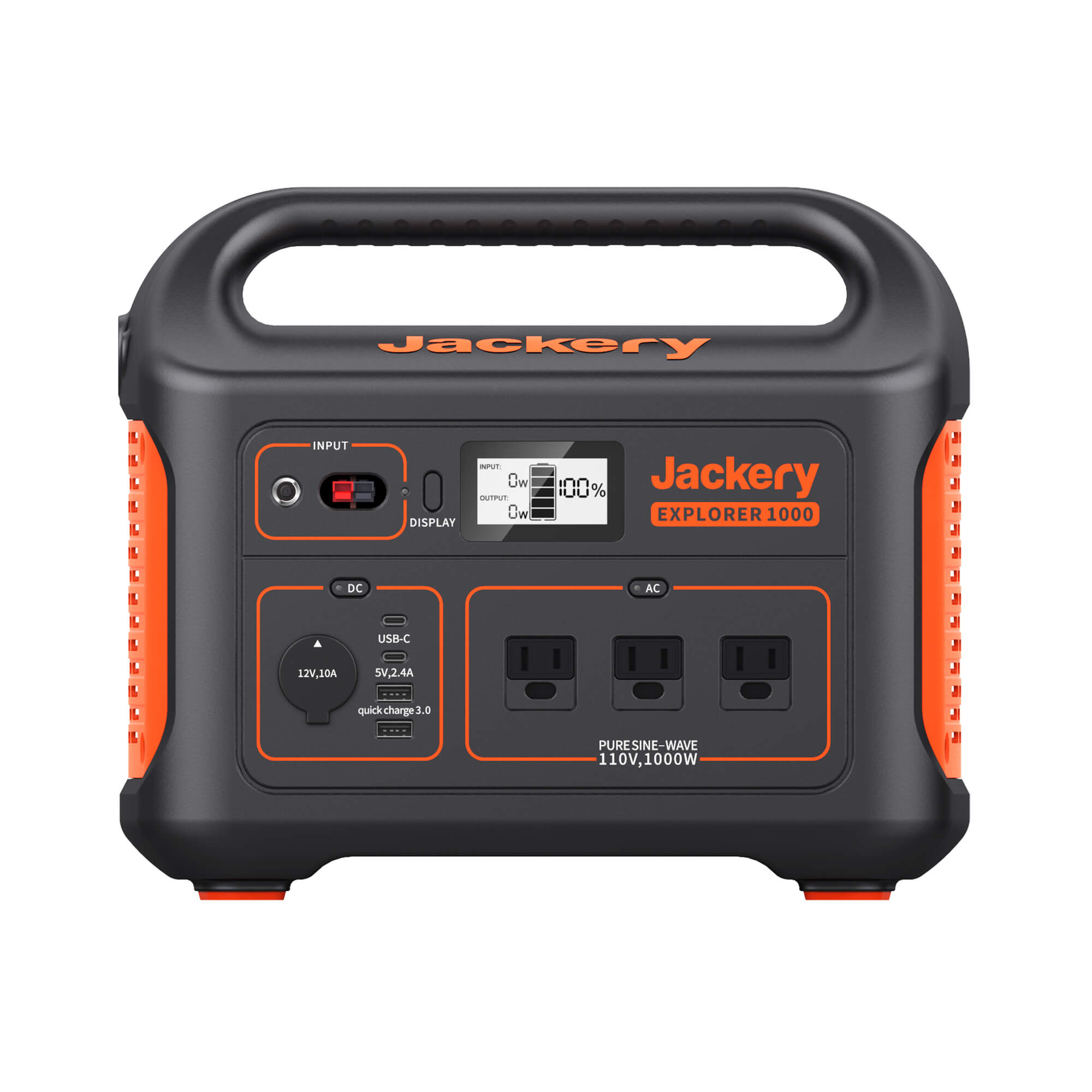
The original Explorer 1000 is listed at 110 V/60 Hz with 1,000 W continuous output and 2,000 W surge. It is not the 120 V JE-1000D Explorer 1000 v2, and its older exact SKU was unavailable in the checked product data.
Explore this need in the finder →Can you use the fixed-capacity station with either a 12 V vehicle charging route or up to two compatible solar panels, without expecting a supplied panel?
The manual lists an included car lead and Y-parallel cable; one panel can use the supported path, and two optional SolarSaga 100 panels use the Y cable. The exact station-only package list does not include a panel. The official sources give different solar recharge-time examples, so do not buy on a promised number of hours.
Explore this need in the finder →Is a fixed-capacity earlier station acceptable, without requiring a supported battery expansion route?
The manual says the output must be enabled manually and states the Explorer 1000 is not a UPS. Support says app control and expansion batteries are not supported; this answer assumes neither feature is essential.
Explore this need in the finder →The original Jackery Explorer 1000 is an earlier, fixed-capacity station for a specific kind of plan: 110 V AC equipment that stays within 1,000 W continuous output, with about one kilowatt-hour of nameplate storage and a carry handle. It should not be confused with the newer Explorer 1000 v2. The older U.S. retail variant reviewed here is SKU 70-1000-USO001; Jackery’s current product-option data marked that variant unavailable when checked. The same web route also contains a current 1,070 Wh JE-1000D v2 and a solar-panel bundle, so its shared “Explorer 1000” name and current card copy are not enough to identify a particular unit.
Start with the voltage and watt ceiling
The English manual and Jackery’s product technical section describe a 1,002 Wh lithium-ion battery, three 110 V/60 Hz AC outlets, 1,000 W maximum continuous output and 2,000 W surge peak. The peak is not a second continuous rating. It fits lights, communications gear, camera batteries or selected small appliances only when combined steady and start-up demand stay within the rating. It is not a 240 V source, and 110 V is not a confirmed 120 V plan. If your appliance requires 120 V or more than 1,000 W continuous, compare an exact model rated for that requirement; the newer 1000 v2 is a separate 120 V/1,500 W design.
One kilowatt-hour is the battery’s nameplate energy, not a promise that a 1,002 Wh load can be delivered through the AC inverter. Conversion loss, the appliance’s actual draw, temperature and cutoff behavior affect runtime. The manual offers example runtimes and an 85% estimate formula, not measurements for your appliance. Check actual draw and compressor or motor start-up rather than treating the surge figure as a guarantee.
Ports support several small-device jobs
Besides the three AC sockets, the manual lists one 12 V/10 A car-style outlet (120 W), two USB-C PD ports rated up to 18 W each, one 5 V/2.4 A USB-A port, and a separate Quick Charge 3.0 USB-A port rated up to 18 W. These are useful for mixing ordinary AC devices with phones, tablets and accessories. Port maxima should not be added as if every connector can supply its top rating at once; the load plan still has to respect the station’s overall limits. The manual’s diagram also shows an LED flashlight, but the current support table marks LED lighting unsupported, so do not make the flashlight a must-have without checking the exact unit in hand.
Solar is possible, but do not buy from the panel count alone
The manual documents 12–30 V DC input at 7.5 A and shows one optional SolarSaga 100 panel or two SolarSaga 100 panels joined with the supplied Y-parallel cable. The two panels are not bundled with the station. The product has two physical charging connectors, DC7909 and Anderson, but Jackery’s support page says the inputs cannot be used at the same time; they are not two independent solar channels. The two-panel plan uses the Y cable. Confirm that a panel and connector are compatible with the voltage/current limits before connecting it.
Do not treat a 200 W panel nameplate as a guaranteed 200 W of delivered input. The manual says roughly 17 hours for one SolarSaga 100 or eight hours for two, while Jackery’s later support table gives different SolarSaga 100 estimates. Weather, sunlight, angle and source-version differences are unresolved. Plan for solar as a variable refill route, not as a fixed daily energy supply. A vehicle-charge path is also documented; the manual lists an included car cable and about 14 hours. AC wall charging is about 7.5 hours. These are manufacturer scenarios, not a tested promise for every source or condition.
Earlier design, with several limits worth knowing
The model is a fixed-capacity lithium-ion/NCM station, with no supported expansion battery and no app control. The manual says its outputs must be turned on manually and explicitly says it cannot be used as a UPS; a pass-through feature does not make it an automatic backup for critical electronics. Jackery’s support material says pass-through charging is supported but the manual cautions against routine use because it may damage battery life. Keep that distinction in mind if you hoped to leave the station permanently connected to an outage-sensitive device.
Some official information for this older model disagrees. The linked product technical section and manual state 800 cycles to 80%+ capacity, while Jackery’s current U.S. Basic Information and series-comparison articles state approximately 500 cycles without the same retention endpoint. The product specs/manual give 22.04 lb and 13.1 × 9.2 × 11.1 inches; support reports about 10.6 kg and a shorter height. These contested figures are not hard weight/dimension filters here; verify clearance or carry weight if close. Official sources also differ on solar-time examples.
When to compare the newer 1000 v2 instead
These two “1000” stations serve different electrical plans. The older Explorer 1000 is 110 V, 1,000 W continuous and NCM; the Explorer 1000 v2 is the distinct JE-1000D, with 120 V, 1,500 W continuous, LiFePO4 chemistry, app control and a much faster wall-charge design. Neither name nor shared product page makes their parts or measurements interchangeable. See the Explorer 1000 v2 review for that current-reference configuration. A requirement for expansion should also be checked against a separate expansion-capable model rather than assumed from the 1000-series name.
Choose it only to identify an earlier offer whose fixed-capacity, 110 V/1,000 W plan fits. The recorded U.S. SKU was unavailable in the manufacturer snapshot, so this page is useful for identifying an existing unit or understanding a secondhand listing—not a claim that Jackery currently sells this base variant. For a new purchase, compare current models against the load and label requirements; the shared “1000” name does not identify one electrical configuration.
Key details at a glance
| Nameplate battery capacity | 1002 Wh |
|---|---|
| Rated AC output | 1000 W |
| Manufacturer surge rating | 2000 W |
| Maximum solar input | 200 W |
| Included panels, combined nameplate | 0 W |
| Maximum USB-C output per port | 18 W |
| Compatible extra-battery expansion | No |
| 12 V DC output | 120 W |
| Maximum AC recharge input | 180 W |
| Base warranty term | 2 years |
| AC outlet output | Yes |
| USB-C ports | 2 |
| USB-A ports | 2 |
| Solar input ports | 2 |
| 12 V car-style output | 120 W |
| Battery chemistry | NCM lithium-ion |
| Home Power Panel in this package | No |
| Separate station units in offer | 1 |
Use the exact model’s instructions for operating limits, supplied equipment and version differences.
Sources for this assessment
- Jackery U.S. Explorer 1000 product route (legacy option and current v2 options)
- Jackery U.S. Explorer 1000 product option JSON
- Jackery Explorer 1000 User Manual, English section; Model Explorer 1000; version JAK-UM-V1.0
- Jackery U.S. Explorer 1000 Basic Information
- Jackery U.S. comparison: Explorer 1000, 1000 Pro, 1000 Plus and 1000 V2
- Jackery U.S. Explorer 1000 legacy-option rendering
- Official CPSC recalls API query for Explorer 1000

A useful match starts with the loads that matter.
Use the finder for hard electrical requirements, then check appliance starting behavior, actual run time and the exact package in the full assessment.