
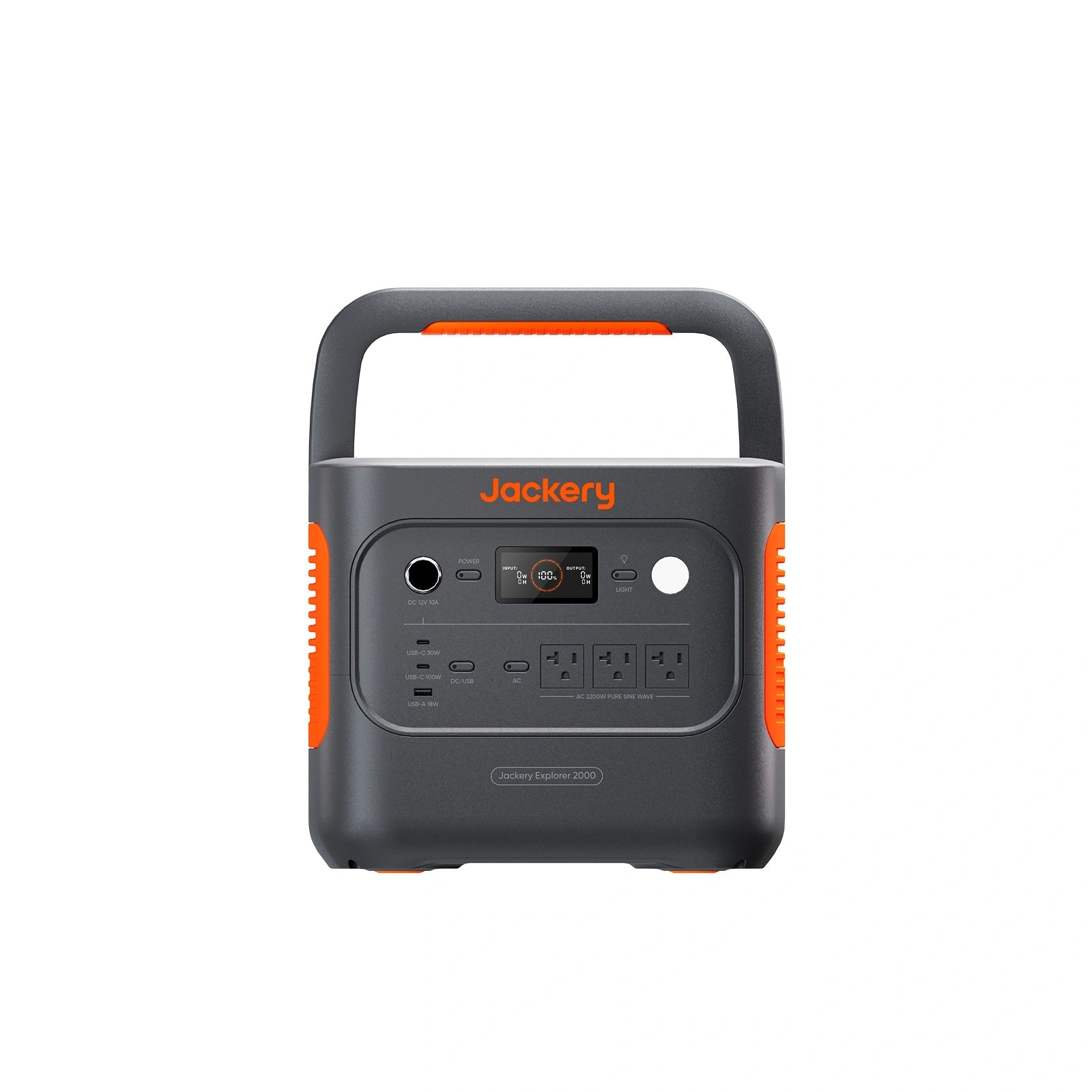
Your needs, this model
Does it fit your priorities?
Does this exact package meet a 120 V, 2,200 W continuous station requirement?
The JE-2000D is documented for 120 V AC, 2,200 W rated total output and 4,400 W peak. Peak is not continuous; startup and simultaneous loads need their own margin.
Explore this need in the finder →Must the package include solar panels, and what total panel nameplate is needed?
This exact offer includes no solar panel. A station solar input does not imply a panel is in the box.
Explore this need in the finder →Must all supplied panels work together within the station’s published ratings at nameplate power?
This exact offer cannot pass a full-nameplate all-panels condition: it has no panel in box.
Explore this need in the finder →Is the exact package warranty and accessory set suitable for your need?
The exact offer does not include a carry bag; new-package warranty is shown as 3+2 years on Jackery.com.
Explore this need in the finder →Do you require a new, non-refurbished unit?
The exact page variant is a new retail offer, not the separately listed refurbished SKU.
Explore this need in the finder →This assessment covers the Jackery Explorer 2000 v2 U.S. standalone configuration, exact offer SKU 21-0001-000266 (station model JE-2000D). Jackery’s U.S. listing also groups the Extreme Kit and solar bundles on related product routes; those are different boxes and have separate reviews here. The station-only choice is the cleanest way to buy the core unit when you already own compatible solar gear or do not need accessories in the package.
A large fixed-capacity station for 120-volt loads
The manual lists 2,042 Wh of LiFePO4 storage and 2,200 W of rated AC output at 120 V, with a 4,400 W surge figure. Those are different limits: a brief surge allowance does not mean a 4,400 W appliance can run continuously. Check the appliance’s running input and its startup demand against the 2,200 W ceiling, and leave margin for simultaneous loads. The manual does not publish AC-delivered energy for a stated load, so 2,042 Wh is not a guaranteed runtime calculator. Inverter losses, cycling and reserve all matter.
Three AC outlets share the inverter. The front panel also has USB-A rated up to 18 W, two USB-C outlets listed at 100 W and 30 W, and a 12 V/10 A car-style socket. These outputs are useful for mixing small electronics with AC equipment, but port maxima are not a promise that every maximum can be drawn simultaneously. The model is not a substitute for a hard-wired whole-home system, and the available sources do not establish a household transfer-switch package with this exact standalone SKU.
Charging inputs have limits; no battery expansion
Jackery’s documentation gives the station two parallel solar input ports, 16–60 V, a 400 W combined solar ceiling and current limits that need to be observed per input and in total. It does not support an add-on battery pack. That makes the capacity a fixed planning quantity: if your essential load list would need more than a little over two kilowatt-hours of nameplate storage, consider a larger expandable station rather than expecting a future capacity upgrade. The 20 ms automatic transfer claim is a short interruption, not a zero-millisecond UPS; Jackery cautions against relying on this behavior for servers, workstations or critical equipment.
The base package is not a solar kit. If solar is essential, choose a bundle with an explicitly named panel and required leads, or verify compatibility and cable requirements for gear you already own. The station’s 400 W maximum also remains the ceiling even when the nameplate total of supplied panels is higher. Solar ratings describe test-condition maxima, not a field charging rate; shade, angle, temperature and cabling change actual input.
Which package changes your answer?
Choose this standalone review when you need the JE-2000D itself but want to source solar separately, and you are comfortable checking the exact array and cable setup. If you want a protective heated carry bag in the same offer, the Extreme Kit adds that accessory but not additional AC power or storage. For panels included at the outset, compare the two SolarSaga 100 Air bundle, the two-panel SolarSaga 200 W package, and the SolarSaga 500 X offer. Their included gear and input tradeoffs are not interchangeable.
The refurbished Explorer 2000 v2 is another exact listing, but its six-month warranty and unspecified battery-condition grading make it a different risk decision—not a discounted proof-equivalent to a new unit. If warranty length or used-battery condition is essential, prefer the new standalone or a clearly documented package. Buyers who need 240 V, supported battery expansion, weatherproof operation or a verified full-home backup interface should rule this unit out before comparing convenience features.
Bottom line
The JE-2000D standalone is most defensible for a buyer who wants about 2 kWh of fixed storage, 120 V/2,200 W AC capability, a mixed USB/DC port set and the freedom to choose a compatible solar arrangement later. Its central tradeoff is not hidden: you get the station and its documented limits, but not a panel, carry bag, expansion route or included transfer-switch system. Decide from the essential loads and one supported charging plan rather than treating the SKU family’s bundle photos, peak wattage or solar-panel nameplate as promises about this particular box.
Key details at a glance
| Nameplate battery capacity | 2042 Wh |
|---|---|
| Rated AC output | 2200 W |
| Manufacturer surge rating | 4400 W |
| Maximum solar input | 400 W |
| Included panels, combined nameplate | 0 W |
| Maximum USB-C output per port | 100 W |
| Listed weight | 39.5 lb |
| Compatible extra-battery expansion | No |
| 12 V DC output | 120 W |
| Maximum AC recharge input | 1800 W |
| Manufacturer UPS transfer figure | 20 ms |
| Base warranty term | 5 years |
| AC outlet output | Yes |
| USB-C ports | 2 |
| USB-A ports | 1 |
| Solar input ports | 2 |
| 12 V car-style output | 120 W |
| Battery chemistry | LiFePO4 |
| Home Power Panel in this package | No |
| Separate station units in offer | 1 |
| Solar panels in exact offer | 0 |
Use the exact model’s instructions for operating limits, supplied equipment and version differences.
Sources for this assessment
- Jackery U.S. exact Explorer 2000 v2 product/package page
- Jackery U.S. selected option JSON
- Jackery U.S. alternate Explorer 2000 v2 route
- Jackery U.S. alternate route option JSON
- Jackery Explorer 2000 v2 User Manual, model JE-2000D
- Jackery Explorer 2000 V2 Basic Information
- CPSC search snapshot
- Exact U.S. selected-option manufacturer image

A useful match starts with the loads that matter.
Use the finder for hard electrical requirements, then check appliance starting behavior, actual run time and the exact package in the full assessment.