
On this page
Your needs, this model
Does it fit your priorities?
Does the selected E3800LFP package meet a 11,520 Wh nameplate minimum at 120 V and 4,200 W?
The selected SKU has one E3800LFP station and 2 EP3800-48V pack(s), for 11,520 Wh combined nameplate capacity; the station output remains 4,200 W at 120 V.
Explore this need in the finder →Must the exact offer include a compatible expansion battery rather than only support one as a separate purchase?
Yes for this configuration: the captured U.S. selected option SKU E3800LFP-2*EP3800-48V names 2 EP3800-48V pack(s). The cable contents remain unconfirmed.
Explore this need in the finder →Is the station’s documented 3,000 W maximum solar-input ceiling sufficient even though this battery bundle includes no panels?
The E3800 station documents two XT60 inputs and up to 3,000 W combined within its stated voltage range, but the selected EP3800 option does not include solar panels.
Explore this need in the finder →Pecron · E3800LFP with two EP3800-48V batteries
Pecron E3800LFP with two EP3800-48V batteries review
The U.S. selected option E3800LFP-2*EP3800-48V names one E3800LFP power station and two EP3800-48V expansion batteries. The station’s own manual lists 3,840 Wh and allows up to six of these packs; Pecron’s EP3800 manual lists 3,840 Wh per pack. The arithmetic for this selected arrangement is 11,520 Wh of combined nameplate storage. The station itself is still rated at 4,200 W for 120 V AC output.
Storage grows; output does not
Two packs make sense when the central problem is energy reserve across a long interruption, not a short, high-watt surge. They add 7,680 Wh of nameplate storage to the station, but they do not make the E3800 a second inverter, change its AC output voltage, or increase its 4,200 W continuous rating. A need for 240 V service is not met by this one-station, two-battery SKU. Pecron’s separate 240 V arrangement uses two E3800LFP stations and a connection box, so verify the exact model and wiring plan rather than treating a pair of expansion batteries as an electrical phase converter.
Capacity is not runtime. A battery’s nameplate watt-hours do not equal guaranteed AC energy delivered to an appliance. Inverter conversion, the appliance’s real draw, startup behavior, cycling, temperature and reserve settings all matter. Do not turn 11.52 kWh into a promised number of hours for a refrigerator, furnace, tool or medical device. For critical loads, calculate from the actual equipment documentation and keep an appropriate backup plan.
Three large pieces of equipment
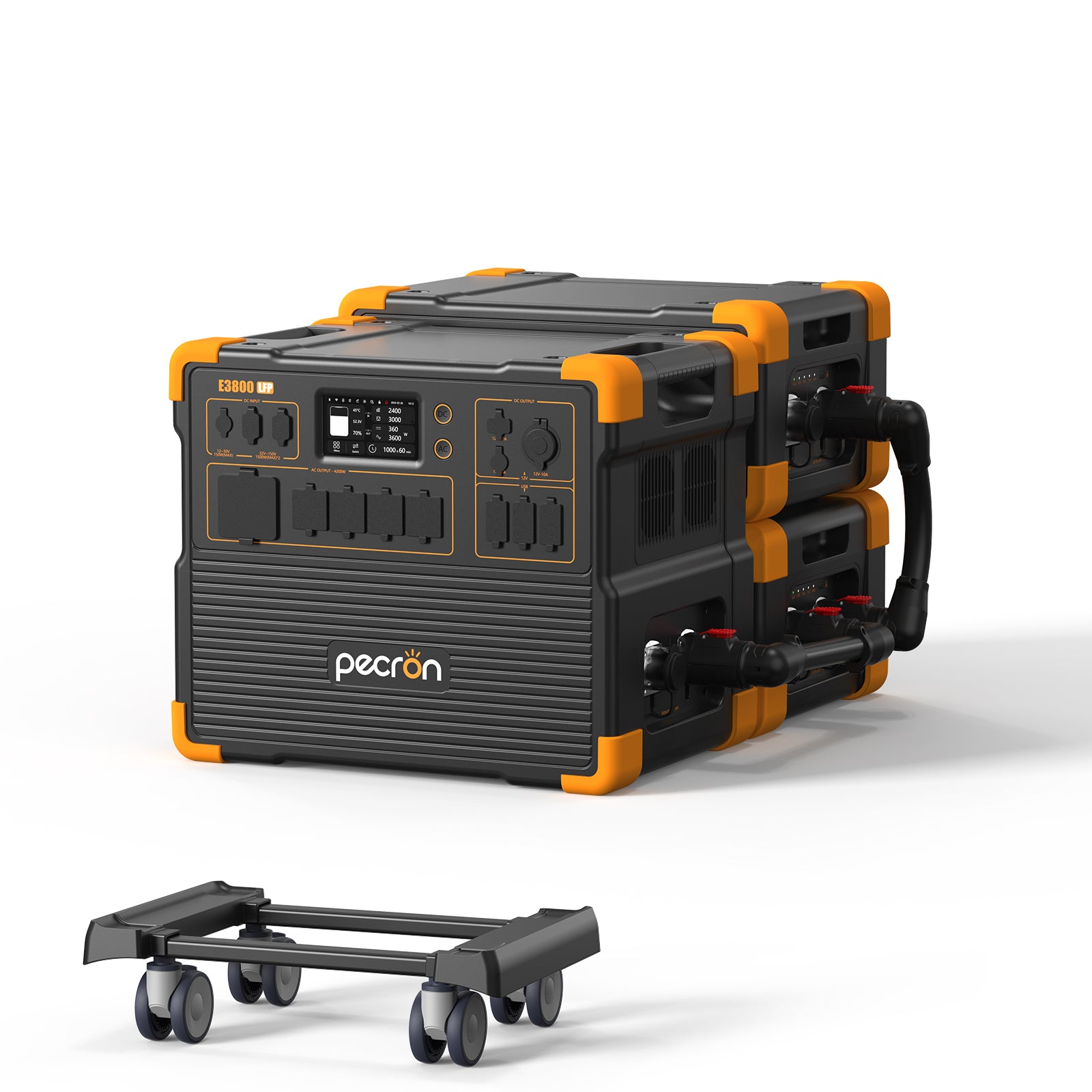
Pecron lists the E3800LFP at about 87.3 lb and each EP3800-48V at about 66.8 lb. This configuration therefore totals roughly 220.9 lb before connection leads and any trolley. The advantage is that the station and batteries are separate modules rather than one 221 lb box; the disadvantage is that all three still need safe placement, ventilation and a sound floor. Map the route into the room before choosing the location, and do not plan to repeatedly move the complete connected set as if it were a wheeled suitcase.
The image for this selected option shows the station, two packs and connecting leads. The official E3800 manual describes the MJ32 cascade system, recommends the official cable for a six-pack connection, and explains serial-number settings and pack balancing. The selected SKU confirms the two batteries, but its captured option details do not establish the exact cable model or the full cable list in the box. Confirm that the correct Pecron cascade cable is supplied or obtain the manufacturer-approved part before relying on the connected configuration. The manual also notes that closer state of charge helps the system balance more quickly.
Solar is another separate decision
The E3800LFP station supports two XT60 solar inputs with a published total ceiling of 3,000 W—up to 1,500 W per input—inside the listed 32–150 V range. This selected offer names two expansion batteries, not solar panels. A high solar-input rating does not identify a compatible panel set or mean the package includes one. Choose panels only after checking their voltage and current against the manufacturer’s limits, including conditions that affect open-circuit voltage, and confirm the appropriate cable path. If an included-panel requirement is essential, select a solar-bundle SKU instead.
The E3800’s separate vehicle input and AC recharge options also remain station features; adding packs does not establish a faster charging rate. Charging time depends on the accepted input, simultaneous loads and battery state. Use the current manual rather than guessing from the total nameplate capacity.
Compare it with one pack or the station alone
The standalone E3800LFP has 3,840 Wh of station capacity and the same 4,200 W output, so it avoids the two added modules if that storage is adequate. The one-EP3800 option is the middle configuration at 7,680 Wh nameplate. This two-pack offer is the one to investigate when the higher energy reserve is worth the additional equipment and setup. For a lighter, lower-output system, the E1500LFP V3 plus one EP3800 is a distinct 120 V arrangement; it should not be selected if your load requires the E3800’s 4,200 W rating.
Set the finder to the real need
Choose 120 V, require AC output, and set the minimum-capacity field to 11,520 Wh if that is a true requirement. A 11,521 Wh threshold is beyond this selected two-pack plan; the one-pack option also falls short at 7,680 Wh. Requiring an expansion battery included in the exact offer will separate both bundle choices from the E3800 station-only listing. The expansion choice means a compatible add-on is present—not that the cord contents are verified or that the system is 240 V.
This is best approached as a fixed energy system for a defined load plan. If your site cannot accommodate about 221 lb of station-and-battery equipment, the nominal capacity is not useful. If your essential load exceeds 4,200 W, uses 240 V, or depends on panels being included, this selected SKU does not satisfy that need. Confirm the exact battery count, cable, accessory list and live availability against the selected U.S. variant before buying; neither a render nor a product title substitutes for a complete order-specific box list.
Key details at a glance
| Nameplate battery capacity | 11520 Wh |
|---|---|
| Rated AC output | 4200 W |
| Maximum solar input | 3000 W |
| Included panels, combined nameplate | 0 W |
| Maximum USB-C output per port | 100 W |
| Listed weight | 87.3 lb |
More specifications and setup details
| Compatible extra-battery expansion | Yes |
|---|---|
| 12 V DC output | 360 W |
| Maximum AC recharge input | 3200 W |
| AC outlet output | Yes |
| USB-C ports | 2 |
| USB-A ports | 4 |
| Solar input ports | 2 |
| 12 V car-style output | 120 W |
| Vehicle charge input | 150 W |
| Battery chemistry | LiFePO4 |
| Expansion battery in this package | Yes |
| Home Power Panel in this package | No |
| Separate station units in offer | 1 |
| Smart Transfer Switch in this package | No |
| Solar panels in exact offer | 0 |
| Included expansion batteries | 2 units |
Use the exact model’s instructions for operating limits, supplied equipment and version differences.
Sources for this assessment

A useful match starts with the loads that matter.
Use the finder for hard electrical requirements, then check appliance starting behavior, actual run time and the exact package in the full assessment.