
Your needs, this model
Does it fit your priorities?
Will the F1000LFP's fixed 960 Wh and 1,500 W output suit your 120 V load?
This offer retains one 120 V F1000LFP rated at 1,500 W AC and 960 Wh; panel count does not increase the inverter or battery.
Explore this need in the finder →Must the exact box include at least 200 W of panel nameplate?
The exact selected offer lists 1 PECRON PV200 panels, 200 W combined nameplate. It does not establish actual solar harvest or the exact connecting cable.
Explore this need in the finder →Must this station support a compatible expansion battery later?
The exact F1000LFP product page and manual reviewed for this assessment do not establish a supported expansion battery; unknown support does not meet an essential expansion requirement.
Explore this need in the finder →Pecron · 960 Wh station with one 200 W panel
Pecron F1000LFP with PV200 review
This selected U.S. F1000LFP offer pairs the station with one PECRON PV200 foldable panel. It is still the same 960 Wh, 1,500 W station assessed in the standalone F1000LFP review; the material difference is one panel in the bundle, not a larger battery or stronger inverter. The manufacturer’s captured product data marked this exact panel option unavailable on October 25, 2026. That dated stock result keeps the configuration in the reference library but should not be mistaken for a live inventory guarantee.
What changes—and what does not
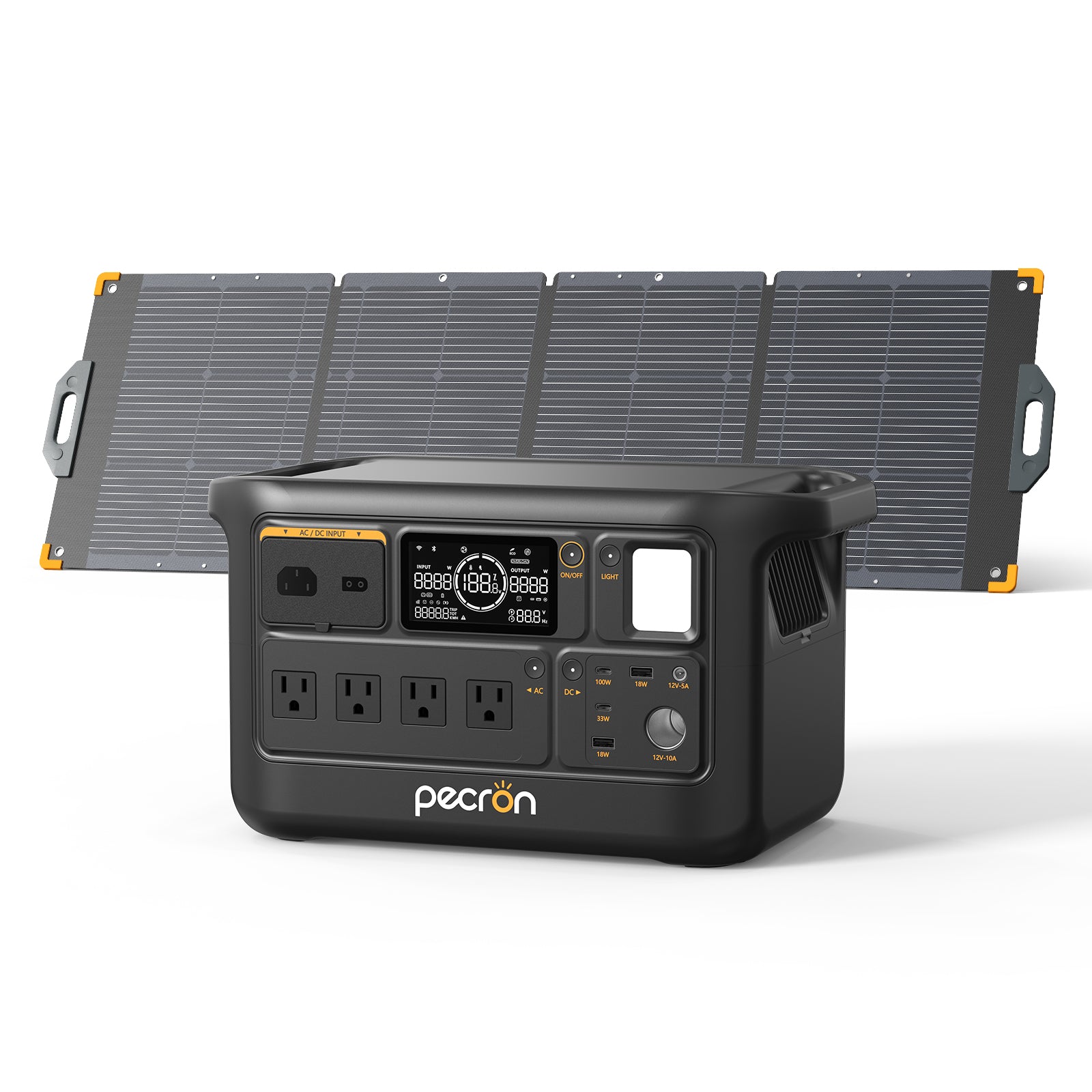
Pecron’s U.S. option code is F1000LFP+PV200, and its linked option image shows one foldable panel with the F1000 station. The manufacturer’s separate PV200 product page identifies the panel as a 200 W, 36 V model with MC4 connectors. That is nameplate panel power, not a promise that the F1000 will receive 200 W continuously or that every hour of sun becomes stored energy. Cloud, angle, shade, dirt, temperature, cable losses, state of charge, and the station’s own charging behavior all affect actual input. The station remains rated at 960 Wh and 1,500 W AC, so the bundle does not solve a too-small battery or an AC load above its rating.
The station’s solar ceiling is a different number: its manual and product page specify one solar input, 11–60 V, up to 600 W and 14 A. A single PV200’s stated 36 V operating voltage and 41.4 V open-circuit figure sit inside that voltage window, while its rated current is about 5.4 A. Those are useful compatibility checks, not evidence that the exact package includes every adapter lead. The panel page lists MC4 at the panel end; the exact offer’s cable contents and the F1000-side connector lead are not separately enumerated in the captured option listing. Confirm the cable and wiring instructions before treating this as ready-to-connect.
A manageable panel, but a separate setup task
PV200 is a four-fold panel. Pecron lists a folded size around 561 × 595 × 40 mm, unfolding to about 2,064 × 595 mm, with a listed weight around 6.9 kg (15.2 lb). Combined with the station’s listed 23.9 lb, it is still a two-piece kit rather than an all-in-one suitcase. The panel’s IP67 rating belongs to the panel only; it does not make the station weatherproof. The F1000 needs shelter and dry, ventilated operation according to its own guidance. Set the panel outdoors with room to unfold and reposition it, then move the station’s charge input out of direct rain, standing water, and damp ground.
The panel is most useful as a way to replenish the battery during a longer outdoor stay or a daylight outage window. It is not an AC generator by itself, and its 200 W label does not mean it will keep a high-watt appliance running while charging. A modest load and intermittent solar recovery are more plausible use cases than continuous heavy AC operation. For a reader whose essential need is only the station’s 600 W input capability, the standalone F1000 can accept a separately chosen panel; this kit’s benefit is that one PV200 is listed with the chosen offer.
How to choose among the F1000 options
The one-panel PV200 kit is the lightest documented panel bundle in this F1000 option family. Two PV200 panels raise the combined nameplate to 400 W but add another panel to carry and deploy. A PV300 kit supplies a higher-rated individual panel, but Pecron lists the PV300 at about 12.74 kg, nearly twice the PV200’s listed weight. The station itself is unchanged in all of these choices. Choose based on the actual setup space, panel load, and whether the package’s combined panel rating matches your practical charging plan—not on a fictional runtime calculation.
For more stored energy or a higher AC ceiling, compare a different station rather than adding panel wattage to this bundle. The F1000 has no confirmed expansion-battery path in the exact manual and product-page evidence reviewed here. The larger E1000LFP has a documented expansion path and a somewhat higher output rating, while the E1500LFP V3 starts with more capacity; both carry a greater lifting burden. If 240 V equipment or multi-day storage is central to the plan, this 120 V, 960 Wh station is the wrong scale.
Who should consider this configuration?
It suits someone who already needs the F1000’s 1,500 W / 960 Wh station and would rather receive one named 200 W panel option than source a panel separately. It is less compelling if the panel must reliably supply a specific daily energy total, if cable contents must be certain before arrival, or if the user expects a single compact carry. Compare the selected-option page carefully, verify the current stock and exact kit contents, and use the manufacturer’s F1000LFP manual together with the PV200 product specifications. The PV200 product page does not link a panel manual in the captured version, so panel setup details beyond its published specifications remain unclaimed.
Key details at a glance
| Nameplate battery capacity | 960 Wh |
|---|---|
| Rated AC output | 1500 W |
| Manufacturer surge rating | 3000 W |
| Maximum solar input | 600 W |
| Included panels, combined nameplate | 200 W |
| Maximum USB-C output per port | 100 W |
| Listed weight | 23.9 lb |
| 12 V DC output | 120 W |
| Maximum AC recharge input | 1000 W |
| AC outlet output | Yes |
| USB-C ports | 2 |
| USB-A ports | 4 |
| Solar input ports | 1 |
| 12 V car-style output | 120 W |
| Vehicle charge input | 120 W |
| Battery chemistry | LiFePO4 |
| Expansion battery in this package | No |
| Home Power Panel in this package | No |
| Separate station units in offer | 1 |
| Smart Transfer Switch in this package | No |
| Solar panels in exact offer | 1 |
Use the exact model’s instructions for operating limits, supplied equipment and version differences.
Sources for this assessment

A useful match starts with the loads that matter.
Use the finder for hard electrical requirements, then check appliance starting behavior, actual run time and the exact package in the full assessment.