
Your needs, this model
Does it fit your priorities?
Does your 120 V load plan need at least 1,536 Wh nameplate and 1,800 W continuous AC?
The U.S. A1772 standalone plan is listed at 1,536 Wh and 1,800 W continuous output. All six AC receptacles share that limit; check startup behavior and do not treat the 2,400 W surge as continuous output.
Explore this need in the finder →Can you use the heavy station as a vehicle or fixed-site unit rather than a frequent long-distance carry?
The A1772 body is listed at 43.7 lb. It is a much heavier carry than the 28.44 lb C1000 or 16.75 lb 535, so set a weight ceiling honestly; it does not fit a 40 lb limit.
Explore this need in the finder →Would a separately purchased compatible solar panel work if the station-side lead is supplied?
The A1772 manual lists its solar charging cable in the box and allows up to 600 W at 11-60 V, with separate current limits by voltage band. It lists no panel in the standalone package, so a panel remains a separate purchase.
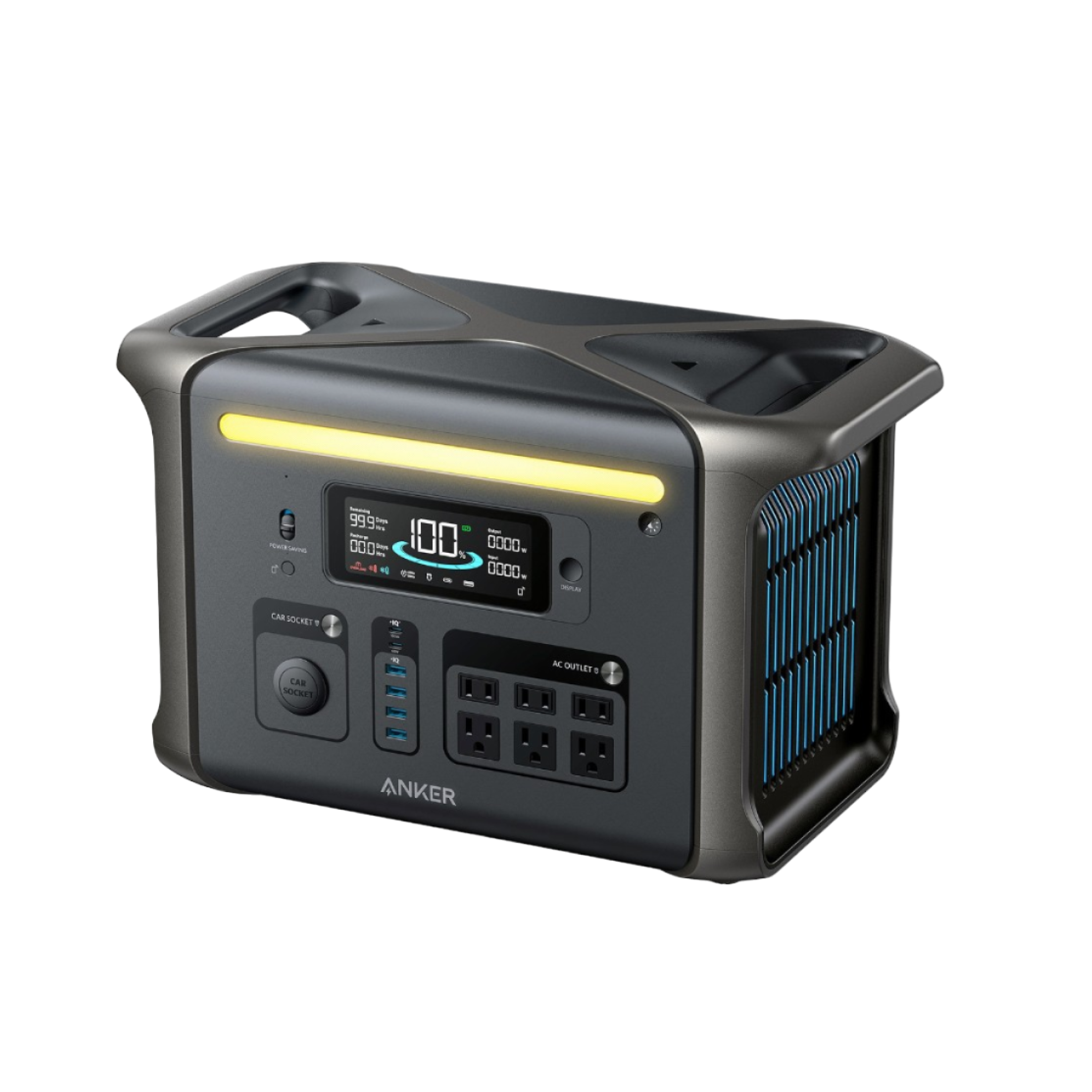
Explore this need in the finder →The Anker SOLIX F1500 suits car-supported backup or camp use when one 120 V station needs more reserve than a small 500 Wh class and up to 1,800 W of continuous AC output. Anker's U.S. page lists the 1,536 Wh standalone F1500; its product number is A1772, with SKU A1772111 and GTIN 194644151775 in the page's structured listing. The A1772 manual confirms its limits. It is distinct from the F1200/757 and F2000/767 names.
A substantial reserve, with a substantial carry cost
Its LiFePO4 battery is rated at 1,536 Wh, and Anker claims 3,000 cycles to 80% capacity. Nameplate capacity is not the energy delivered at AC: inverter losses, idle draw, temperature and the load's own supply all affect runtime. Anker's FAQ offers a rough capacity × 0.8 estimate only for loads of 300 W or greater; it is not a measured result for a particular refrigerator or laptop.
The station weighs 43.7 lb and measures 18.2 × 11.3 × 9.3 inches. It is manageable into a car or around a garage, not a casual carry for repeated stairs or a long walk to a tent. The 535 PowerHouse is 16.75 lb but has 512 Wh and 500 W AC; the SOLIX C1000 lists 1,056 Wh and the same 1,800 W continuous rating at 28.44 lb. The latter trades capacity for easier handling.
Six receptacles do not raise the 1,800 W ceiling
Anker rates the F1500's six 120 V AC outlets at 1,800 W continuous and 2,400 W surge. Those are shared station limits, not six independent 1,800 W circuits. A 1,200 W appliance plus other AC loads must still fit within the total continuous rating, and startup behavior of motors or compressors is a separate question. A stated surge rating does not guarantee that every motor will start or that it can sustain a load above the continuous rating. If your essential device requires 240 V or split phase, this single 120 V plan is not a match.
Four USB-A ports are listed at up to 12 W each; its two USB-C ports are rated 100 W and 60 W. The 12 V / 10 A car-style outlet is rated 120 W. Verify each device's input and connector, and do not add every port maximum as if all outputs were guaranteed at full rating simultaneously. The manual also describes an ambient light and SOS mode.
Solar and car charging are different routes
The manual's box list includes AC, vehicle and solar charging cables, but no panel; the current U.S. selection is the standalone station. Anker rates AC input at up to 1,000 W, solar at up to 600 W through the XT60 input, and vehicle charging at up to 120 W. Solar accepts 11–60 V, with limits of 11–32 V / 10 A and 32–60 V / 12.5 A. Up to three Anker panels can be connected in parallel, subject to the station's 600 W ceiling. Buy a compatible panel separately if needed; no harvest rate or recharge time is promised.
Anker's FAQ says AC input takes priority if AC and DC sources are connected together. Do not add AC and solar maxima as if they were simultaneous. A wall outlet is the direct refill route; the included vehicle lead is slower.
Useful features have boundaries
Anker lists Wi-Fi/Bluetooth app control and a UPS switching time under 20 ms. Initial app setup requires a network connection; after setup it can connect to devices off-grid. Power-saving mode may stop outputs after charging, so disable it for sustained low-draw devices. The manual describes UPS use for office equipment such as PCs and warns against equipment needing extremely high reliability or whose failure could threaten life or safety. Do not treat the feature as a medical-device or life-support guarantee.
Charging is specified from 32–104°F (0–40°C), discharge from -4–104°F (-20–40°C). The guide says to keep it away from rain and snow and that it is not permitted on aircraft. Turn outputs off when idle and store it in a cool, dry place.
Who should choose it?
Choose the F1500 when your measured load fits 120 V / 1,800 W continuous, 1,536 Wh nameplate is useful, and you can handle 43.7 lb. If 1,056 Wh is enough, the lighter C1000 has the same continuous AC rating. If you need more than 1,800 W, 240 V, confirmed expansion or a panel in the box, the standalone F1500 does not meet that documented requirement. Its five-year warranty and 3,000-cycle claim are manufacturer statements, not test results; check current terms and included accessories for the exact sale configuration.
For the electrical limits and setup sequence, consult the Anker SOLIX F1500 A1772 user manual and the Anker SOLIX U.S. F1500 product page.
Key details at a glance
| Nameplate battery capacity | 1536 Wh |
|---|---|
| Rated AC output | 1800 W |
| Manufacturer surge rating | 2400 W |
| Maximum solar input | 600 W |
| Maximum USB-C output per port | 100 W |
| Listed weight | 43.7 lb |
| 12 V DC output | 120 W |
| Maximum AC recharge input | 1000 W |
| Base warranty term | 5 years |
| AC outlet output | Yes |
| USB-C ports | 2 |
| USB-A ports | 4 |
| Solar input ports | 1 |
| 12 V car-style output | 120 W |
| Battery chemistry | LiFePO4 |
Use the exact model’s instructions for operating limits, supplied equipment and version differences.
Sources for this assessment

A useful match starts with the loads that matter.
Use the finder for hard electrical requirements, then check appliance starting behavior, actual run time and the exact package in the full assessment.