
Your needs, this model
Does it fit your priorities?
Is a 3.97 lb station with 128 Wh and one 200 W, 120 V AC outlet enough for your small-load plan?
The exact EL10 standalone plan supplies 128 Wh nameplate and 200 W of rated 120 V AC at about 3.97 lb. The 400 W Power Lifting figure is limited to pure resistive loads and does not increase the rated AC output.
Explore this need in the finder →Would one 100 W maximum solar input and a 100 W USB-C port meet your top-up plan?
The manual lists 100 W maximum solar input within 12–28 V and 8.2 A, plus one 100 W USB-C output. The standalone unit does not include a solar panel or the optional solar charging cable.
Explore this need in the finder →Do you need the compact station to also provide a 12 V car-style output socket?
The EL10 has no car-style output socket. Its DC5521 connector is listed at 13.5 V/5 A by default or 12.5 V/5 A through the app; compatibility depends on the device and cable, and unknowns should not satisfy an essential car-socket requirement.
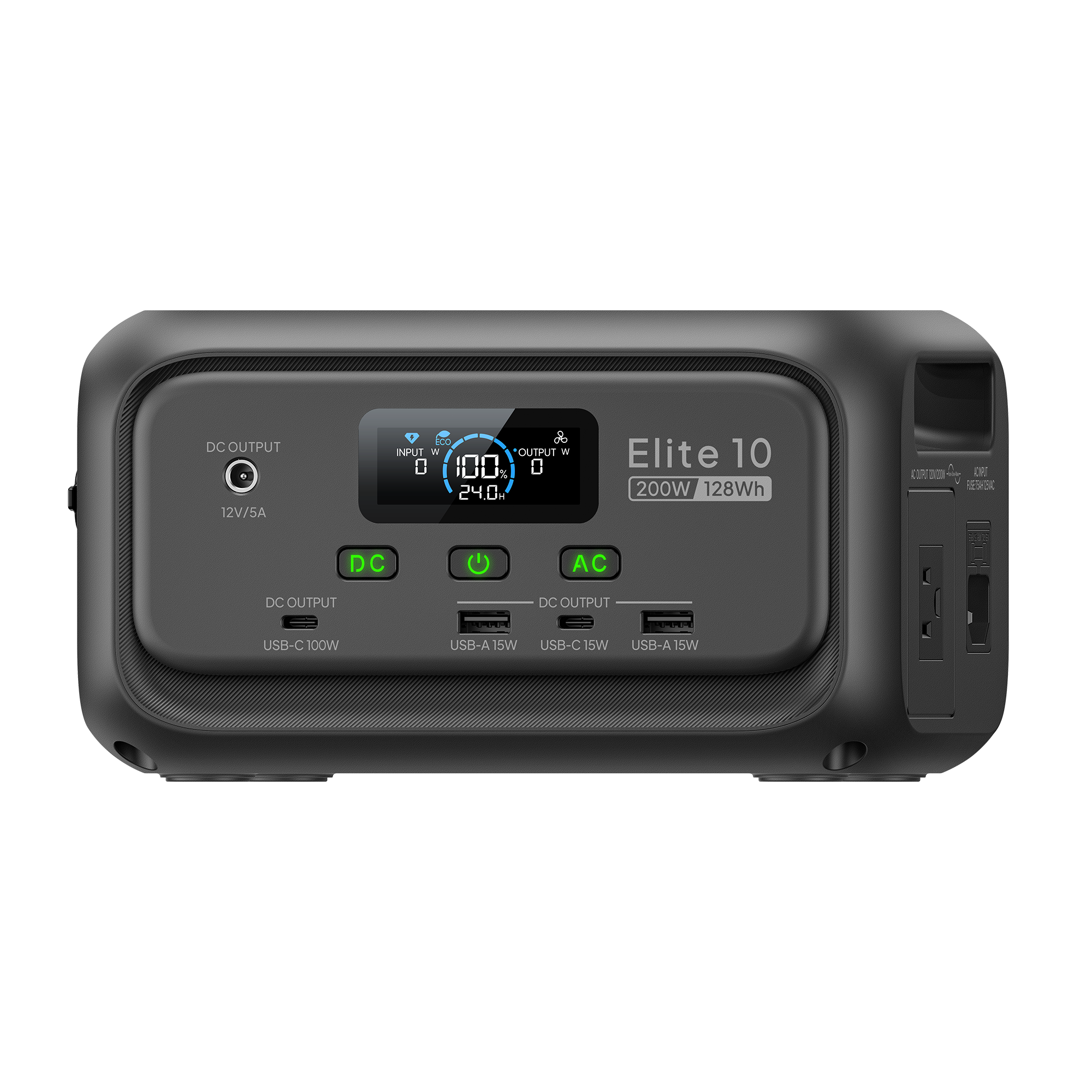
Explore this need in the finder →The BLUETTI Elite 10 (EL10, US standalone SKU EL10-US-GY-BL-SPFUS-00) is closer to a very small outlet-equipped power bank than a household backup station. It stores 128 Wh, provides one 120 V AC outlet rated at 200 W, and weighs about 3.97 lb. That combination makes it unusually easy to carry for a camera bag, day trip, desk kit or a few small essentials, but the tiny capacity and single low-power inverter set a firm boundary around what it can keep running.
Six output connections do not mean six large loads
The output layout is more varied than the body suggests: one AC outlet, two USB-A ports, two USB-C ports (one rated to 100 W and the other to 15 W), and one DC5521 port. The USB-A ports share a 15 W maximum. DC5521 is 13.5 V/5 A by default, with a 12.5 V/5 A setting in the app. It is not a conventional 12 V car-style socket, so check your device's actual voltage and connector rather than treating it as a universal 12 V supply.
BLUETTI rates the AC outlet at 200 W. Its manual separately lists a 300 W maximum for combined AC and DC output; that higher aggregate number does not raise the AC outlet's own limit. Power Lifting is described for pure resistive loads rated as high as 400 W, but the manual says actual output remains 200 W. Do not use that mode as a reason to count on a 400 W appliance, and do not assume it helps a motor, compressor or other load with a difficult startup. BLUETTI's own manual says some motor/compressor devices can draw several times their nameplate power when starting. A fridge, pump, kettle or tool that looks small on paper can therefore be a poor fit even if its steady-state number appears close.
Capacity is the bigger limit for overnight backup
At 128 Wh, this unit is best for topping up phones, cameras, lights, a small laptop or a low-power router—not for running them indefinitely. Nameplate capacity is not AC-delivered energy. BLUETTI's manual uses 95% depth of discharge, inverter efficiency over 90%, and about 7 W of self-consumption with AC and DC on. Its formula implies roughly four hours for a constant 20 W AC load, but that is an estimate rather than a measured result; actual draw and conditions change runtime. For a critical load, calculate from the device's actual consumption and keep a fallback.
Solar and car charging are modest, separate input routes
The station accepts up to 100 W of solar input at 12–28 V open-circuit voltage and 8.2 A. A separate 100 W vehicle-input route accepts a 12 V or 24 V source; the manual says to charge with the engine running to avoid draining the vehicle battery. Input ceilings do not promise nameplate solar output in poor conditions. The standalone box lists the station, AC and vehicle charging cables, and documents; no panel is included, and the manual lists the solar cable as optional. BLUETTI shows separate 60 W and 100 W panel options, but their exact panel models and package contents remain unresolved.
AC charging is listed up to 150 W, with Standard, Turbo and Silent modes; Turbo is activated through the app. The approximately 70-minute full-charge claim is an estimate, not a sample test. Charging speed varies by mode and conditions; the stated charging-temperature range is 32–104°F.
Useful smart features, with small-station caveats
The manufacturer describes a UPS switchover within 10 ms and Bluetooth app control. Neither statement is an independent transfer test or a guarantee for a medical device, workstation or other load that cannot tolerate a brief interruption. The manual also says ECO modes can switch outputs off after a period of low or no load; that behavior matters for a low-draw modem, sensor or light. Test the particular load and settings before depending on unattended backup. The station is IP20, and the manual says not to use it in rain. It is compact enough to take along, but it still needs a dry, ventilated place; charging below freezing is outside its stated charging range even though discharge is permitted down to -4°F.
When a different size is the better answer
Choose the Elite 10 if low carry weight, a 100 W USB-C connection and a real AC outlet matter more than long runtime. It does not meet a firm need for a 12 V car socket; expansion support was not established in the sources reviewed. A 201 W minimum AC requirement should also rule it out rather than treating Power Lifting as a higher continuous rating.
The Elite 30 V2 is a natural step up when 288 Wh and a 600 W AC rating justify its greater 9.48 lb weight. The Elite 100 V2 moves into a much heavier 25.3 lb, 1,024 Wh, 1,800 W class for larger loads and more substantial solar input. For phone-only charging, a lighter USB power bank may avoid carrying an inverter at all. The right comparison is therefore not “how many ports?” but which exact device must run, at what starting load, for how long, and whether you can recharge before the next use.
Key details at a glance
| Nameplate battery capacity | 128 Wh |
|---|---|
| Rated AC output | 200 W |
| Maximum solar input | 100 W |
| Maximum USB-C output per port | 100 W |
| Listed weight | 3.97 lb |
| Maximum AC recharge input | 150 W |
| Manufacturer UPS transfer figure | 10 ms |
| AC outlet output | Yes |
| USB-C ports | 2 |
| USB-A ports | 2 |
| Solar input ports | 1 |
| Vehicle charge input | 100 W |
| Battery chemistry | LiFePO4 |
| Ingress rating | IP20 |
Use the exact model’s instructions for operating limits, supplied equipment and version differences.
Sources for this assessment

A useful match starts with the loads that matter.
Use the finder for hard electrical requirements, then check appliance starting behavior, actual run time and the exact package in the full assessment.