
Your needs, this model
Does it fit your priorities?
Do you need a supplied panel of at least 100 W with the small station?
This selected U.S. offer lists one 100 W SP100L, while the EL30V2 itself remains a 288 Wh / 600 W station. Its narrow 12–28 V station input and 200 W ceiling remain relevant; panel nameplate is not a harvest guarantee.
Explore this need in the finder →Would a 9.48 lb station and 600 W AC rating fit your carry-and-load plan?
The station body is listed at 9.48 lb and supplies 600 W of rated 120 V AC. The separate panel weighs 10.9 lb, so the package is not a 9.48 lb kit; full package weight is not published.
Explore this need in the finder →Is a known SP100L model more important than a large solar array?
The package explicitly identifies one SP100L 100 W panel. That is below the EL30V2 station’s 200 W solar-input limit, and the 28 V ceiling leaves little room to infer a cold-voltage margin from the published 24.62 V Voc.
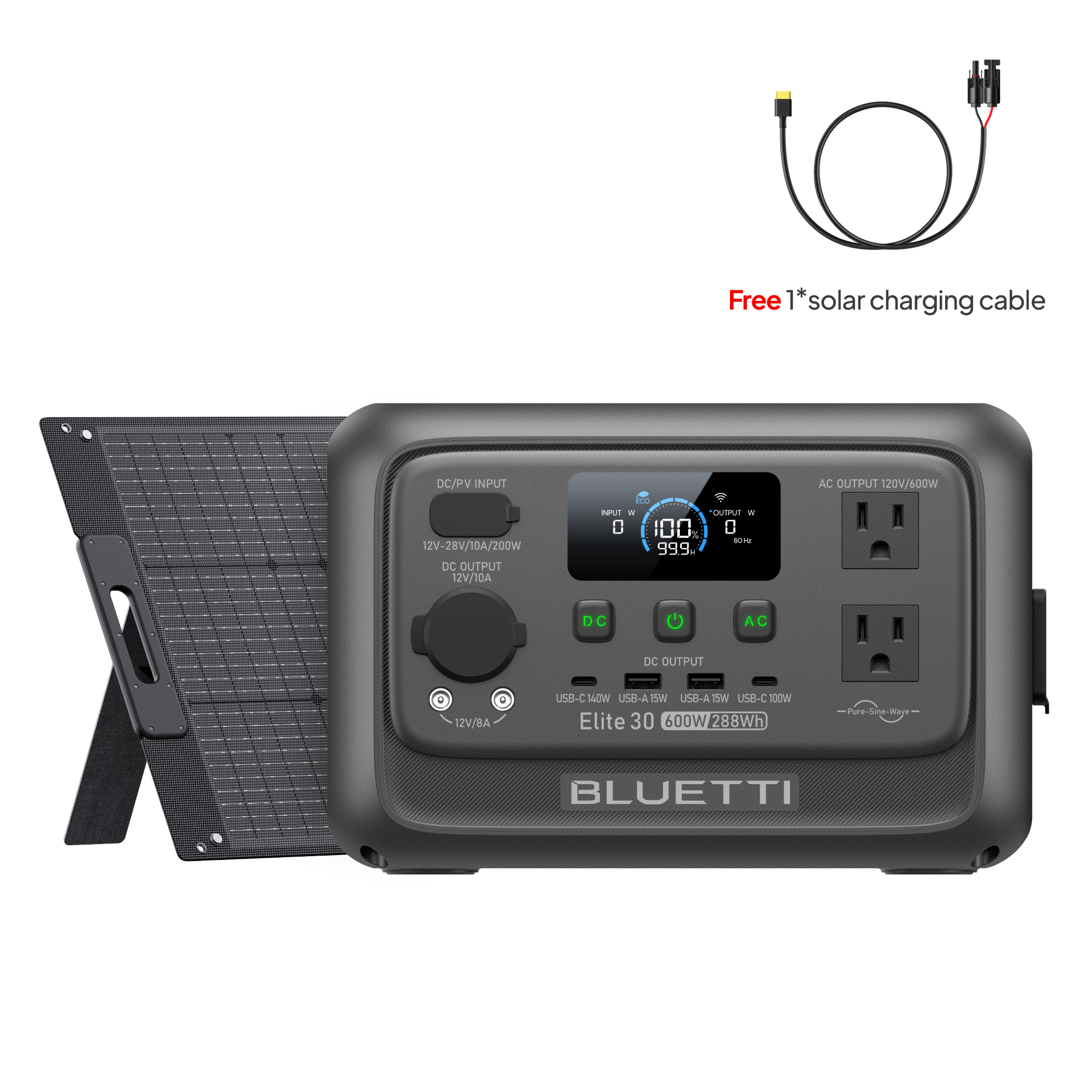
Explore this need in the finder →The U.S. Elite 30 V2 + 100W Solar option combines the EL30V2 power station with one folding SP100L panel and a solar charging cable listed in the selected offer. It is still a compact 288 Wh, 600 W station; the panel adds a way to recharge, not more stored energy or a higher AC ceiling. The sensible question is whether you need this particular one-panel bundle or whether the station alone is already the right size.
A useful daylight route, with a narrow voltage margin
The included SP100L is rated for 100 W maximum. Its manufacturer page lists 24.62 V open-circuit voltage and 5.13 A short-circuit current. The Elite 30 V2 manual gives a single solar input rated up to 200 W, 12–28 V and 10 A. One listed panel is therefore below the station’s current and wattage limits at the published panel conditions, but its 24.62 V nominal open-circuit figure is not far below the station’s 28 V ceiling. The panel temperature coefficient needed to calculate a cold-weather voltage rise was not found in the reviewed sources. Follow the exact kit instructions and verify cold-corrected voltage for your site before relying on solar charging in low temperatures; do not assume the 100 W label by itself guarantees a safe input in every condition.
Under suitable sun, 100 W nameplate gives a stronger starting panel than the 60 W Elite 30 V2 option. Actual input changes with angle, shade, cloud, temperature and how much sunlight reaches the panel. No solar-yield test was performed here, and the manufacturer’s rating is not a forecast of daily energy. A panel also has to be set up and aimed; it is not a hands-off replacement for grid charging.
The station’s limits do not change
The EL30V2 stores 288 Wh and provides 600 W of 120 V AC output. Those figures make it a reasonable small station for a few communications devices, camera or laptop charging, lights and other short-duration loads that fit its outlet and energy limits. The manual describes Power Lifting for certain pure-resistive loads up to 1,500 W, but the normal AC rating remains 600 W; that feature is not a way to run an arbitrary motor or appliance above the continuous rating. Check starting current for compressors, pumps and tools instead of deciding from their running wattage alone. A 100 W panel cannot turn 288 Wh into a whole-home reserve, and a single panel does not supply power after dark unless the battery has been recharged first.
BLUETTI lists the station at 9.48 lb and the SP100L at 10.9 lb. Their component weights total about 20.4 lb before the cable, packaging or any other carried item; no full bundle weight is published. The panel is the larger piece to carry and unfold. This distinction matters if you are choosing a packable day setup: the station itself is quite small, while the complete solar kit is not a pocket-sized accessory.
Who should choose this option?
Choose the bundle if the load list fits a 288 Wh battery and 600 W inverter, a panel must be supplied at purchase, and a 100 W panel is worth the extra carry and setup. Requiring an included panel changes the choice: the standalone EL30 V2 has the same station limits without the panel, while this option supplies one SP100L. Raising the minimum included-panel requirement above 100 W rules this package out even though the station accepts up to 200 W of solar input. That input ceiling is a separate station specification, not a statement that a larger panel is in the box.
If you already own a compatible panel and cable, the standalone Elite 30 V2 avoids buying a duplicate. When your real minimum is about 1 kWh or 1,800 W AC, the Elite 100 V2 + 100W has a much larger station but also a heavier body. Check compatible panel limits separately: the EL30V2 has a narrower 12–28 V input window than its larger siblings.
Use the checklist, not the bundle name
This configuration is a good fit only when the station and solar needs both work. If you select 120 V AC, require solar input, require a panel in the package, set a 100 W minimum for that panel, and stay at or below the EL30V2’s 288 Wh and 600 W limits, the option aligns with those published values. A request for more than 288 Wh, more than 600 W of continuous AC, a heavier lift limit below 9.48 lb, or a panel above 100 W changes the recommendation. Check the appliance’s startup needs separately; the finder cannot turn a nameplate rating into a successful compressor start or a promised runtime.
Keep the station dry, use only the supplied charging path and the model’s manual, and treat the included panel as a way to replenish this same small battery under favorable conditions. If cold-weather solar is essential, resolve the voltage margin with BLUETTI before depending on the kit. The bundle’s advantage is a listed one-panel charging route; its limits remain the EL30V2’s modest reserve, 600 W continuous output and the real burden of carrying a panel alongside the station.
Key details at a glance
| Nameplate battery capacity | 288 Wh |
|---|---|
| Rated AC output | 600 W |
| Maximum solar input | 200 W |
| Included panels, combined nameplate | 100 W |
| Maximum USB-C output per port | 140 W |
| Listed weight | 9.48 lb |
| Compatible extra-battery expansion | No |
| 12 V DC output | 120 W |
| Maximum AC recharge input | 380 W |
| Manufacturer UPS transfer figure | 10 ms |
| AC outlet output | Yes |
| USB-C ports | 2 |
| USB-A ports | 2 |
| Solar input ports | 1 |
| 12 V car-style output | 120 W |
| Battery chemistry | LiFePO4 |
| Ingress rating | IP20 |
| Solar panels in exact offer | 1 |
Use the exact model’s instructions for operating limits, supplied equipment and version differences.
Sources for this assessment
A useful match starts with the loads that matter.
Use the finder for hard electrical requirements, then check appliance starting behavior, actual run time and the exact package in the full assessment.