
Your needs, this model
Does it fit your priorities?
Would a 350 W continuous AC ceiling and about 297 Wh of nameplate storage fit your small-load plan?
Goal Zero rates the Yeti 300 for 350 W continuous AC, 600 W surge and 296.96 Wh of LFP capacity. The surge figure is not a continuous-load rating, and the nameplate energy is not delivered AC energy.
Explore this need in the finder →Do you require a 12 V accessory socket and a solar input capped at 200 W?
The Yeti 300 lists a 12 V auxiliary socket and a 200 W maximum solar input. The standalone box does not include a panel or car-charging cable.
Explore this need in the finder →Is a 5-year warranty and operation down to −10 °C for discharge enough for your plan?
The current model page lists a five-year warranty; the linked manual lists discharge to −20 °C, but charging begins at 0 °C. Neither figure promises performance for every load in cold weather.
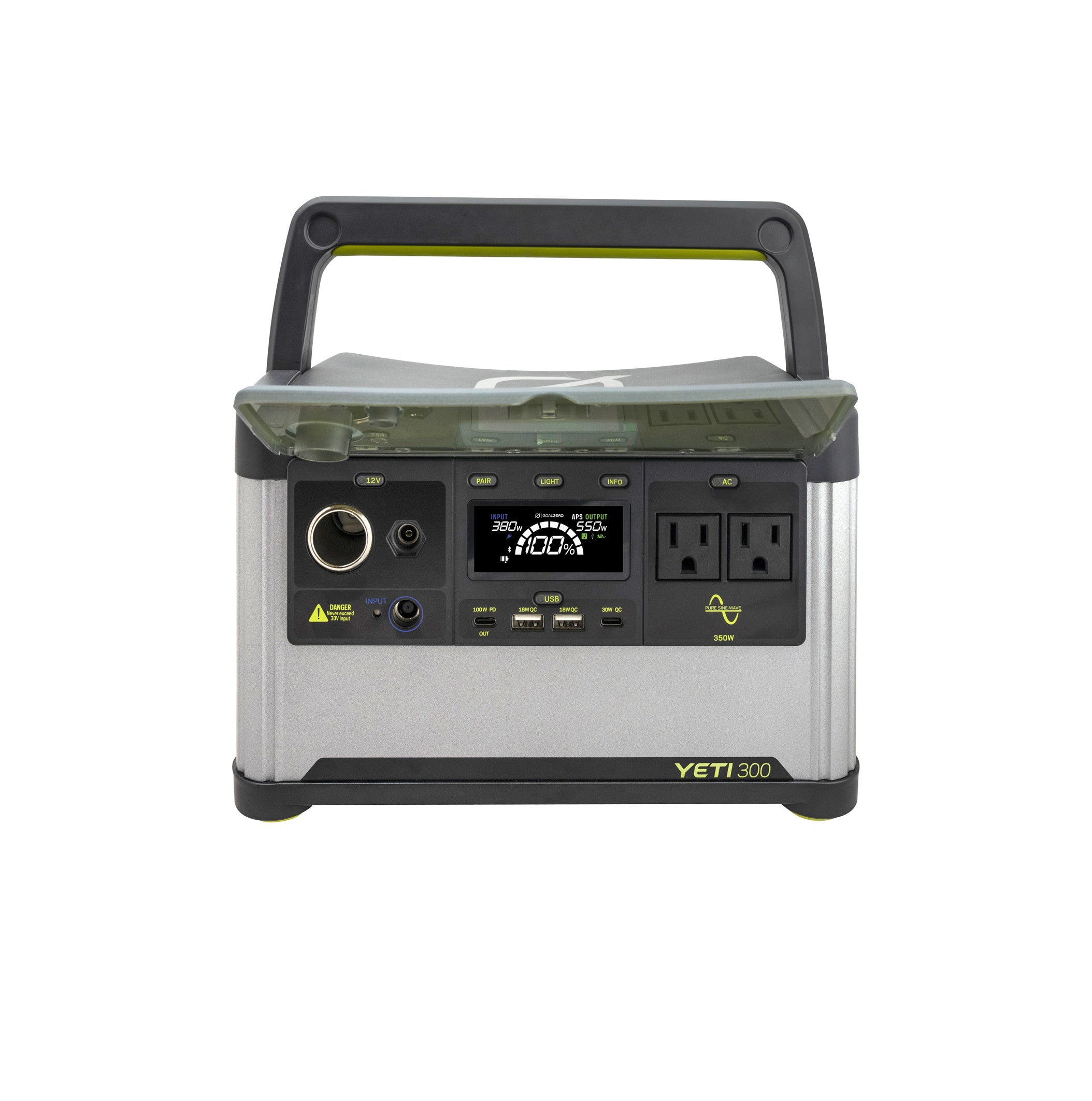
Explore this need in the finder →The Goal Zero Yeti 300 is the smallest AC-equipped station in the current Yeti 300/500/700 compact family. Its exact U.S. offer is SKU 36900: a 297 Wh LiFePO4 battery with two 115 V AC outlets rated for 350 W continuous output and 600 W surge. That is a useful campsite or day-trip reserve for modest loads, not an appliance-sized inverter. The official page currently shows the station as sold out; the model remains worth assessing, but availability should be checked before planning around it.
Start with the running load, not the surge figure
The 350 W continuous limit is the practical ceiling for an AC device that runs for more than a moment. A brief 600 W surge rating does not make the Yeti 300 suitable for a tool or appliance whose normal demand stays above 350 W. Its 297 Wh is battery nameplate capacity rather than a promise of AC energy at the outlet: inverter overhead, the load’s duty cycle, temperature and any reserve you keep all matter. Do not calculate a guaranteed runtime by dividing the nameplate number by an appliance label. If your measured load plan needs 500 W continuously or substantially more stored energy, the Yeti 500 or 700 is the more relevant step up.
Two AC receptacles do not mean two independent 350 W channels. Both draw from the same inverter, and the manual also publishes a 550 W maximum combined-output ceiling across the station’s outputs. Keep your combined plan below the applicable limit and verify a device’s starting surge separately. This is especially important if USB gear and 12 V accessories will be connected at the same time.
Useful ports, with a solar input ceiling
Goal Zero lists two USB-A outputs up to 18 W each, one USB-C up to 100 W, and a second USB-C up to 30 W. Its 12 V car-style socket is rated up to 162 W, with a separate 6 mm 12 V output rated up to 135 W; the two 12 V outputs together are limited to 13.5 A. These connections make more sense for a small mixed setup—phones, camera gear, a laptop and a 12 V cooler—than for a high-demand AC appliance. The AC, USB, and DC labels describe port maxima, not amounts that can all be added without the unit-wide limit.
The station accepts up to 200 W through its 8 mm low-voltage input, with a 12.3–28 V range and 10 A maximum. The manual warns not to exceed 30 V. The standalone box lists the Yeti, an AC power cord, and a user guide, not a solar panel or the optional vehicle-charging cable. A panel is a separate purchase, and its connector and open-circuit voltage must match the instructions. A panel’s advertised wattage is not a forecast of harvest in shade, cloud or a poor angle.
Portability and outdoor use have boundaries
Goal Zero’s product page lists the Yeti 300 at 13.7 lb; its linked manual says 14.1 lb. Those manufacturer sources disagree, so I would plan for a roughly 14 lb box rather than promise a precise carry weight. The page calls the enclosure IPX4 and describes outdoor use, but that is not permission to leave ports exposed to rain or immerse the station. Keep it ventilated, dry and protected, and follow the manual’s temperature limits: charging begins at 0 °C, while discharge is listed down to −20 °C. The maker’s cycle claim is 4,000 cycles to 80% under its stated test conditions, not a guaranteed service life in every use pattern.
The Yeti can pass AC power through and switch to battery in under 20 ms, but the manual says switching is not zero-time and warns that sensitive loads may be interrupted. It is not certified for life-saving medical equipment; do not treat a manufacturer’s illustrative CPAP runtime as medical-backup approval. For a protected small-load setup, the Yeti 300 is the lightest capacity choice in this family, but the 500 adds both storage and continuous AC headroom. Compare the Yeti 500 if a 350 W ceiling is tight, and the Yeti 700 if your measured load approaches 600 W.
Primary references: Goal Zero Yeti 300 U.S. product page, Goal Zero Yeti 300/500/700 support page and linked user guide, and CPSC’s model-specific YETI 3000X recall notice. Product-page availability can change; this is not a physical-sample test.
Key details at a glance
| Nameplate battery capacity | 297 Wh |
|---|---|
| Rated AC output | 350 W |
| Manufacturer surge rating | 600 W |
| Maximum solar input | 200 W |
| Included panels, combined nameplate | 0 W |
| Maximum USB-C output per port | 100 W |
| 12 V DC output | 182 W |
| Maximum AC recharge input | 420 W |
| Base warranty term | 5 years |
| AC outlet output | Yes |
| USB-C ports | 2 |
| USB-A ports | 2 |
| Solar input ports | 1 |
| 12 V car-style output | 162 W |
| Battery chemistry | LFP |
| Ingress rating | IPX4 |
| Manufacturer minimum charge temperature | 0 °C |
| Manufacturer minimum discharge temperature | -20 °C |
| Solar panels in exact offer | 0 |
Use the exact model’s instructions for operating limits, supplied equipment and version differences.
Sources for this assessment
A useful match starts with the loads that matter.
Use the finder for hard electrical requirements, then check appliance starting behavior, actual run time and the exact package in the full assessment.