
Your needs, this model
Does it fit your priorities?
Is 600 W continuous AC output with about 677 Wh of nameplate energy the right compact class?
The Yeti 700 is rated at 600 W continuous and 677.376 Wh; 1,000 W is the surge ceiling, not a sustained appliance rating.
Explore this need in the finder →Do you need 200 W solar input and a 12 V vehicle-style output, but not a panel included in the box?
The exact standalone box includes the station, AC power cord and user guide; the station supports up to 200 W solar input and a 12 V auxiliary socket. Panels and the vehicle cable are separate.
Explore this need in the finder →Can your plan use cold-weather discharge down to −10 °C with a five-year warranty, without requiring charging in subfreezing weather?
Goal Zero lists discharge down to −20 °C and charging from 0 °C. A need to charge at −10 °C is different and is not supported by the listed range.
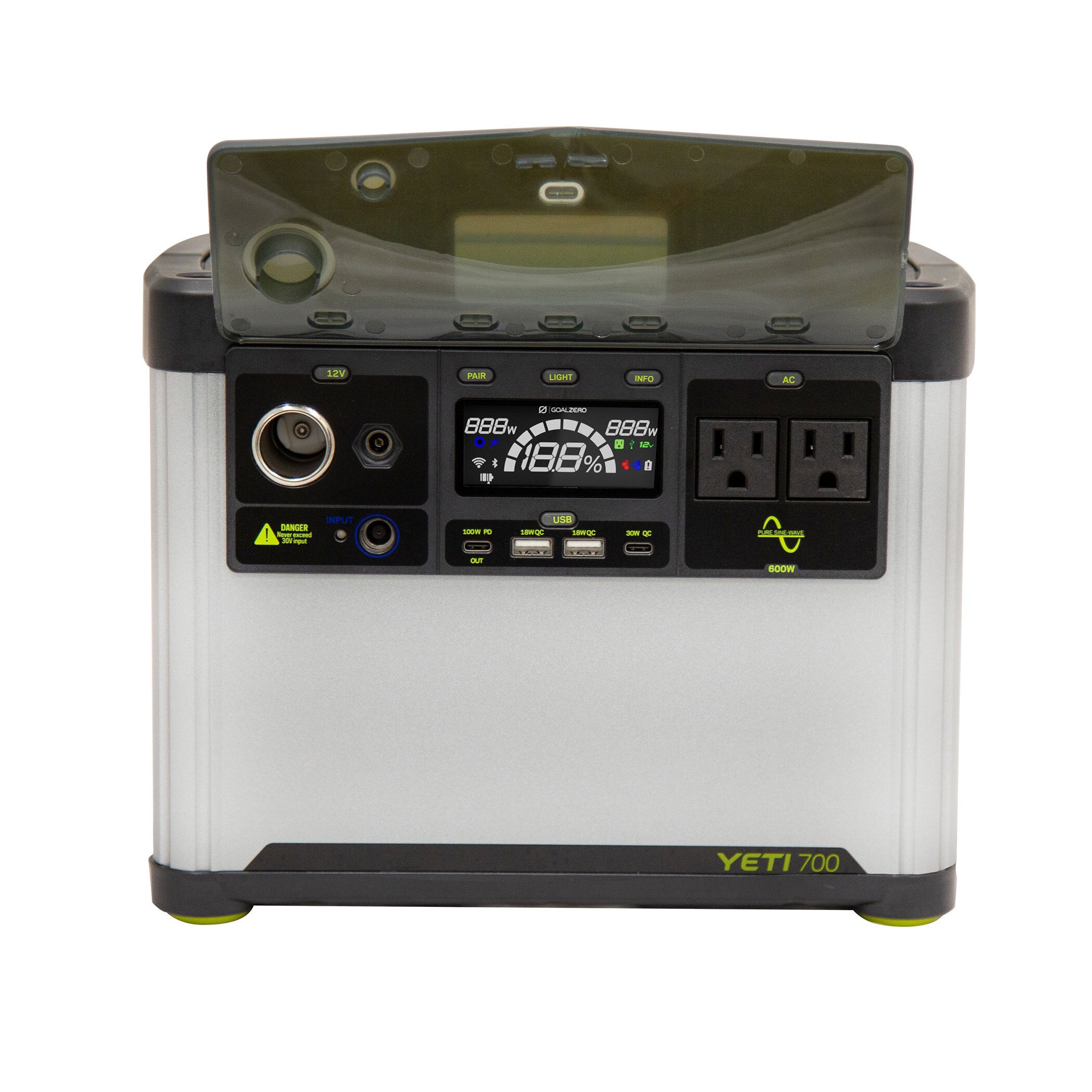
Explore this need in the finder →The Goal Zero Yeti 700 is the largest of the compact 300/500/700 models, with 677.376 Wh of LiFePO4 storage and a 600 W continuous, 115 V AC inverter. It offers more headroom than the Yeti 500, but it is still a compact station rather than a 2 kW appliance supply. The product page’s 1,000 W surge rating is intended for short startup events; it does not support a load that continuously draws above 600 W. If an essential appliance needs more than 600 W, or requires 240 V, this is the wrong class regardless of the battery capacity.
Why the 700 earns its extra capacity
For a campsite, field kit or brief outage plan built around lights, electronics and a carefully checked small appliance, the Yeti 700 gives the family’s largest single-battery reserve. Its 677 Wh figure remains nameplate energy, not guaranteed usable energy at an AC receptacle. The inverter consumes some power, and device cycling, ambient temperature, cable losses and the reserve you keep affect runtime. Goal Zero’s own example loads are estimates, not a test of your fridge or tool. Use the device label and its measured or manufacturer-documented operating draw to set a conservative plan.
Two 115 V AC outlets share the 600 W inverter. The manufacturer guide lists an 850 W maximum combined-output ceiling across AC and DC ports. Two USB-A ports are rated to 18 W; the USB-C ports are 100 W and 30 W. The 12 V auxiliary socket is listed at 162 W and the 6 mm outlet at 135 W, while the 12 V ports together are limited to 13.5 A. Treat the station-wide and per-port restrictions as real simultaneous-use limits: a high AC draw leaves less room for other loads than simply adding every output label suggests.
Solar and wall charging are capped independently
The Yeti 700’s single 8 mm low-voltage input accepts up to 200 W at 12.3–28 V and 10 A; the manual warns against exceeding 30 V. A larger panel nameplate does not force more than the station’s input ceiling, and the standalone box lists no panel or vehicle-charging cable. A compatible panel must match the voltage and connector rules, and the product page treats Nomad panels and the solar-generator bundles as separate accessories or offers. Sunlight, shading and panel angle decide whether an advertised recharge time is realistic.
On AC, Goal Zero lists up to 500 W fast input and 340 W for low-speed charging. The lower mode is shipped as default and is described as quieter and cooler; the unit’s controls can change the input limit. Decide whether a faster refill before departure matters more than slower, quieter charging in camp. Vehicle charging uses a separately sold 12 V cable according to Goal Zero’s page. The internal input cap and the optional cable are separate facts; no vehicle-input wattage is assumed here.
Outdoor rating, switching, and practical limits
Goal Zero lists IPX4 water resistance, 4,000 cycles to 80% under its specified conditions, a 5-year warranty, a charging minimum of 0 °C and a discharge lower limit of −20 °C. The enclosure is not a permission to leave the ports open in weather; keep it under cover, ventilated, and away from water. The exact station’s weight is unresolved across the manufacturer’s sources: its current page says 20.3 lb and its linked guide says 20.9 lb. Use the more cautious expectation of a roughly 21 lb lift rather than filtering on an exact weight until Goal Zero clarifies which figure applies to the current production unit.
The manual describes Automatic Power Switching under 20 ms, not zero-time, and explicitly warns that the transition can interrupt sensitive equipment. It also says not to use the Yeti with life-saving medical equipment. Do not use its illustrative CPAP runtime as medical approval or as a guaranteed duration. For a household outlet plan near 600 W with a separate charging source, the 700 is the strongest compact option in this trio; if weight and input/output headroom matter more than extra storage, compare the 500. For a lower 350 W requirement, the 300 has a smaller nameplate battery and a sold-out page snapshot, so check current supply before relying on it.
Primary references: Goal Zero Yeti 700 U.S. product page, Goal Zero Yeti 300/500/700 support page and linked user guide, and CPSC’s model-specific YETI 3000X recall notice. Manufacturer runtimes and recharge rates depend on operating conditions; no physical sample was tested.
Key details at a glance
| Nameplate battery capacity | 677.38 Wh |
|---|---|
| Rated AC output | 600 W |
| Manufacturer surge rating | 1000 W |
| Maximum solar input | 200 W |
| Included panels, combined nameplate | 0 W |
| Maximum USB-C output per port | 100 W |
| 12 V DC output | 182 W |
| Maximum AC recharge input | 500 W |
| Base warranty term | 5 years |
| AC outlet output | Yes |
| USB-C ports | 2 |
| USB-A ports | 2 |
| Solar input ports | 1 |
| 12 V car-style output | 162 W |
| Battery chemistry | LFP |
| Ingress rating | IPX4 |
| Manufacturer minimum charge temperature | 0 °C |
| Manufacturer minimum discharge temperature | -20 °C |
| Solar panels in exact offer | 0 |
Use the exact model’s instructions for operating limits, supplied equipment and version differences.
Sources for this assessment
A useful match starts with the loads that matter.
Use the finder for hard electrical requirements, then check appliance starting behavior, actual run time and the exact package in the full assessment.