
Your needs, this model
Does it fit your priorities?
Do you need at least 499 Wh and a 500 W continuous AC inverter without stepping up to the Yeti 700?
The Yeti 500 lists 499.2 Wh and 500 W continuous AC output; its 1,000 W surge rating does not increase its continuous limit.
Explore this need in the finder →Would a 200 W solar ceiling with a 12 V accessory output meet your recharge plan?
The station’s single low-voltage input is limited to 200 W; the manual specifies a 30 V maximum. A compatible panel and optional vehicle cable are not in the standalone box.
Explore this need in the finder →Do you need a station documented for −10 °C discharge, while allowing charging to wait until above freezing?
The linked manual permits discharge down to −20 °C but lists charging from 0 °C. This can meet a cold-use output threshold; it does not support charging at −10 °C.
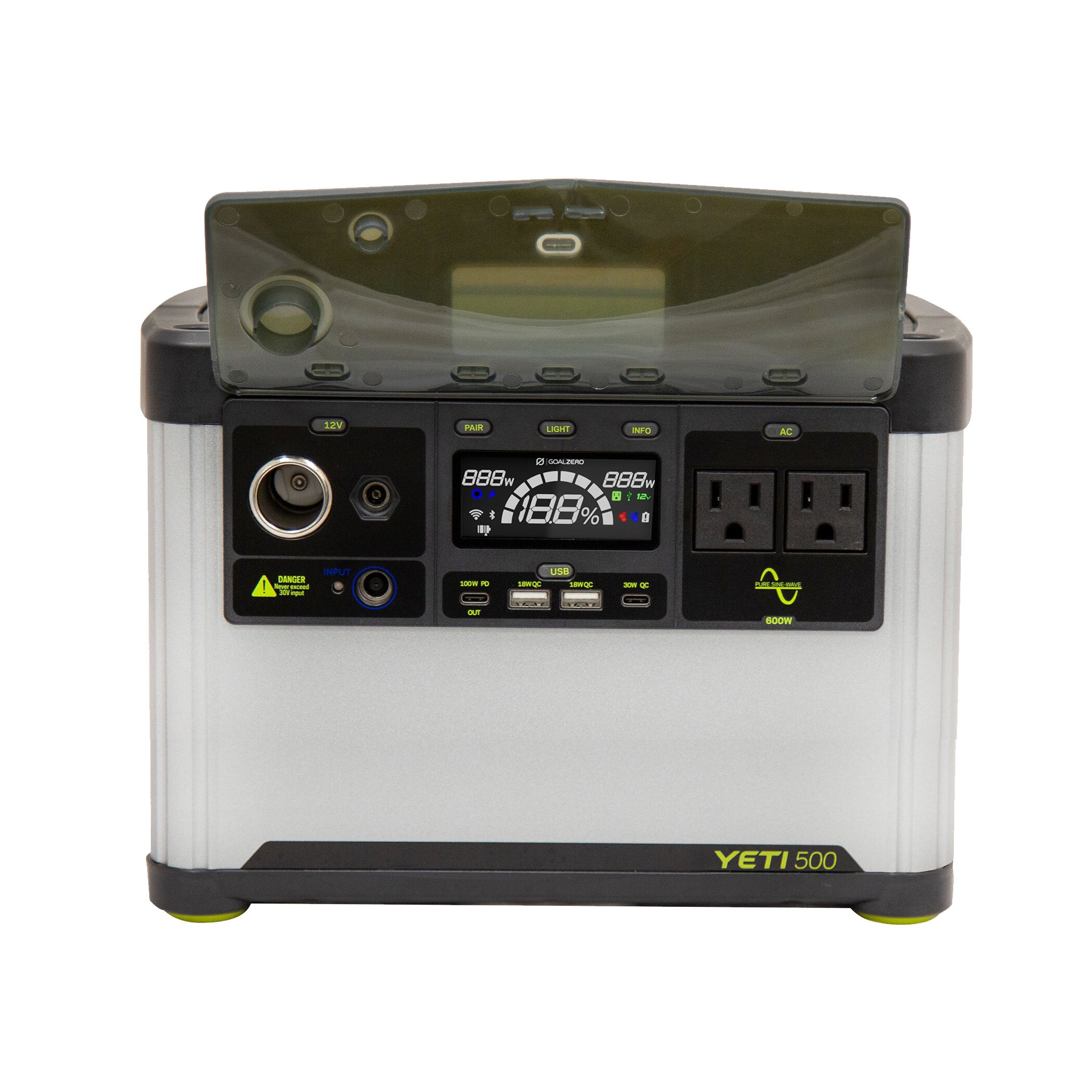
Explore this need in the finder →The Goal Zero Yeti 500 is the middle model in the compact Yeti 300/500/700 range, with a useful distinction between energy and power: the U.S. listing specifies 499.2 Wh of LiFePO4 storage and a 500 W continuous, 115 V AC inverter. The surge rating is 1,000 W, but that is not a second operating tier for loads that draw more than 500 W continuously. Choose it when your essential 120 V-plug devices fit within the published 500 W limit and the 297 Wh Yeti 300 would leave too little nameplate capacity; choose the 700 if you need 600 W continuous output or more storage.
A stronger midpoint, not a household-backup system
The two AC outlets share one 500 W inverter. A motor, compressor, heater or kitchen appliance may draw more at startup or run beyond the continuous rating, so compare the appliance’s actual input and starting behavior with the station’s limits rather than relying on the surge number. Goal Zero’s user guide also lists a 770 W maximum combined output across the ports. That combined ceiling matters if you plan to run AC and DC equipment together. The 499.2 Wh nameplate figure is not a load-specific AC-delivered-energy result, so a runtime estimate should start with your real duty cycle and account for conversion loss and reserve.
For device charging, the station has two USB-A ports rated to 18 W, a 100 W USB-C, and a second 30 W USB-C. On the DC side it offers a 12 V auxiliary socket up to 162 W and a 6 mm 12 V port up to 135 W; their combined current is limited to 13.5 A. The product can therefore handle a mix of common electronic and vehicle-style 12 V loads, but the port maxima are not all independent. A practical plan leaves margin below the stated system and per-port ceilings.
Recharge choices and what the box does not supply
The included AC power cord supports fast and low-speed charging modes. Goal Zero lists up to 500 W AC input in fast mode and 240 W in the default low-speed mode; the manual says the slower mode reduces heat and noise and can be selected at the unit. For solar, the 8 mm input is capped at 200 W, 12.3–28 V and 10 A. The user guide specifically says not to exceed 30 V. That input rating is useful for planning a compatible panel, but the base Yeti 500 box contains no panel or solar cable. An official solar-generator bundle is a separate option and should be reviewed by its own itemized contents, not inferred from a family photograph.
Goal Zero rates the 500 at IPX4 and lists its charge range starting at 0 °C and discharge down to −20 °C. Treat IPX4 as splash resistance, not waterproofing: protect the input and output panel, keep the enclosure ventilated, and do not operate a submerged or significantly wet unit. The maker lists 4,000 cycles to 80% capacity under its stated test condition. It also describes Automatic Power Switching under 20 ms, but the manual says the transition is not 0 ms and sensitive equipment can be interrupted. The manual explicitly says the Yeti is not for life-saving medical equipment.
Check weight evidence and the load you actually have
There is a small but material source conflict in the weight listing: the current product page gives 16.1 lb, while the manufacturer’s linked user guide says 16.7 lb. I have not selected one as a verified exact figure; plan for a compact but substantial box, and do not use this record to meet a strict carry-weight ceiling. This matters more for frequent lifting than for a station that stays in one vehicle or at a campsite.
At a 500 W limit, the Yeti 500 suits lights, electronics, and other 120 V equipment whose running draw fits; it is not a promise that any refrigerator or appliance will run for a particular number of hours. If your plan must remain below 350 W and 300 Wh, the Yeti 300 is smaller. If you need 600 W continuous output and 677 Wh nameplate storage, compare the Yeti 700. In either case, the exact station and the separate solar or vehicle cable should be budgeted as different parts of the setup.
Primary references: Goal Zero Yeti 500 U.S. product page, Goal Zero Yeti 300/500/700 support page and linked user guide, and CPSC’s model-specific YETI 3000X recall notice. Manufacturer runtime and recharge estimates depend on conditions; this assessment is not a physical-sample test.
Key details at a glance
| Nameplate battery capacity | 499.2 Wh |
|---|---|
| Rated AC output | 500 W |
| Manufacturer surge rating | 1000 W |
| Maximum solar input | 200 W |
| Included panels, combined nameplate | 0 W |
| Maximum USB-C output per port | 100 W |
| 12 V DC output | 182 W |
| Maximum AC recharge input | 500 W |
| Base warranty term | 5 years |
| AC outlet output | Yes |
| USB-C ports | 2 |
| USB-A ports | 2 |
| Solar input ports | 1 |
| 12 V car-style output | 162 W |
| Battery chemistry | LFP |
| Ingress rating | IPX4 |
| Manufacturer minimum charge temperature | 0 °C |
| Manufacturer minimum discharge temperature | -20 °C |
| Solar panels in exact offer | 0 |
Use the exact model’s instructions for operating limits, supplied equipment and version differences.
Sources for this assessment
A useful match starts with the loads that matter.
Use the finder for hard electrical requirements, then check appliance starting behavior, actual run time and the exact package in the full assessment.