
Your needs, this model
Does it fit your priorities?
Does this exact package include at least two named 100 W-class solar panels?
Yes. The selected U.S. SKU lists two SolarSaga 100W Air panels with cable; the exact panel manual identifies model JS-100H and 100 W STC nameplate per panel.
Explore this need in the finder →Does the station keep the same 120 V / 2,000 W AC limit as the standalone option?
Yes. The station remains the JE-1500D with 120 V output and 2,000 W rated continuous AC across three outlets; the bundle only adds the panel pair.
Explore this need in the finder →Does the two-panel bundle deliver 400 W of included solar nameplate?
No. It includes two 100 W STC panels, 200 W combined. The 400 W number is the station input maximum, not the box's panel wattage.
Explore this need in the finder →Will the included solar kit make the station a 240 V or expandable system?
No. The kit remains one fixed-capacity JE-1500D with 120 V output and no supported battery expansion; panels only provide a charging input.
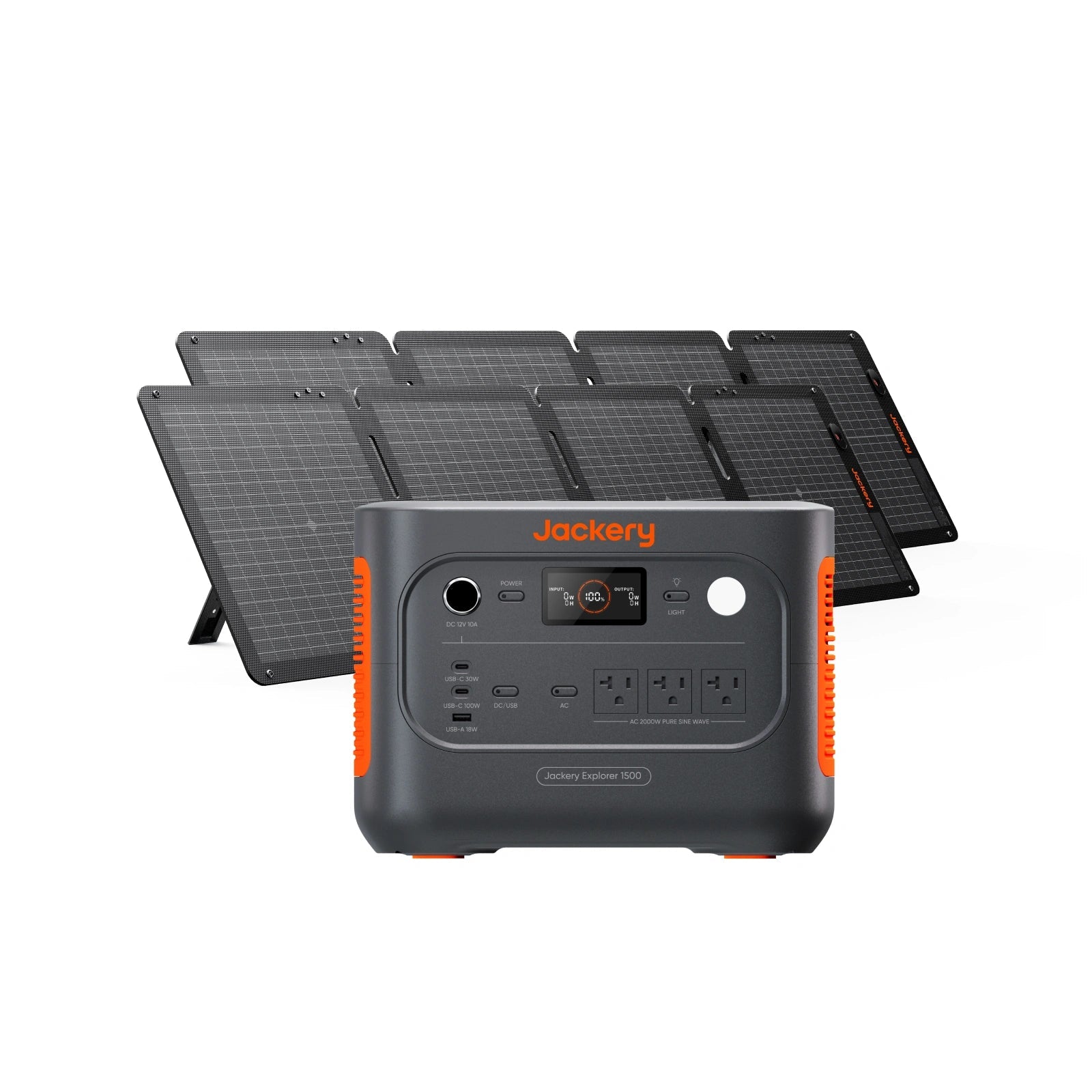
Explore this need in the finder →This exact Jackery package combines one Explorer 1500 v2 station with two SolarSaga 100W Air panels. The U.S. product page labels the selected option Explorer 1500 v2 + SolarSaga 100W Air x 2; its bundle SKU is 60-150010-US00303 (variant 42138492207191). The power station itself is model JE-1500D, and Jackery’s SolarSaga 100 Air manual identifies the panel as JS-100H. This is a meaningful package choice, not a larger battery or a higher-output version: the station remains 1,536 Wh and 2,000 W rated AC.
The included pair changes the first solar setup
The selected option’s box list names one station, one AC charging cable, one user manual and two SolarSaga 100W Air panels with cable. Jackery’s panel manual describes the JS-100H as a bifacial 100 W panel under standard test conditions (STC); its separate 110 W BNPI figure uses a different front-plus-rear irradiance condition and should not be read as ordinary 110 W nameplate output. For the two included panels, the relevant combined STC nameplate is 200 W. The product page image shows the station with two fold-out panels, but it is a promotional rendering rather than a photo of a sample or a real-world harvest test.
The station’s dual DC8020 solar inputs can accept up to 400 W in a supported configuration, so the bundled pair does not fill its published ceiling. The package still gives a buyer a usable same-model panel set from the outset; in favorable sunlight it may recharge at a different rate from one panel, but weather, shade, angle and temperature control the result. Do not convert the 200 W rating into guaranteed daily energy or a fixed charging time. Jackery specifies same-model panel arrangement across its parallel inputs, and the station’s instructions support one, two or four panels—not an arbitrary mix. Adding a third panel is not a supported shortcut; any later expansion of the array must follow Jackery’s stated wiring and voltage limits.
Each panel’s manual gives a folded size of about 17.05 by 16.65 by 1.85 inches and weight around 7.05 lb. Together with the 31.97 lb station, the main components weigh roughly 46 lb before any extra case or accessories, divided between the station and two separate panels. That is practical to load in a car and deploy at a site, but less convenient than a bare station if you must carry everything far by hand. The panels’ own IP68 rating applies to the panel, not to the power station; keep the JE-1500D dry and ventilated.
What the station does—and does not—gain
Three 120 V, 60 Hz receptacles share 2,000 W rated continuous output, with 4,000 W peak surge. Check motor or compressor startup loads rather than assuming the surge figure is an operating rating. The manual also reduces the AC ceiling to 1,200 W from -4°F to 14°F. The unit weighs about 31.97 lb, stores 1,536 Wh by nameplate, and uses a LiFePO4 battery rated by Jackery for 6,000 cycles to 70% or more capacity. That cycle figure is a manufacturer rating, not an observed lifetime test or a promise of delivered AC watt-hours.
The station adds two USB-C outputs (100 W and 30 W), USB-A up to 18 W, a 12 V / 10 A output and an integrated LED light. Those ports and the solar bundle make a flexible mix for household essentials, electronics and outdoor use, but do not make it a 240 V, whole-home, or expandable-battery system. Its app can report and control settings; the manual’s battery and temperature limitations still apply. Jackery lists a 3-year standard warranty with an extra two years on its official offer, subject to its current conditions.
UPS and cold-weather limits matter as much as the panel count
The manufacturer manual gives a 10 ms transfer in bypass/UPS mode and explicitly warns that the station is not a 0 ms UPS. It recommends testing a specific appliance and says not to use it for equipment such as data servers or workstations that requires a true no-break supply. Before an outage, bypass output is limited to 1,440 W. The panels do not change any of these transfer or AC-load limits, so choose a purpose-built UPS if the connection must not blink.
Charging and discharging are specified from -4°F to 113°F. Cold also narrows the AC output, while hot or poorly ventilated operation can trigger protection. Use the package in dry, open conditions, keep its intake and exhaust clear, and store it according to the manual rather than leaving it depleted in a vehicle. The panel set is for recharging; it does not protect the station from rain or turn it into a permanent outdoor installation.
Who should pay for this selected package?
Choose this version when the station’s 120 V / 2,000 W plan fits your appliances, 1,536 Wh is an appropriate nameplate buffer, and two named 100 W panels are useful additions to the box. It is a straightforward car-camping or outage kit for someone willing to set up portable panels and manage charging conditions. It is not the choice if you need two kilowatts of panel input, guaranteed fridge runtime, 240 V, a higher cold-weather AC ceiling, or a seamless UPS.
If you already own compatible panels or want to choose a different array, compare the standalone Explorer 1500 v2; the station’s ratings are the same, and the standalone package does not include solar hardware. For more battery capacity, the Explorer 2000 v2 is a larger and heavier alternative. For a similar-capacity station with another output and input balance, compare the Anker SOLIX F1500. Use the exact load, cable and solar-input plan to decide; the bundle itself changes what arrives, not the inverter’s limit.
Jackery Explorer 1500 v2 U.S. option page · Station manual · SolarSaga 100 Air manual.
Key details at a glance
| Nameplate battery capacity | 1536 Wh |
|---|---|
| Rated AC output | 2000 W |
| Manufacturer surge rating | 4000 W |
| Maximum solar input | 400 W |
| Included panels, combined nameplate | 200 W |
| Maximum USB-C output per port | 100 W |
| Listed weight | 31.97 lb |
| Compatible extra-battery expansion | No |
| 12 V DC output | 120 W |
| Manufacturer UPS transfer figure | 10 ms |
| Base warranty term | 3 years |
| AC outlet output | Yes |
| USB-C ports | 2 |
| USB-A ports | 1 |
| Solar input ports | 2 |
| 12 V car-style output | 120 W |
| Battery chemistry | LiFePO4 |
| Home Power Panel in this package | No |
| Separate station units in offer | 1 |
| Solar panels in exact offer | 2 |
Use the exact model’s instructions for operating limits, supplied equipment and version differences.
Sources for this assessment
- Jackery U.S. portable power station collection, observed Explorer 1500 v2 card
- Jackery selected Explorer 1500 v2 + SolarSaga 100W Air x 2 U.S. bundle option
- Jackery Explorer 1500 v2 exact option JSON
- Jackery product JSON, package variant and exact SKU data
- Jackery Explorer 1500 U.S. user manual, model JE-1500D
- Jackery SolarSaga 100 Air U.S. manual, model JS-100H
- Jackery Explorer 1500 V2 support information
- U.S. CPSC recall search for JE-1500D
- Jackery exact selected-option image for the two-panel bundle

A useful match starts with the loads that matter.
Use the finder for hard electrical requirements, then check appliance starting behavior, actual run time and the exact package in the full assessment.