
Your needs, this model
Does it fit your priorities?
Can every essential load run directly from USB or 12 V DC, with no household AC outlet?
The JE-300D is explicitly DC-only: no AC inverter, 288 Wh nameplate battery, 300 W total DC output and a 120 W 12 V socket. A household-plug-only load is incompatible.
Explore this need in the finder →Would a light 288 Wh station with three USB-C ports, including 140 W output, suit your carry-and-charge list?
The station weighs about 5.51 lb and has three USB-C ports (C1 and C2 up to 140 W, C3 up to 65 W); all output ports remain subject to a 300 W total DC ceiling.
Explore this need in the finder →Is one 100 W solar input plus a 12 V vehicle-charge option enough for a compact DC-only plan?
The single solar/vehicle DC input takes one panel up to 100 W or a 12 V car source up to 96 W; the car lead is separate, 24 V charging is not supported, and the two charging sources cannot be combined.
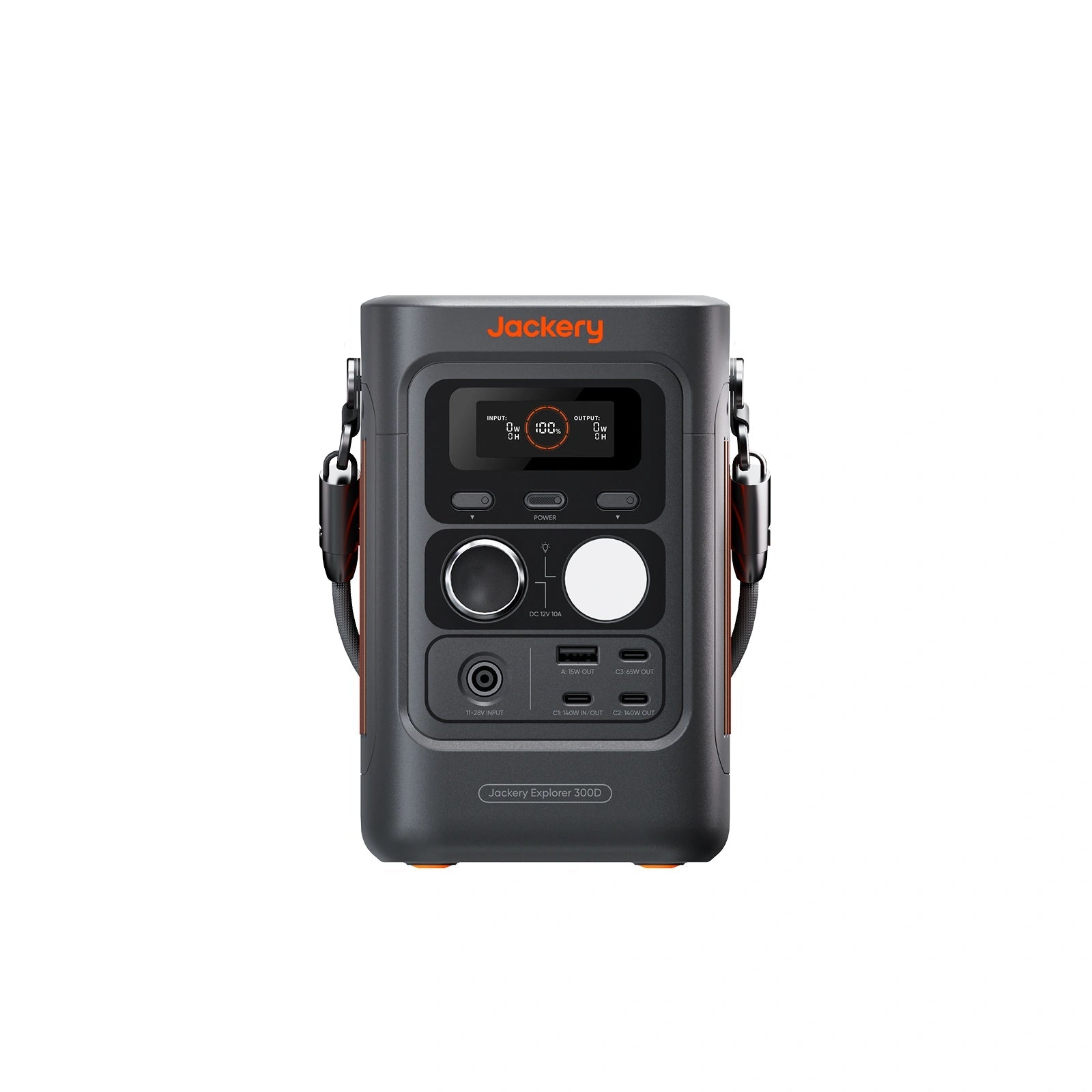
Explore this need in the finder →The Jackery Explorer 300D is a direct-current battery station, not a small version of a household-outlet power station. That distinction should decide the purchase before capacity or color does: the exact US unit, model JE-300D and standalone SKU 21-0001-000360, has no AC inverter or 120 V receptacle. It is for loads that can connect through USB or its 12 V socket. A lamp with a household plug, a mains-only router, or any other AC-only device will not run from it.
Capacity and output answer different questions
Jackery lists 288 Wh of LiFePO4 storage and 300 W maximum total DC output. The watt-hour figure is a nameplate energy amount, not a promise that every connected device receives 288 Wh; conversion losses, device behavior and conditions affect delivered energy. The 300 W figure is the ceiling across the DC outputs, not a separate allowance for each port. Adding several port ratings together does not create extra battery capacity or a larger total output budget.
The front has three USB-C ports: C1 accepts input and supplies up to 140 W, C2 supplies up to 140 W, and C3 supplies up to 65 W. There is also one USB-A port rated up to 15 W and a 12 V, 10 A car-style output (120 W). Those are useful combinations for compatible laptops, phones, cameras, lighting and a modest 12 V accessory. Before relying on an appliance, check its connector, voltage, steady draw and start-up demand. A device that only accepts household AC is incompatible, regardless of its wattage.
A carry handle that doubles as a high-power USB-C lead
The 300D is about 5.51 lb and measures roughly 4.67 by 4.73 by 7.20 inches. It is notably easier to pack than a typical AC-inverter station in the same nominal capacity class. Jackery's product page and manual identify the two-in-one USB-C cable/handle; the manual also shows that a compatible USB-C power source connects at C1 for charging. That design reduces loose-cable clutter, but it does not turn this into an AC-charging unit. The exact base offer lists one station and a user manual; a wall adapter is not listed in the box contents.
The included station is different from a bundle. The product page offers separate add-ons, but the standalone SKU does not include a solar panel or car-charging cable. Jackery's manual says the car lead is sold separately. For solar, the unit has one DC8020 input rated 16–28 V, 6 A and up to 100 W. The manufacturer says no more than one panel may be connected; do not parallel panels with an adapter. Solar and car charging use the same DC input, so the two sources are not simultaneous inputs. This is a small recharge ceiling: choose it for a modest panel plan, not for fast recovery from a large array.
Plan the vehicle connection and charging temperatures
Vehicle charging is a supported input, not the 12 V output socket. Jackery lists 11–16 V and up to 96 W for that input, with 24 V vehicle charging unsupported. The manual cautions against using a 24 V vehicle supply and says the car-charging cable is separate. Owners who need to refill while driving should verify that their vehicle has a suitable 12 V outlet and budget for the right lead; do not assume a truck's 24 V circuit is compatible. USB-C input is rated up to 140 W with a suitable USB-PD source, but the charging adapter is not included in the base offer.
Jackery rates the LiFePO4 battery for 4,000 cycles to at least 70% remaining capacity. That is a manufacturer durability rating, not a life test or a guarantee of a fixed number of calendar years. The published charging range is 32–113°F and the discharge range is 5–113°F. The manual's storage guidance becomes more restrictive for longer storage periods, so follow it rather than leaving a depleted station in a hot vehicle. Jackery lists no app support and no water or dust protection; keep it dry and treat it as an indoor or sheltered-use product.
How it differs from other compact DC stations
The Explorer 300D's strengths are its light 5.51 lb body, built-in 140 W USB-C handle/cable, and direct DC output. The EcoFlow TRAIL 300 DC is also a 288 Wh, 300 W DC-only station, but its documented solar input reaches 110 W and it supports a separate 12/24 V vehicle input; its single input is also the reason to plan solar and vehicle charging one at a time. The Anker SOLIX C300 DC has four USB-C ports and the same 100 W solar ceiling, though its listed body weight is higher. These are not interchangeable bundle promises: compare the exact selected package and cable list, not just the shared “300” name.
Who should shortlist it—and who should not
Choose the 300D when every essential load is compatible with USB or 12 V DC, a 288 Wh nameplate battery is enough for your planned interval, a 300 W total draw ceiling is adequate, and the integrated cable/handle is more useful than a conventional outlet. It can make sense for direct charging of a small set of electronics or a carefully checked 12 V accessory, with solar as a slow top-up path up to the station's 100 W limit.
Skip it if any essential appliance needs a standard AC outlet, if you need more than 300 W total DC, a larger or expandable battery, app monitoring, weather protection, or more than 100 W of solar input. Do not buy it as a generic outage generator or infer runtime from a marketing example. Write down the actual connector and watt draw for each device, check the source voltage and cable, and choose an inverter-equipped model if even one critical load needs household AC.
Key details at a glance
| Nameplate battery capacity | 288 Wh |
|---|---|
| Maximum solar input | 100 W |
| Included panels, combined nameplate | 0 W |
| Maximum USB-C output per port | 140 W |
| Listed weight | 5.51 lb |
| Compatible extra-battery expansion | No |
| 12 V DC output | 120 W |
| Base warranty term | 3 years |
| Total rated DC output | 300 W |
| AC outlet output | No |
| USB-C ports | 3 |
| USB-A ports | 1 |
| Solar input ports | 1 |
| 12 V car-style output | 120 W |
| Vehicle charge input | 96 W |
| Battery chemistry | LiFePO4 |
| Home Power Panel in this package | No |
| Separate station units in offer | 1 |
Use the exact model’s instructions for operating limits, supplied equipment and version differences.
Sources for this assessment
- Jackery U.S. Explorer 300D product page
- Jackery U.S. Explorer 300D product option JSON
- Jackery Explorer 300D User Manual, English section; Model JE-300D
- Jackery U.S. Explorer 300D Basic Information support page
- Jackery U.S. Explorer 300D product-page front rendering
- Jackery U.S. Explorer 300D alternate angled product rendering
- U.S. CPSC recall API query for Jackery
- U.S. CPSC recall API query for JE-300D
- U.S. CPSC recall API query for Explorer 300D


A useful match starts with the loads that matter.
Use the finder for hard electrical requirements, then check appliance starting behavior, actual run time and the exact package in the full assessment.