
Your needs, this model
Does it fit your priorities?
Do you need two separate direct-DC stations rather than one larger connected system?
The exact U.S. offer lists two independent A1726 units. Each has its own 288 Wh battery and 300 W total DC plan; Anker does not document a link that combines their storage or output.
Explore this need in the finder →Must each station support at least a 288 Wh, 300 W DC load plan?
Each unit independently meets those nameplate thresholds. A requirement above 288 Wh or 300 W for one load is not met by adding the other disconnected unit.
Explore this need in the finder →Do both separate stations need the C300 DC port mix and 100 W solar-input ceiling?
The A1726 model information applies to each unit: four USB-C ports, a 120 W car socket, and up to 100 W solar input per station. Panels and solar charging leads are not confirmed as included with this exact offer.
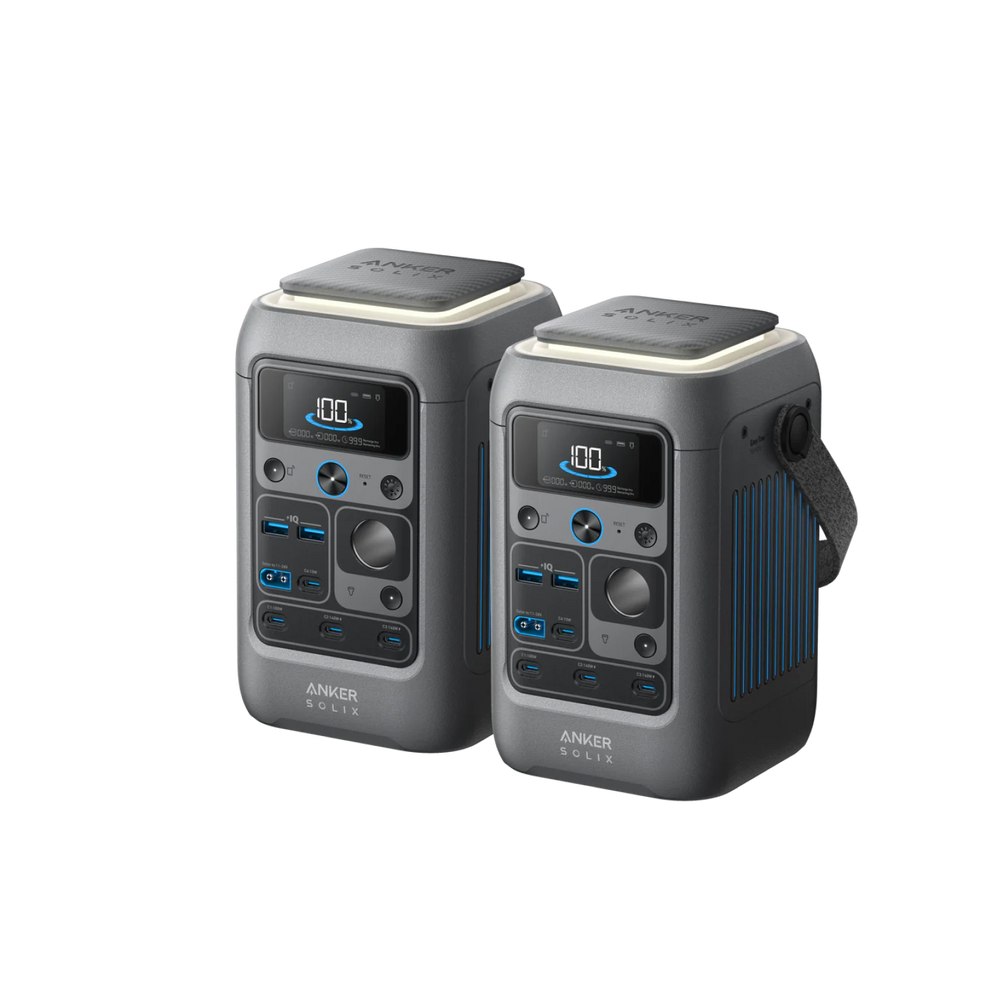
Explore this need in the finder →The Anker SOLIX C300 DC two-unit offer is unusual for a small station: its exact U.S. page lists two A1726 C300 DC stations under bundle SKU BUNDLE-A17260Z1-2. Each unit is a 288 Wh, 300 W direct-current power source with no inverter. The pair gives you two separate charging hubs, not one larger station. Adding the nameplate capacities gives 576 Wh across the offer, but no single load can draw from both batteries as if they were joined together.
Two independent stations, not a larger power system
This is most useful when you have two distinct places or device groups to supply: a USB-heavy work kit and a campsite, two separate camera tables, or one station in use and another ready elsewhere. Each C300 DC can run its own supported devices; the official material reviewed here does not document a parallel link, shared DC bus, or coordinated output arrangement. Do not join the units with improvised cables, count on a combined 600 W output, or use the pair to run a single appliance that needs more than one station can provide.
For each unit, the manufacturer rates total direct-DC output at 300 W. The port mix is four USB-C ports, two USB-A ports and a 12 V car-style socket. The two bidirectional USB-C ports can each reach 140 W, while the other USB-C ports are limited to 100 W and 15 W. The USB-A ports and the 15 W USB-C port share a 20 W ceiling. The car socket is rated 12 V/10 A, or 120 W. These are not all simultaneously available at their individual maxima; the manual's output combinations show the limits for a group of ports. If your device needs an ordinary wall plug, this is the wrong branch of the C300 line: neither station in this pack has an AC inverter.
Plan capacity per station
Each battery is rated at 288 Wh. That figure is stored nameplate energy, not a promise of 288 Wh delivered to a particular device. Conversion losses, battery reserve, temperature, cable conditions and the load's own behavior affect what you can use. The pair's arithmetic total is 576 Wh, but it is still split between two separately operated batteries. If one essential load needs more than 288 Wh from a single source, the two-pack does not automatically solve that need. It may still serve two smaller loads independently, provided each load fits one unit's port and total-output limits.
Weight follows the same distinction. Anker lists one A1726 at 6.17 lb. That is the weight of a station, not the weight of the complete two-unit offer; carrying both means handling two separate pieces, and a package-level shipping weight is not given in the page reviewed. The units are small enough to move individually, but a user who only wants one compact charging source may have no use for the second battery.
Each station needs its own charging plan
The A1726 manual lists up to 280 W of USB-C input using both 140 W bidirectional ports together. For solar it allows one panel on each station's XT60 input, up to 100 W per station, within 11–28 V and 8.2 A. Anker recommends its 60 W or 100 W panels and warns that PS30 and USB-C panels, PS200 and PS400 are not compatible. The two-unit offer page names the stations; it does not establish included panels or solar cables, so budget for the correct charging accessories separately unless the exact current offer says otherwise. A separately sold car-charging cable is also needed for vehicle recharge, and its exact input wattage is not stated in the reviewed manual.
Do not treat two stations as one 200 W solar input or assume one panel can safely charge both through a splitter. The straightforward supported plan is to charge each unit through its own documented input and stay within that unit's voltage, current and port limits. The two-pack is not an expansion-battery system: no extra battery connects to either C300 DC.
Who should choose this offer?
Choose the two-unit offer over a single C300 DC when you have a real reason to keep two independent DC supplies available. The individual stations retain the same basic strengths as the standalone A1726: four USB-C ports, a useful 120 W 12 V socket, a retractable light and a carry weight of 6.17 lb each. If a single load is your priority, the standalone C300 DC review describes the same per-station limits without adding another unit. If any essential equipment needs 120 V AC, compare the AC-equipped C300 or a larger inverter station instead. The EcoFlow TRAIL 300 DC is another DC-only alternative, but its port layout, solar ceiling, weight and exact operating plan differ.
In the finder, mark direct DC only and set the minimum station count to two if the second unit is essential. Keep capacity and output thresholds per station: a 288 Wh, 300 W DC plan fits the published A1726 limits, while a 289 Wh single-unit requirement, a 301 W single-unit output floor, a 101 W per-station solar floor or any AC requirement does not. That boundary is intentional; the bundle's two batteries are independent, not a workaround for a single station's rating.
The official Anker U.S. page showed the exact two-unit offer as sold out when checked on October 24, 2026; that snapshot is not a promise about later stock. The manufacturer's product rendering shows two C300 DC units, but no sample was inspected and no independent electrical or runtime testing was performed. Confirm the exact bundle SKU, current box contents and instructions before purchase.
Key details at a glance
| Nameplate battery capacity | 288 Wh |
|---|---|
| Maximum solar input | 100 W |
| Maximum USB-C output per port | 140 W |
| Listed weight | 6.17 lb |
| Compatible extra-battery expansion | No |
| 12 V DC output | 120 W |
| Total rated DC output | 300 W |
| AC outlet output | No |
| USB-C ports | 4 |
| USB-A ports | 2 |
| Solar input ports | 1 |
| 12 V car-style output | 120 W |
| Battery chemistry | LFP |
| Expansion battery in this package | No |
| Separate station units in offer | 2 |
| Aggregate nameplate capacity across independent units | 576 Wh |
Use the exact model’s instructions for operating limits, supplied equipment and version differences.
Sources for this assessment
A useful match starts with the loads that matter.
Use the finder for hard electrical requirements, then check appliance starting behavior, actual run time and the exact package in the full assessment.