
Your needs, this model
Does it fit your priorities?
Do you want one modest panel included with a small 120 V station for daytime top-ups?
This exact U.S. option pairs the 128 Wh/200 W EL10 with one 60 W SORA 60 panel. Its 100 W station solar-input rating is not a 100 W supplied panel; use the published one-panel 27.5 V Voc and 28 V station ceiling, and do not assume a second panel.
Explore this need in the finder →Is a 128 Wh, 200 W station enough for the actual light-load device you plan to use?
The package keeps the EL10’s 128 Wh nameplate capacity, 200 W continuous AC rating and single 120 V outlet; Power Lifting does not raise that rated ceiling. A greater minimum AC demand is a reason to choose another station.
Explore this need in the finder →Would a 60 W panel meet your supplied-panel requirement, or do you need a higher-rated included panel?
The included SORA 60 has a manufacturer rating of 60 W maximum. If your non-negotiable threshold is 100 W of panel nameplate, this package does not qualify, even though the EL10 input can accept up to 100 W.
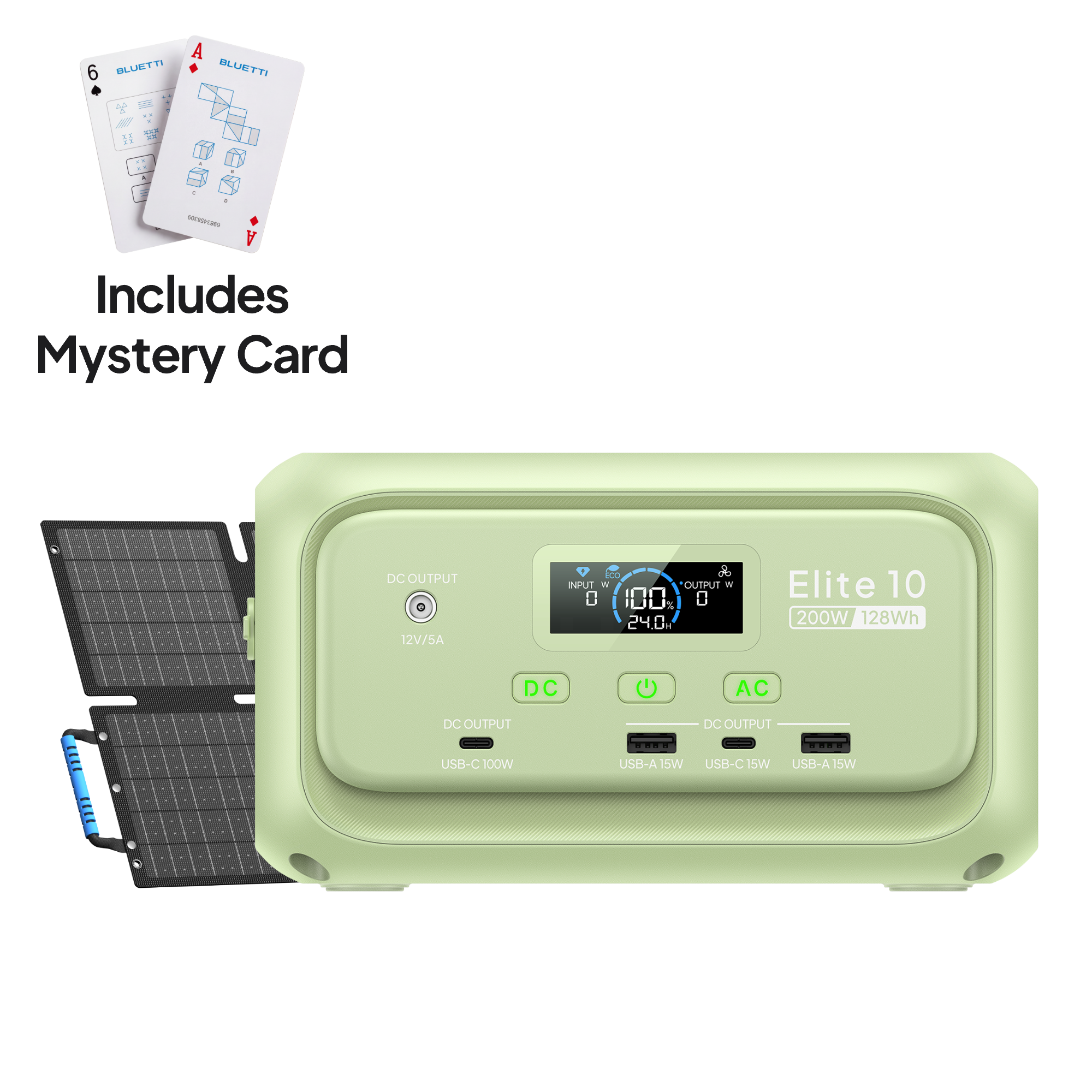
Explore this need in the finder →The exact U.S. Elite 10+60W option combines the small EL10 station with one 60 W foldable panel. This selected retailer variant is the Meadow Green finish; the manufacturer’s image is a promotional composite, not a photograph of a tested package. The useful distinction from the standalone EL10 is simple: you get a modest solar panel alongside the same 128 Wh battery and 200 W inverter. Neither the panel nor the bundle makes the station a larger backup unit.
A small, one-panel plan
One workable use is a day trip where a phone or camera can be charged directly from the panel in sunlight, while the EL10 handles a short, low-power AC or USB-C job from its battery. The station is rated for 120 V AC at 200 W, has a 100 W USB-C port, and stores 128 Wh nameplate. The panel’s own one-page guide lists a 60 W maximum; that is a laboratory rating, not a promise of steady charging. Cloud, shade, angle, dirt and heat all reduce output. A solar input limit describes what the station can accept, not the energy the panel will deliver in a real afternoon.
For charging the EL10 from this panel, the connection details matter. The station’s DC input is XT60 and its manual accepts 12–28 V open-circuit voltage, up to 8.2 A and 100 W. The SORA 60 manual identifies 27.5 V open-circuit voltage, 2.58 A at maximum power, and a 1.2 m DC5521-to-XT60 cable in its box. A single panel is within the published station limits on those nominal figures. Its 27.5 V open-circuit figure sits close to the station’s 28 V ceiling; the manual pages reviewed do not give a temperature coefficient for checking the coldest conditions. Do not add panels in series or treat a second panel as an automatic upgrade.
What you actually gain—and what stays small
The solar panel does not add battery capacity or raise the EL10’s 200 W AC limit. Power Lifting remains limited to certain pure-resistive loads; it does not turn the AC outlet into a 400 W source. For an appliance with a motor or compressor, starting demand can exceed its running label, so use the exact startup requirement rather than assuming the station will handle it. The 128 Wh battery is still best for brief or modest jobs. It is not a strong match for overnight refrigerator duty, a heater, or repeated laptop charging without a dependable recharge window.
The panel is eight-fold and its manufacturer guide gives 35.4 × 16.7 inches open and 8.9 × 8.3 × 2.8 inches folded. There is a discrepancy in the maker’s own weight information: the technical table in the SORA 60 guide says 3.09 lb, while a product-page highlight says 4.8 lb. The station itself is about 3.97 lb. Treat the panel as a second item to carry, and verify its actual carry weight before planning around a tight total-weight limit; the complete package weight is not published here.
Keep the two devices dry and manage the lead
BLUETTI describes the SORA 60 as IP65 splash-resistant, but its guide says not to leave the panel in rain or water for long. The EL10 is IP20 and is not waterproof, so the station belongs under shelter even when the panel is outside. Lay the panel without shade, keep the connector dry, and avoid kinks or pulling on the short 1.2 m lead. The panel guide also lists two carabiners, the connector lead, a manual and warranty card. The EL10’s separate base-box list names the station, AC and car charging cables, and documents; it does not include a panel as a standalone purchase. The selected bundle page does not provide one consolidated carton list, so check that the panel’s cable and small accessories are present when the chosen package arrives.
Which answer changes the recommendation?
If a panel in the box is essential and 60 W is enough, this offer is more complete than the standalone EL10, which has no panel. If you only need a solar-capable station and already own a compatible panel and lead, the lower-complexity standalone EL10 may be the better choice. If the included panel must be rated at 100 W, this 60 W package should be filtered out even though the station itself accepts up to 100 W. That input ceiling is not a bundled-panel rating. If the station must run larger AC loads or sustain a higher-energy overnight plan, step up to a unit with substantially more capacity and output instead of buying another small panel.
Compared with the standalone Elite 10, the main change is the supplied daylight option, not the core station. The Elite 30 V2 offers a larger 288 Wh battery and higher 600 W AC rating at greater weight; the Elite 100 V2 is a much larger 1,024 Wh / 1,800 W step for loads that outgrow a 128 Wh class. Those alternatives solve different energy and load problems. Choose the EL10+60W only when its modest carryable station, limited AC load, and one-panel recharge route match the actual devices and outdoor conditions you have in mind.
Key details at a glance
| Nameplate battery capacity | 128 Wh |
|---|---|
| Rated AC output | 200 W |
| Maximum solar input | 100 W |
| Included panels, combined nameplate | 60 W |
| Maximum USB-C output per port | 100 W |
| Listed weight | 3.97 lb |
| Maximum AC recharge input | 150 W |
| Manufacturer UPS transfer figure | 10 ms |
| AC outlet output | Yes |
| USB-C ports | 2 |
| USB-A ports | 2 |
| Solar input ports | 1 |
| Vehicle charge input | 100 W |
| Battery chemistry | LiFePO4 |
| Ingress rating | IP20 |
| Solar panels in exact offer | 1 |
Use the exact model’s instructions for operating limits, supplied equipment and version differences.
Sources for this assessment
- BLUETTI US Elite 10 product page and exact selected gray option
- BLUETTI Elite 10 US support/download page
- Elite 10 User Manual V1.0, US English/French edition
- BLUETTI manufacturer Elite 10 primary product image
- BLUETTI U.S. Elite 10+60W option, exact selected Meadow Green variant
- BLUETTI U.S. SORA 60 Solar Panel | 60W
- BLUETTI SORA 60 Solar Panel User Guide, English, one-page spread
- EL10 U.S./English-French manual V1.0, reused from the standalone review
- Exact green Elite 10+60W option image (original response is PNG)


A useful match starts with the loads that matter.
Use the finder for hard electrical requirements, then check appliance starting behavior, actual run time and the exact package in the full assessment.