
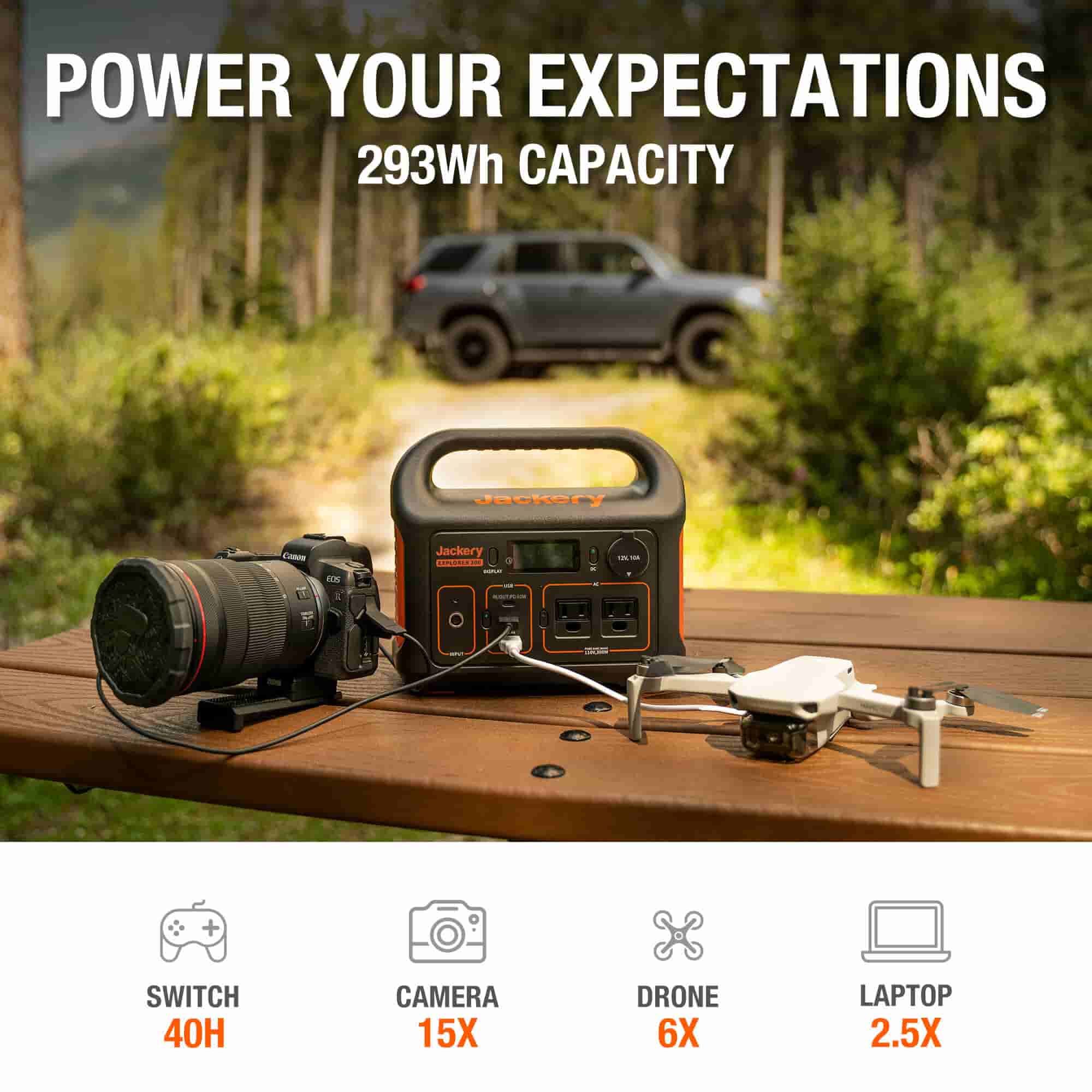
Your needs, this model
Does it fit your priorities?
Can your small AC load run on a documented 110 V / 300 W plan, without needing 120 V or higher continuous output?
The exact Explorer 300 manual and support article list 110 V AC and 300 W continuous (500 W instantaneous peak), with 293.8 Wh nameplate capacity. Loads requiring 120 V, 240 V or more than 300 W continuously are not confirmed for this SKU.
Explore this need in the finder →Is a fixed-capacity station acceptable when future battery expansion is not essential?
Jackery support says this Explorer 300 does not support extra battery packs. It does not pass a requirement for compatible expansion.
Explore this need in the finder →Does the base Explorer 300 offer work for you without an included solar panel?
The exact standalone package lists one station and cables/manual, not a solar panel; select a panel-in-box requirement only for a verified bundle.
Explore this need in the finder →The Jackery Explorer 300 is easy to confuse with the newer Explorer 300 v2 and the direct-current Explorer 300D. This assessment is for the original AC-equipped Explorer 300 on the U.S. listing: product 4600340971607, variant 32311565844567, SKU 70-0300-USO001. The manufacturer’s current option data marked that exact variant available, while the product route also advertises a newer 300 v2 and the 300D separately. Match the SKU before ordering; the shared “300” name is not an electrical specification.
A small 110-volt AC plan, not a 120-volt assumption
The original Explorer 300 has two household AC receptacles, with a manual and support specification of 110 V, 60 Hz and 300 W maximum continuous output. Jackery lists a 500 W instantaneous peak, but that is not a second continuous-watt allowance. A load above 300 W or with a starting surge beyond what the station can supply can shut the inverter down. Check both the appliance label and its startup demand; an “under 300 W” running figure alone is not enough for a motor, compressor or other difficult load.
Its 293.8 Wh nameplate battery is best understood as a small reserve for a few modest loads or short intervals, not a promise of 293.8 Wh delivered from the AC sockets. The product sources do not publish a tested AC-energy figure for a stated load. Account for conversion losses, the load’s actual cycling and the reserve you want to keep rather than translating nameplate watt-hours directly into hours. If the item requires a confirmed 120 V or 240 V output, this exact model is not established for that plan. A 110 V rating should not be silently treated as 120 V compatibility.
Check the front ports against the exact manual
In addition to the two AC outlets, the unit has a 12 V, 10 A car-style output (120 W). The English manual describes one USB-C PD input/output port and two USB-A ports: a standard 5 V/2.4 A outlet and a Quick Charge 3.0 outlet. The manual and current support article give the USB-C a 60 W maximum, USB-A port details of 12 W and up to 18 W, and the 12 V socket 120 W. Some current promotional copy and product-page artwork show different USB ratings. Because the official material does not reconcile those details for SKU 70-0300-USO001, do not buy this model to meet a particular USB-C wattage threshold without confirming the exact unit and revision. Port maxima are not all simultaneous power budgets.
The manual lists a roughly 3.2 kg / 7.1 lb body and dimensions around 9.1 × 5.2 × 7.8 inches. The active product page instead calls it about 7.5 lb. I have not used weight as a hard match because that difference remains unresolved. The compact carry handle and roughly 294 Wh scale make it easier to move than a large outage station, but the exact current device and package should be weighed if lifting capacity is a strict constraint.
Recharge is modest, and one panel is the limit
The manual and support table describe approximately 4.5 hours on AC and about five hours from a car charging cable. A single SolarSaga 100 is the manual’s recommended solar panel; the support page permits only one panel and specifically warns against connecting two through an adapter because voltage may exceed its safe range. Jackery’s official sources give differing solar-time examples, so treat every stated recharge time as a favorable-condition estimate, not a field guarantee. Solar input and vehicle charging share one DC input and cannot be used at once. A solar panel is not listed among the base package contents; the product page separately notes that panel type and quantity depend on the purchase. The exact current standalone listing names the station, AC cables, car-charging cable and manual, so do not assume a bundled panel.
Pass-through use is documented, but the manual says it does not recommend routine use because it may damage battery life. More importantly, this is not a UPS: the manual says the AC/USB/DC outputs must be switched on manually and there is no automatic transfer. Do not depend on it to keep a router, computer or medical device uninterrupted during a power failure.
Do not mix marketing copy from two generations
There is a material official-source conflict on battery chemistry and longevity. The English Explorer 300 manual names the model and lists lithium-ion with 800 cycles to at least 80% capacity; Jackery’s Explorer 300 support article specifies NCM lithium-ion and the same 800-cycle/80% claim. The current U.S. product page, still using SKU 70-0300-USO001, now advertises LiFePO4 and 4,000-plus cycles to 70%. Those statements cannot be confidently reconciled from the available material. I leave chemistry and a cycle-life threshold unscored instead of borrowing the newer 300 v2’s specifications. Treat the product’s battery generation as unresolved and verify the label/manual supplied with the exact unit before making chemistry or life expectancy essential.
Who should consider it?
This Explorer 300 makes sense when the exact load is comfortable on the documented 110 V, 300 W AC plan, a roughly 294 Wh battery is adequate, manual output switching is acceptable, and you value a compact station with a 12 V socket and small-device ports. Its current U.S. listing makes this original version different from an unavailable archive-only model, but availability does not remove the spec conflicts. Keep the product code in your notes and verify the box list, particularly if a seller mixes accessory options into its title.
Choose another configuration if 120 V is essential, the load exceeds 300 W continuously, a supported expansion battery or automatic UPS behavior is required, a panel must come in the box, or exact chemistry/cycle-life figures decide the purchase. The Explorer 300D is lighter and DC-only, so it cannot run an AC appliance. The Anker SOLIX C300 offers a 120 V, 300 W plan in a similar capacity class; the C300 DC is an alternative only when every load can use direct DC. These are distinct electrical choices, not interchangeable “300” products.
Key details at a glance
| Nameplate battery capacity | 293.8 Wh |
|---|---|
| Rated AC output | 300 W |
| Manufacturer surge rating | 500 W |
| Included panels, combined nameplate | 0 W |
| Compatible extra-battery expansion | No |
| 12 V DC output | 120 W |
| Maximum AC recharge input | 90 W |
| Base warranty term | 2 years |
| AC outlet output | Yes |
| USB-C ports | 1 |
| USB-A ports | 2 |
| Solar input ports | 1 |
| 12 V car-style output | 120 W |
| Home Power Panel in this package | No |
| Separate station units in offer | 1 |
Use the exact model’s instructions for operating limits, supplied equipment and version differences.
Sources for this assessment
- Jackery U.S. Explorer 300 product page
- Jackery U.S. Explorer 300 product-option JSON
- Jackery Explorer 300 User Manual, Model Explorer 300, version JAK-UM-V1.0
- Jackery U.S. Explorer 300 Basic Information
- Jackery U.S. portable-power-stations collection card
- Jackery U.S. Explorer 300 exact product-page lifestyle rendering
- Jackery U.S. Explorer 300 exact product-page alternate product rendering
- U.S. CPSC Recalls API query for Explorer 300


A useful match starts with the loads that matter.
Use the finder for hard electrical requirements, then check appliance starting behavior, actual run time and the exact package in the full assessment.